
Almost every traveler researching cosmetic dentistry abroad has seen the viral social-media photos: young patients with healthy natural teeth aggressively filed down into tiny pointed pegs—commonly dubbed “shark teeth”—in order to receive full-mouth crowns advertised inaccurately as “veneers.” That troubling trend has understandably made thoughtful international patients cautious about traveling to Asia or Europe for aesthetic smile upgrades.
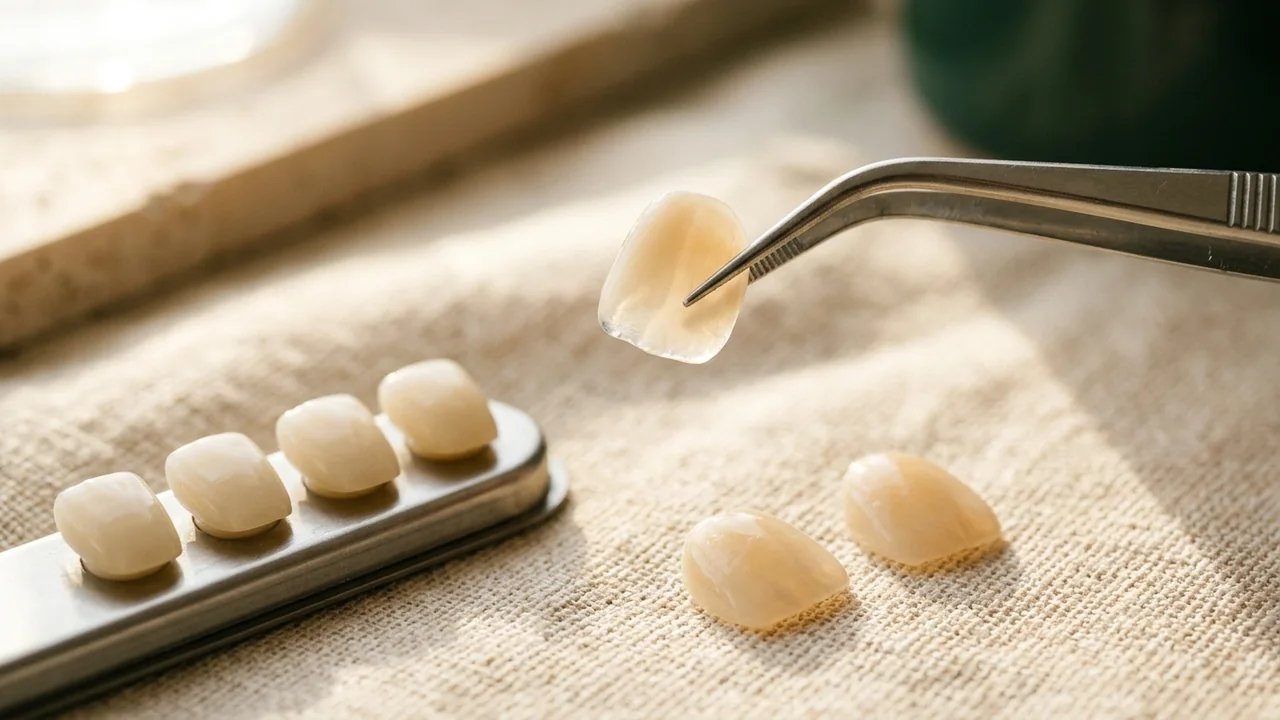
The reality is that true porcelain veneers and full-coverage dental crowns are fundamentally different clinical restorations with completely different biological costs. At Kind Dental Vietnam in District 1, Ho Chi Minh City, Dr. Nguyen Van Cuong, DDS follows strict biomimetic enamel-conservation principles: never shave 360 degrees of healthy enamel when a conservative 0.2–0.5mm bonded Ivoclar Vivadent IPS e.max veneer can achieve superior aesthetics while keeping your tooth nerve calm and intact.
Why Some Overseas Clinics Push Full Crowns Instead of Real Veneers
If minimal-prep veneers preserve far more healthy tooth structure, why do high-volume cosmetic studios overseas so frequently grind down intact front teeth for zirconia crowns instead? Three non-clinical incentives explain the shortcut:
- Speed & Easier Cementation: Adhesive bonding of ultra-thin 0.3mm lithium disilicate veneers requires meticulous rubber-dam moisture isolation, multi-step hydrofluoric etching, silanization, and painstaking removal of microscopic excess resin. Sliding a 360-degree zirconia crown onto a heavily shaved peg takes a fraction of the chairside skill and time.
- Instant Orthodontic Bypass: Rather than advising mild clear aligners for crowded or rotated teeth, aggressive clinics simply amputate protruding enamel until every peg stands straight—frequently encroaching dangerously close to the living dental pulp (nerve).
- Marketing Mislabeling: Some overseas clinics advertise “Zirconia Veneers” when they are actually placing full-coverage crowns. While true porcelain veneers cover only the visible facial surface and thin incisal edge, crowns remove structure circumferentially across the front, back, and sides.
The Enamel Biology Rule: Why Staying in Enamel Protects Your Smile for Decades
Human dental enamel is the hardest mineral tissue in the body—and crucially, the gold-standard substrate for modern dental adhesives. When a glass-ceramic restoration like Ivoclar IPS e.max is acid-etched and bonded directly onto intact enamel, shear bond strengths routinely reach 25 to 35 MPa, effectively fusing ceramic and tooth into a unified biomechanical structure.
Once a drill cuts aggressively past the enamel layer into deeper yellow dentin (as happens with unnecessary full crowns on intact teeth), three long-term biological consequences follow:
- Weaker Adhesive Sealing: Bonding to wet, organic dentin tubules is inherently less durable over decades than bonding to dry crystalline enamel.
- Heightened Pulp Trauma Risk: Peer-reviewed prosthodontic literature shows that aggressive full-crown preparation on previously untouched teeth carries a measurably higher risk of delayed nerve inflammation or necrosis (requiring root canal treatment years later) compared with conservative enamel veneers.
- Irreversible Re-Treatment Cycle: No dental ceramic lasts indefinitely without eventual replacement over a 40-year adult lifespan. A tooth retaining 80–90% of its natural enamel beneath a minimal veneer stays strong enough for straightforward replacement decades later; an aggressively shaved peg leaves little tooth core to rebuild.
Head-to-Head Comparison: Minimal-Prep IPS e.max Veneers vs. 3D Multilayer Zirconia Crowns
Understanding the structural, optical, and financial differences helps you evaluate any overseas treatment plan critically. You can also explore deeper material science on our IPS e.max vs. Zirconia Materials Hub.
| Clinical Feature | Ivoclar IPS e.max Minimal-Prep Veneer | 3D Multilayer Monolithic Zirconia Crown |
|---|---|---|
| Ceramic Chemistry | Lithium disilicate glass-ceramic (Ivoclar Vivadent) | Yttria-stabilized polycrystalline zirconium dioxide |
| Tooth Preparation Depth | 0.2 – 0.5mm facial enamel only (conservative) | 1.0 – 1.5mm circumferential (360-degree wrap) |
| Natural Tooth Structure Preserved | ~75% – 90% preserved | ~30% – 45% preserved (indicated when already damaged) |
| Flexural Strength | ~400 – 530 MPa (high strength once enamel-bonded) | ~800 – 1,200 MPa (exceptional fracture resistance) |
| Optical Translucency | Benchmark lifelike opalescence & enamel depth | High aesthetic gradient (improved 3D multilayer; slightly less glass-like than e.max) |
| Retention Mechanism | Chemical & micromechanical adhesive resin bonding | Mechanical wall resistance + resin/luting cement |
| Primary Clinical Role | Healthy anterior teeth needing shape, shade, or gap refinement | Structurally compromised, root-canaled, cracked, or heavily filled teeth & posterior molars |
| Kind Dental Vietnam 2026 Fee | $320 – $420 USD / tooth 10-Yr Warranty | $260 – $350 USD / tooth 10-Yr Warranty |
| Typical AU / US Fee | $1,400 – $2,200 USD / tooth | $1,300 – $2,000 USD / tooth |
When a Full-Coverage Zirconia Crown Is Genuinely the Safer Choice
Conservative dentistry does not mean putting veneers on every tooth regardless of condition. Attempting to place a thin veneer onto a broken-down, heavily restored tooth is just as flawed as over-shaving a healthy virgin tooth for a crown. Dr. Cuong recommends 3D multilayer zirconia crowns specifically when clinical anatomy demands full 360-degree structural reinforcement:
- Teeth With >50% Existing Restoration or Decay: Large failing fillings leave thin unsupported enamel walls that fracture unless splinted circumferentially by a crown.
- Root-Canal-Treated Teeth (Especially Premolars & Molars): Endodontically treated teeth lose internal moisture and structural roof support; full-cuspal coverage protects against catastrophic vertical root splitting.
- Replacing Existing Old Crowns: Once a tooth has previously been prepared for a crown, replacement requires a new crown (often upgrading old porcelain-fused-to-metal units with grey gum lines to modern biocompatible zirconia).
- Severe Dark Intrinsic Discoloration or Metal Posts: Ultra-thin translucent e.max veneers cannot always block deep charcoal tetracycline staining or dark cast-metal posts underneath; multilayer zirconia or opaque-core layered ceramics provide reliable shade masking.
- Heavy Posterior Chewing & Bruxism Loads: Back molars absorb intense bite forces where monolithic zirconia’s 1,000+ MPa toughness outperforms glass-ceramics.
Case-by-Case Biomimetic Decision Matrix
In real-world smile rehabilitations, hybrid plans are very common—for example, placing minimal-prep IPS e.max veneers on six healthy front teeth while placing two matching ceramic crowns on adjacent teeth that already have large old fillings or root canals.
| Patient Presentation | Recommended Clinical Approach | Why This Option Protects Long-Term Health |
|---|---|---|
| Healthy front teeth with small gaps or worn edges | Minimal-prep IPS e.max veneers (0.2–0.4mm) | Closes spaces naturally while preserving living enamel & nerve vitality. |
| Moderate yellowing on well-aligned virgin teeth | Clinical whitening first (or ultra-thin veneers) | Ethical care starts least-invasively; whitening often satisfies goals with zero drilling. |
| Front tooth with old darkened PFM crown | Layered zirconia or full e.max crown | Eliminates black metal gumline while matching neighboring veneers seamlessly. |
| Significantly crowded or overlapping front teeth | Short Invisalign course → minimal veneers | Aligns roots first so veneers require minimal enamel polishing instead of aggressive shaving. |
| Back molar with cracked amalgam filling | 3D multilayer monolithic zirconia crown | Withstands heavy posterior grinding without ceramic chipping. |
| Severe nighttime clenching (bruxism) + worn front edges | Bite rehabilitation + custom protective nightguard | Ceramic choice paired with occlusal guard prevents fracture of veneers or crowns. |
How Dr. Cuong Ensures Conservative Enamel Preparation
Rather than eyeballing reduction freehand, Dr. Cuong uses a methodical additive mock-up protocol over your 5–7 day visit in Ho Chi Minh City:
- Optical Scan & Facial Photography: Captures lip dynamics and enamel thickness without gag-inducing putty trays.
- Trial Mock-Up Over Untouched Teeth: A temporary resin preview sits directly over unshaved teeth so you approve shape and length in daylight before drilling begins.
- Calibrated Depth-Cut Preparation Through the Mock-Up: Depth-marker burs cut precisely 0.2–0.5mm through the approved trial smile, removing only essential enamel (leaving recessed areas virtually untouched).
- Isolated Adhesive Bonding & 24-Hour Bite Buffer: Master ceramics are bonded under strict moisture control, verified the next day, and protected with a custom nightguard when clenching is present.
Candid Risks, Contraindications & Longevity Expectations
Active untreated gum disease must be stabilized before ceramic margins are placed so tissues do not recede afterward. Untreated severe bruxism without nightly guard wear increases chipping risk for any ceramic. Under routine hygiene maintenance, clinical studies report 10-year survival exceeding 93–96% for enamel-bonded IPS e.max veneers and multilayer zirconia crowns—backed by Kind Dental Vietnam’s written 10-year clinical warranty. Quoted “16–20 crowns” elsewhere? Send smile photos or X-rays directly to Dr. Cuong via our consultation portal or WhatsApp +84 853 020 003, and review our 2026 Pricing page.
Frequently Asked Questions
Are “no-prep” veneers always better than minimal-prep (0.2–0.5mm) veneers?
Not always. True no-prep veneers suit naturally small, recessed, or spaced teeth where adding 0.3mm improves lip balance. On full-sized or slightly protruding teeth, zero-prep ceramic creates bulky contours and gum ledges that trap plaque. Conservative 0.2–0.5mm minimal preparation stays safely within enamel while delivering flush, natural margins.
Will my teeth become painfully sensitive after minimal-prep IPS e.max veneers?
Because minimal preparation remains primarily in outer enamel rather than exposing deep dentin near the nerve, severe sensitivity is uncommon. Mild temporary sensitivity to cold drinks can occur for 1–2 weeks post-bonding and typically resolves calmly with desensitizing toothpaste.
Can Dr. Cuong combine IPS e.max veneers and zirconia crowns in the same smile?
Yes—this hybrid biomimetic approach is standard whenever healthy teeth sit beside root-canaled teeth or old crowns. Our master ceramist crafts both together with matched ingots, surface micro-texture, and translucency so light reflects uniformly across your smile.
How can I verify my veneers are genuine Ivoclar IPS e.max and not cheap composite?
Genuine Ivoclar IPS e.max is lab-fabricated lithium disilicate glass-ceramic requiring 3–4 days of CAD/CAM pressing/milling, hand layering, and glazing—never plastic resin sculpted in one afternoon. You receive a laboratory material certificate alongside your written 10-year warranty.
Can I receive IPS e.max veneers if I clench or grind at night?
Mild-to-moderate clenchers can often receive IPS e.max veneers safely when bite contacts are carefully balanced at the 24-hour check and protected nightly with a custom occlusal nightguard. Heavy bruxers receive individualized bite evaluation pairing posterior zirconia strength with anterior ceramics where indicated.
Will my veneers look natural instead of blinding “Hollywood white”?
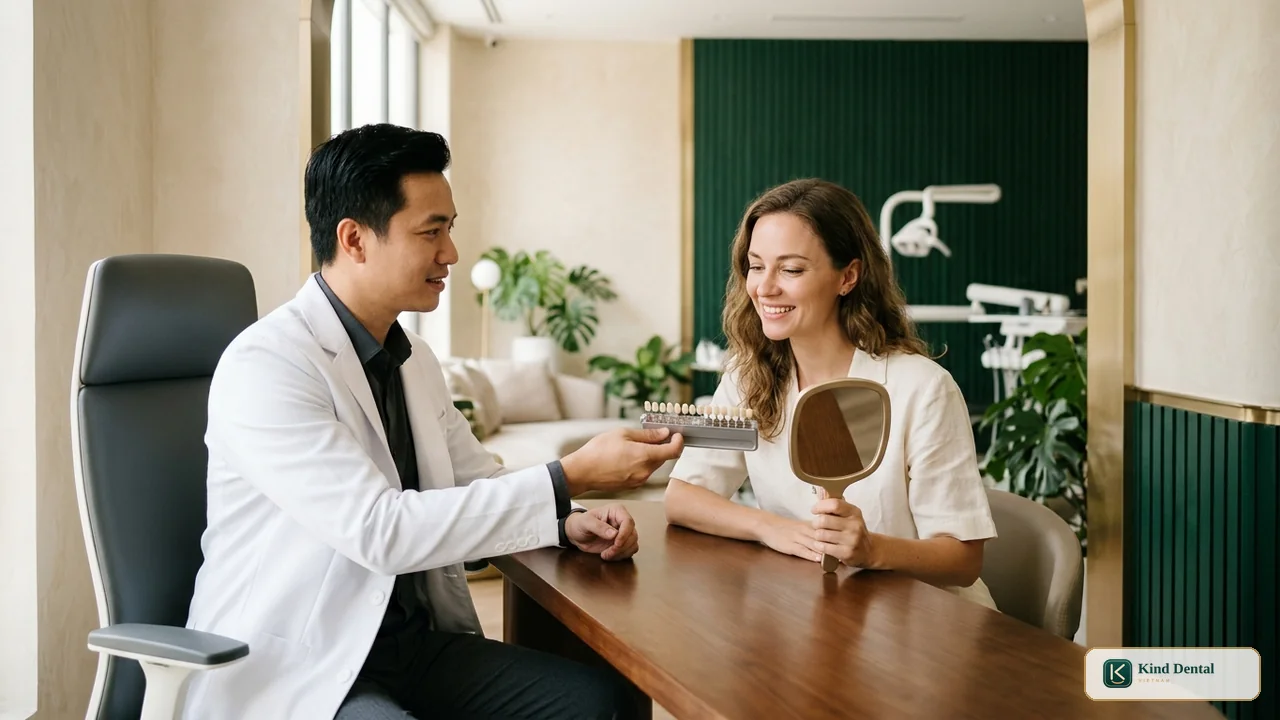
Always—unless you specifically ask for bright bleached shades. Most Kind Dental Vietnam patients select refined natural shades (BL3, BL4, or Vita A1/B1) featuring realistic incisal translucency and subtle enamel texture, previewed and approved in daylight before final bonding.
Want Honest Clinical Advice on Your X-Ray or Quote?
Send your panoramic OPG scan or an existing treatment estimate via WhatsApp. Dr. Cuong will provide a clear, conservative comparison with zero agency markup.