
Surgeon’s Executive Summary (2026 Quick Verdict):
- Why “Zero-Drill” Marketing Often Backfires: True no-prep veneers work beautifully in only ~15%–20% of smiles—specifically small, recessed, or spaced teeth (peg laterals or gaps). Placing no-prep porcelain onto normal or slightly forward-tilted teeth creates bulky “horse-tooth” contours and plaque-trapping gum ledges.
- The Biomimetic Gold Standard (0.2–0.5mm Minimal-Prep IPS e.max): Ultra-conservative enamel recontouring stays strictly inside the outer enamel layer (preserving 100% of enamel-resin bond strength while creating razor-flush, plaque-free gum margins).
- 2026 Transparent Pricing in Ho Chi Minh City: Authentic Liechtenstein Ivoclar Vivadent IPS e.max veneers at Kind Dental Vietnam cost $320 – $420 USD per tooth (8-tooth upper arch: $2,560–$3,360 USD), completed cleanly in one single 5–7 day trip with a 10-year written ceramic warranty.
2. The Truth About No-Prep Veneers
3. No-Prep vs. Minimal-Prep vs. Crowns
4. Mock-Up Guided Precision Prep
5. IPS e.max vs. Feldspathic Ceramics
6. 2026 Costs & 5–7 Day Trip Plan
7. Saving $3,000+ Without Over-Drilling
8. Honest Risks & Longevity Habits
9. Peer-Reviewed PubMed Studies
10. Patient FAQs
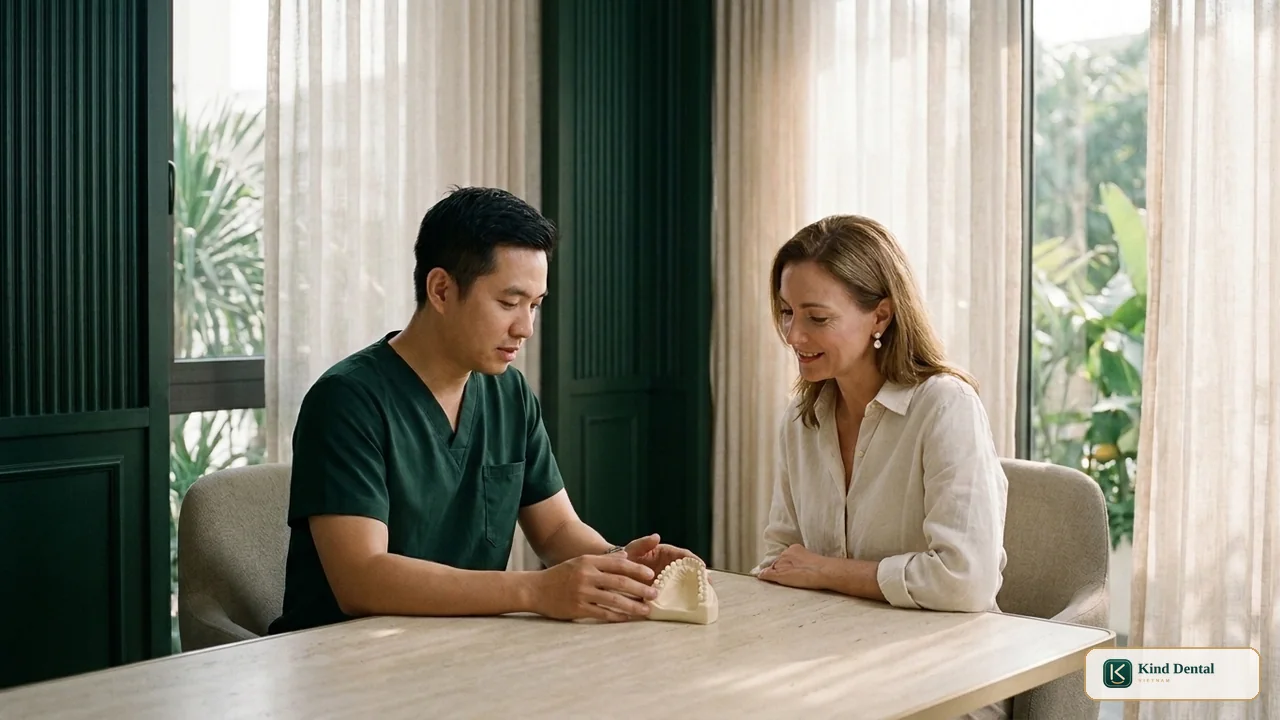
Every week, international patients from Sydney, Melbourne, London, and Los Angeles message Dr. Nguyen Van Cuong, DDS with the exact same understandable fear: “I want a brighter, harmonious smile in Vietnam—but I am terrified of clinics shaving my healthy teeth down to tiny pegs.”
Viral social-media videos of aggressive overseas “shark-tooth” crown mills have rightly pushed thoughtful travelers to search for no-prep veneers—paper-thin ceramic shells bonded directly over untouched teeth with zero drilling.
Yet in clinical adhesive dentistry, an honest specialist must share a crucial nuance that social-media ads routinely hide: true no-prep veneers are fantastic for the right 15% of smiles, yet problematic for the other 85%. When placed onto normal-sized or crowded teeth without microscopic margin finishing, add-on shells can make teeth look bulky, trap bacteria along an over-contoured gumline, and fail to mask dark underlying discoloration.
At Kind Dental Vietnam in District 1, Ho Chi Minh City (Private Appointment Only), Dr. Cuong (Vietnam MOH License 0003265/BL-CCHN) practices biomimetic enamel-preserving cosmetic dentistry. This guide uses live-verified PubMed survival studies (2012–2025) to clarify when no-prep veneers succeed, why 0.2–0.5mm minimal-prep Ivoclar IPS e.max veneers remain the global clinical gold standard, and how to complete your transformation safely in one 5-to-7 day visit.
1. The Biological Secret of Veneer Longevity: Enamel vs. Dentin Bonding
Why do some porcelain veneers stay firmly bonded and stain-free for 15 to 20 years, while cut-rate overseas makeovers debond, chip, or leak dark stains within 24 months? The answer comes down to one microscopic boundary: whether the veneer is bonded to outer enamel or deep inner dentin.
Natural front tooth enamel is roughly 0.5 to 1.0 mm thick across the middle face of the tooth and thins to 0.3–0.4 mm near the gumline. Enamel is ~96% crystalline mineral—making it the strongest, driest, most predictable adhesive bonding surface in the human body.
Beneath enamel lies softer, moist, tubular dentin. Clinical studies published in the Journal of Adhesive Dentistry (Öztürk & Bolay, 2014; PMID 25279393) and the Journal of Esthetic and Restorative Dentistry (Burke, 2012; PMID 22863131) prove dramatically higher debonding and fracture rates whenever aggressive preparation strips away enamel and exposes >50% dentin.
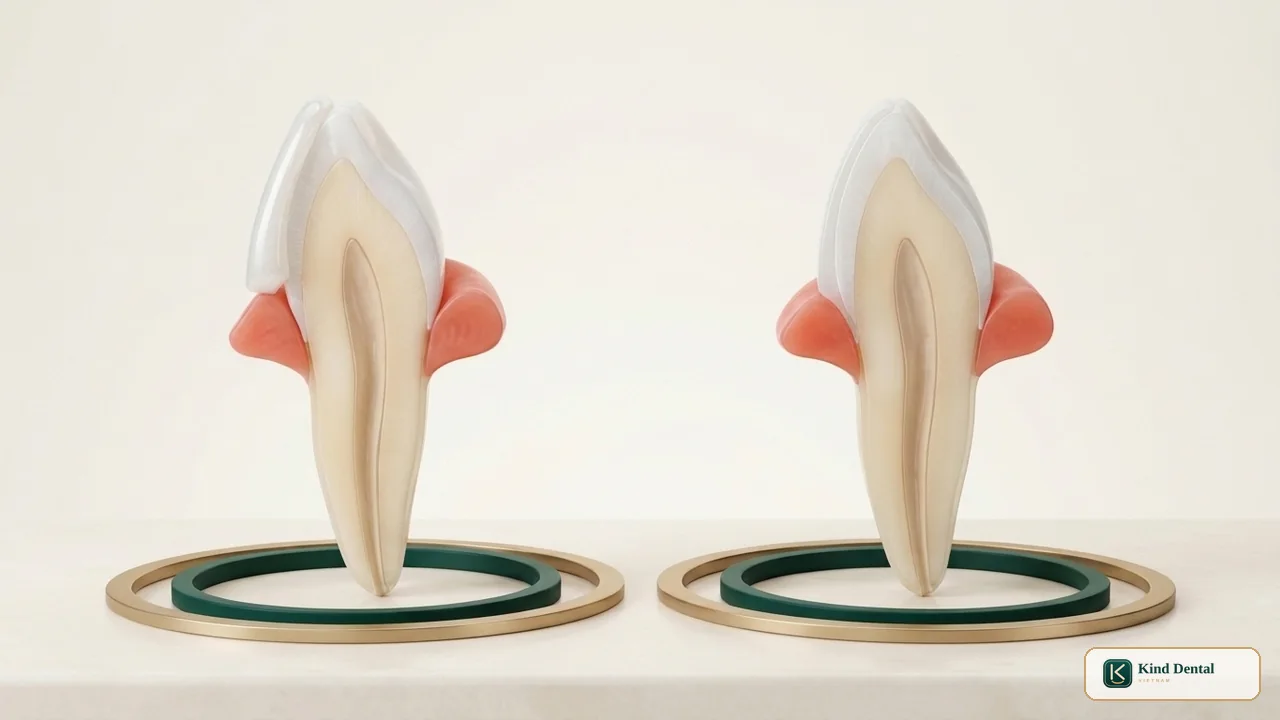
The Three Real Tiers of Tooth Preparation (Never Confuse Them)
- True No-Prep Veneers (0.0 mm reduction): Porcelain (0.2–0.3 mm) bonded straight onto unpolished or lightly micro-etched enamel. Strictly additive.
- Minimal-Prep Biomimetic Veneers (0.2–0.5 mm reduction): Subtle enamel smoothing confined strictly to the front surface—leaving >80%–100% enamel intact, keeping the entire back of the tooth untouched, and creating a crisp micro-chamfer margin for zero gum inflammation.
- Aggressive 360° Full-Coverage Crowns (1.2–2.0 mm all-around reduction — “Turkey Teeth”): Shaving healthy front teeth into tapered pegs into deep dentin. Reserved only for heavily decayed, fractured, or root-canal-treated teeth—never virgin aesthetic teeth (compare in our Minimal-Prep Veneers vs. Crowns Guide).
2. When Do True No-Prep Veneers Actually Work—And When Do They Fail?
A 9-year prospective comparative study published in Clinical Oral Investigations (Smielak et al., 2022; PMID 34927224) and a retrospective clinical evaluation in the Journal of Prosthetic Dentistry (De Angelis et al., 2023; PMID 34059296) confirm that no-prep veneers achieve outstanding multi-year survival strictly when case selection is disciplined.
Ideal Candidates for True No-Prep Veneers (~15%–20% of Patients)
- Naturally narrow or undersized teeth (such as “peg lateral” incisors) where adding 0.3 mm of ceramic improves proportion.
- Visible spacing or midline gaps (diastemas) with mild inward-tilted tooth alignment.
- Worn-down biting edges on otherwise bright, well-aligned teeth needing additive length restoration.
- Minimal color change needed (lifting shade gently by 1–2 tones without masking dark grey or tetracycline stains).
When No-Prep Veneers Create Cosmetic & Gum Problems (~80% of Patients)
- Protruding or Bulky “Chicklet” Look: Adding even 0.3–0.4 mm of porcelain onto already prominent front teeth pushes the smile outward, altering lip seal and speech pronunciation.
- Chronic Red, Bleeding Gums: Without a microscopic finish margin, the edge of an add-on shell forms a subtle convex “speed bump” at the gumline that traps bacterial plaque and inflames delicate gingival papillae.
- Poor Masking of Dark Stains: Paper-thin 0.2 mm translucent porcelain cannot hide deep brown fluorosis, dark root-canal discoloration, or grey tetracycline bands without looking muddy or unnaturally chalky.
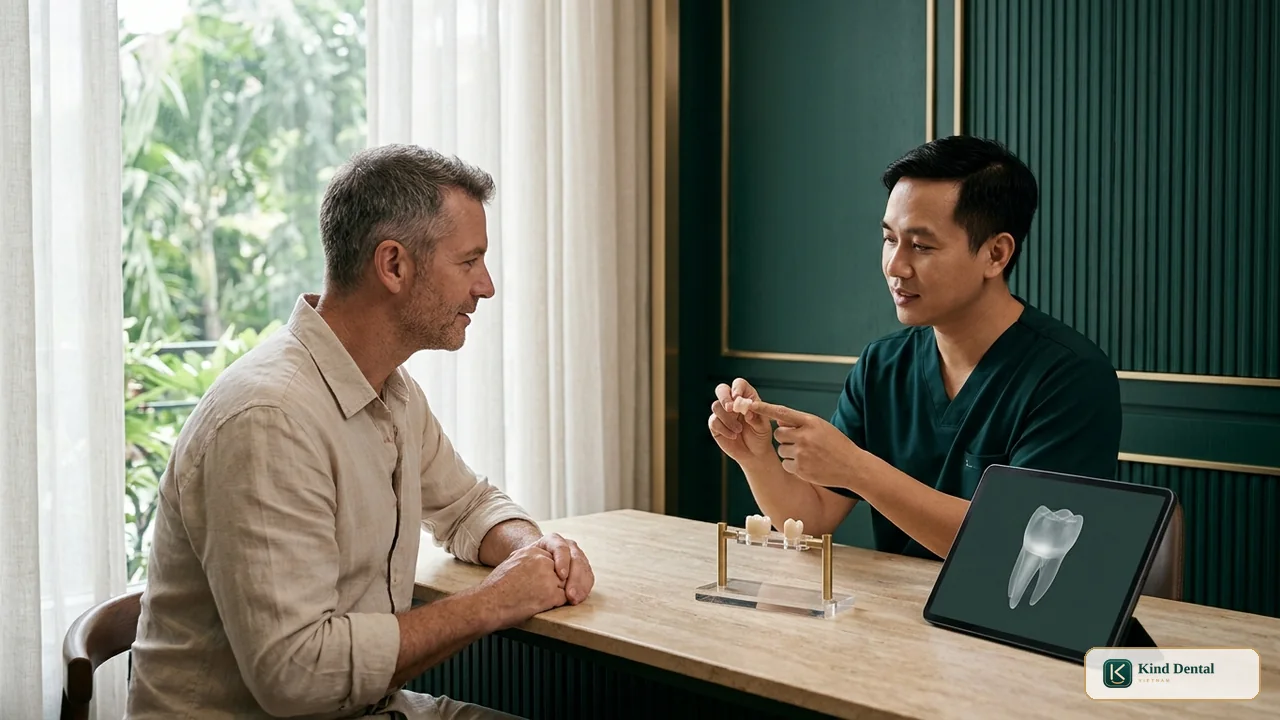
Dr. Cuong’s Honest Diagnostic Standard: At Kind Dental Vietnam, we never force teeth into a “no-prep” label just to match a marketing slogan. If your teeth are small and recessed, Dr. Cuong happily keeps prep at 0.0 mm. If a gentle 0.25–0.4 mm enamel contour prevents bulky lips and bleeding gums for the next 15 years, we show you why digitally before you decide.
3. Complete Clinical Comparison: No-Prep vs. Minimal-Prep E.max vs. Full Crowns
Use this side-by-side matrix to see exactly where each cosmetic approach excels—and where compromises arise:
| Clinical Parameter | True No-Prep Veneers (0.0 mm) | Minimal-Prep IPS e.max Veneers (0.2–0.5 mm) | Full Zirconia Crowns (1.2–1.5 mm 360°) |
|---|---|---|---|
| Natural Enamel Preserved | 100% untouched | ~80%–95% intact (100% back surface untouched) | ~30%–40% remaining (full 360° coverage) |
| Gum Margin Transition | Slight convex step possible on normal-sized teeth | Razor-flush margin; calm, healthy pink gums | Flush margin (requires heavier tooth reduction) |
| Color Masking Power | Mild (1–2 shades brighter only) | High (masks moderate stains with natural translucency) | Maximum (masks black root-canal teeth or old metal) |
| 10-Year Clinical Survival | ~91%–96% (strictly selected cases) | ~94%–97% across broad aesthetic cases (Klein 2025) | ~93%–96% (higher nerve sensitivity if used on virgin teeth) |
| Anesthesia Required? | Often minimal or none | Gentle, pain-conscious local numbing | Standard local anesthesia |
| 2026 Kind Dental Vietnam Fee | $320 – $420 USD / tooth | $320 – $420 USD / tooth | $260 – $350 USD / tooth |
| Best Clinical Indication | Small, spaced, or inward-tilted virgin teeth | Most cosmetic smile makeovers on healthy front teeth | Cracked teeth, large old fillings, root-canal teeth, molars |
4. Mock-Up Guided Preparation: How Dr. Cuong Prevents Over-Drilling
How can you be certain—not just promised verbally—that your dentist in Ho Chi Minh City will never over-prepare your teeth? The secret is an evidence-based biomimetic technique called Aesthetic Pre-Evaluative Temporaries (APT) / Mock-Up Guided Preparation.
Instead of picking up a handpiece blindly on Day 1, Dr. Cuong follows four disciplined precision steps:
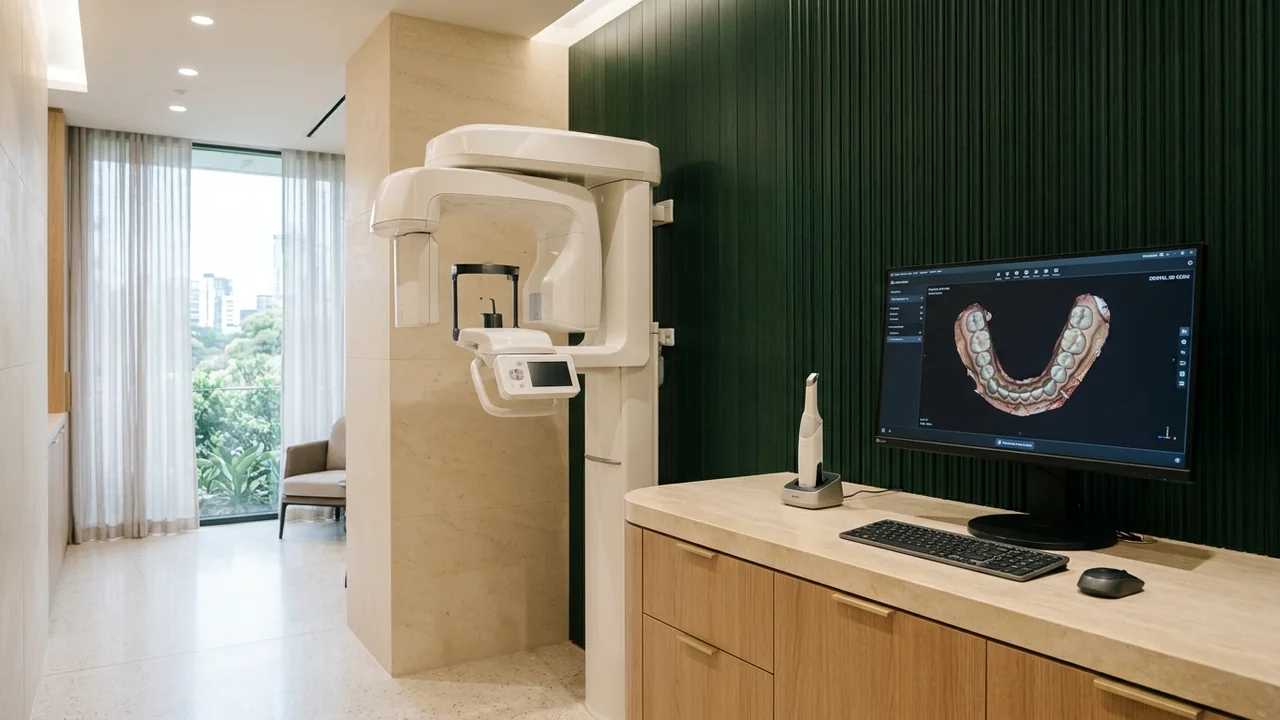
- Digital Smile Design (DSD) & Trial Mock-Up: Using facial photography and a wireless 3D intraoral scan (zero goopy putty), we design your future tooth proportions and transfer a removable temporary resin preview directly over your untouched teeth.
- Real-Life Daylight Approval: You walk around, speak, take photos, and inspect tooth length and fullness in natural sunlight before any enamel is touched.
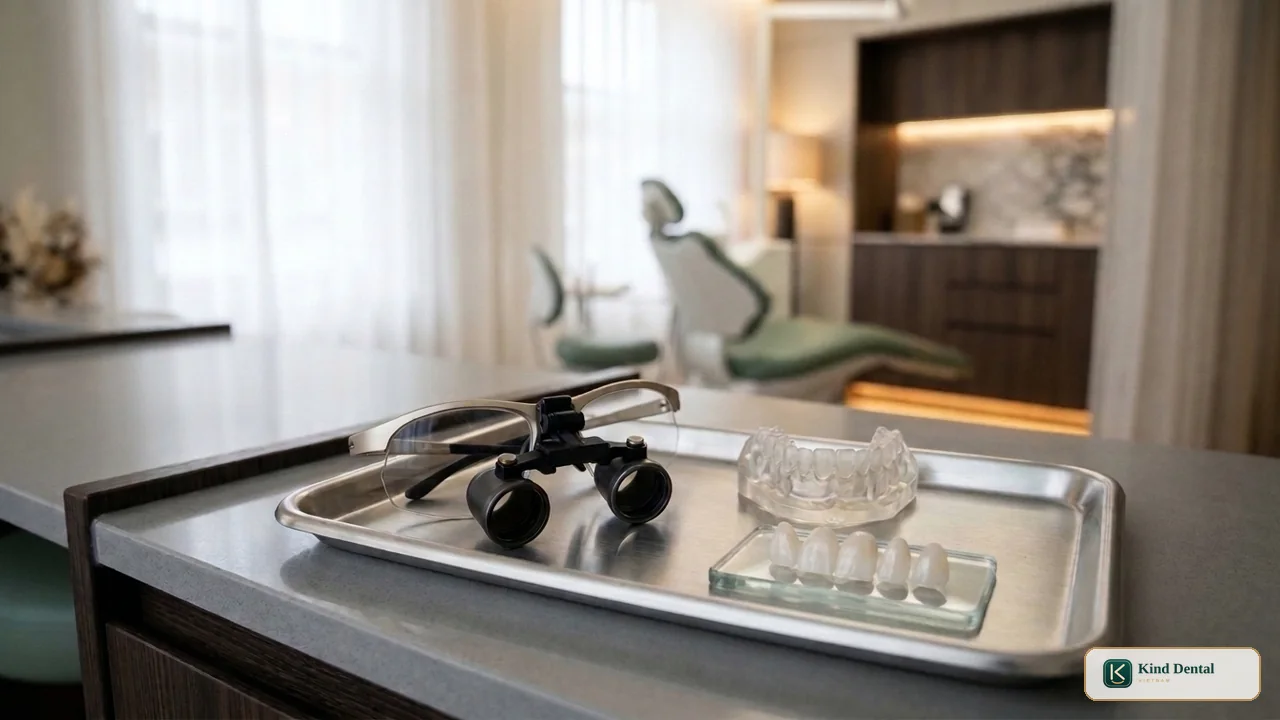
- Calibrated Depth-Cutter Preparation Through the Mock-Up: Once you love the trial smile, Dr. Cuong uses calibrated 0.3 mm depth-limiting diamond guides directly through the temporary resin under optical magnification loupes. Wherever the mock-up already adds 0.3 mm of volume, the bur removes resin only—leaving underlying enamel completely untouched (0.0 mm!).
- Rubber-Dam Isolated Adhesive Bonding: Authentic hydrofluoric-etched, silanized lithium disilicate shells are bonded in a bone-dry isolated field to lock in maximal enamel adhesion.
5. Ceramic Science: Why Ivoclar IPS e.max Leads Over Feldspathic & Cheap Zirconia
Two landmark systematic reviews—a 2025 meta-analysis in the Journal of Esthetic and Restorative Dentistry (Klein et al., 2025; PMID 39523553) and a 2024 clinical review in the Journal of Prosthodontic Research (Komine et al., 2024; PMID 38220160)—evaluate survival across feldspathic porcelain, lithium disilicate (IPS e.max), and zirconia laminate veneers.
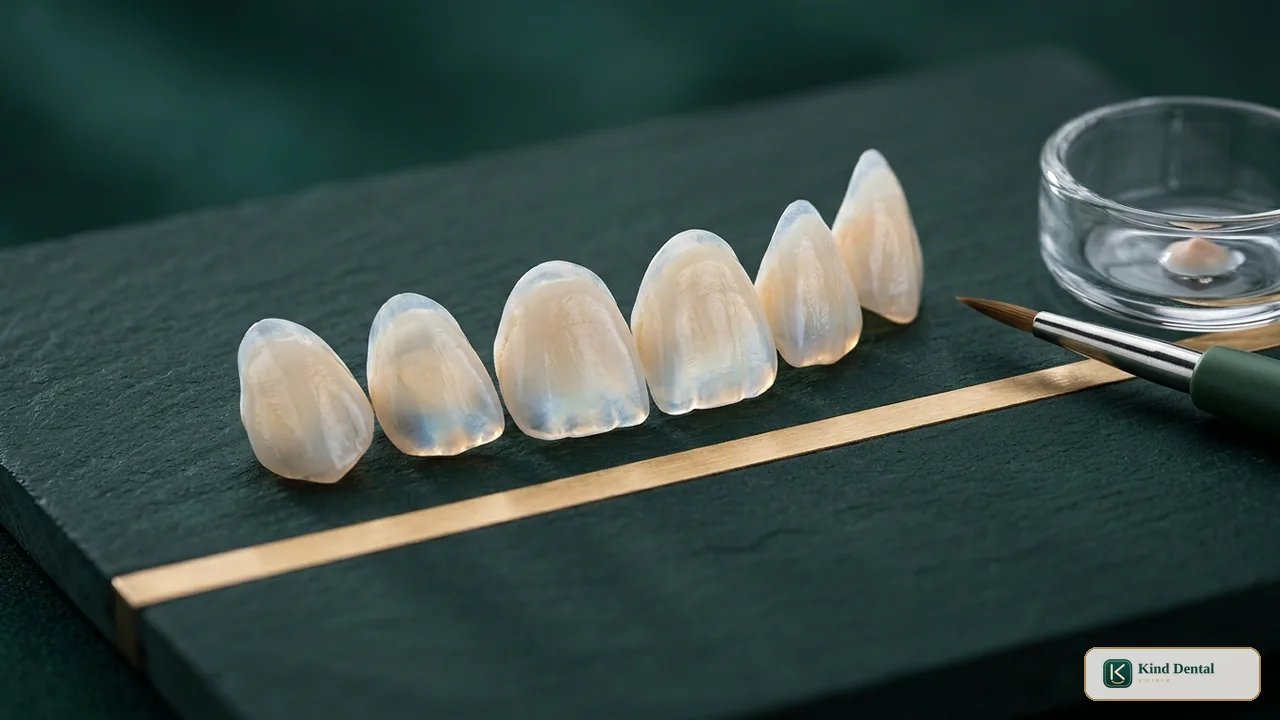
- Ivoclar Vivadent IPS e.max (Lithium Disilicate — Kind Dental Standard): Delivers ~400–530 MPa flexural strength—nearly four times stronger than traditional feldspathic porcelain—while still containing etchable glass silica for an extraordinarily durable micromechanical resin bond to tooth enamel.
- Hand-Layered Feldspathic Porcelain: Exquisite artistic translucency at 0.2 mm, yet more fragile (~80–120 MPa) and prone to edge chipping in patients with vigorous bites.
- Why Zirconia Is Rarely First Choice for Thin Veneers: Although 3D multilayer zirconia excels for full-coverage crowns and back molars (explore our IPS e.max vs. 3D Zirconia Guide), zirconia lacks glass silica and cannot be acid-etched like lithium disilicate—giving it higher debonding risk when crafted as a thin facial veneer.
Be cautious of cut-rate overseas clinics advertising “$120 veneers” using unverified bulk ceramic blocks or substituting opaque crowns for veneers (learn the warning signs in Why Ultra-Cheap Dental Work Abroad Fails Within 3 Years).
6. Transparent 2026 IPS e.max Veneer Costs & 5–7 Day Single-Trip Schedule
Unlike implants, porcelain veneers require only one relaxed 5-to-7 day trip to Ho Chi Minh City. Every fee below aligns transparently with our Porcelain Veneers & Crowns Cost Schedule and bundles Digital Smile Design, 3D optical scanning, trial temporaries, rubber-dam bonding, and our 10-year written ceramic warranty:
| Ivoclar IPS e.max Veneer Package | Kind Dental Vietnam (USD) | Indicative AUD / GBP* | Typical Australia / USA / UK Fee | Est. Savings |
|---|---|---|---|---|
| 1 Unit: Authentic Ivoclar IPS e.max Veneer | $320 – $420 | A$495 – A$645 £255 – £330 |
$1,500 – $2,200 USD | Save ~78% |
| 4 Units: Upper Central & Lateral Incisors | $1,280 – $1,680 | A$1,970 – A$2,585 £1,010 – £1,325 |
$6,000 – $8,800 USD | Save ~79% |
| 8 Units: Classic Upper Smile Arch | $2,560 – $3,360 | A$3,940 – A$5,175 £2,020 – £2,655 |
$12,000 – $17,600 USD | Save ~79% |
| 10 Units: Wide Upper Smile Line | $3,200 – $4,200 | A$4,930 – A$6,470 £2,530 – £3,320 |
$15,000 – $22,000 USD | Save ~79% |
| 16 Units: Upper & Lower Full Smile (8+8) | $5,120 – $6,720 | A$7,885 – A$10,350 £4,045 – £5,310 |
$24,000 – $35,200 USD | Save ~79% |
*Indicative conversions at ~1.54 AUD and ~0.79 GBP/USD. $320–$360 covers CAD/CAM pressed/milled IPS e.max with natural stain-glaze; $380–$420 covers master ceramist hand-layered translucent incisal characterization.
Your Calm 5–7 Day District 1 Appointment Rhythm
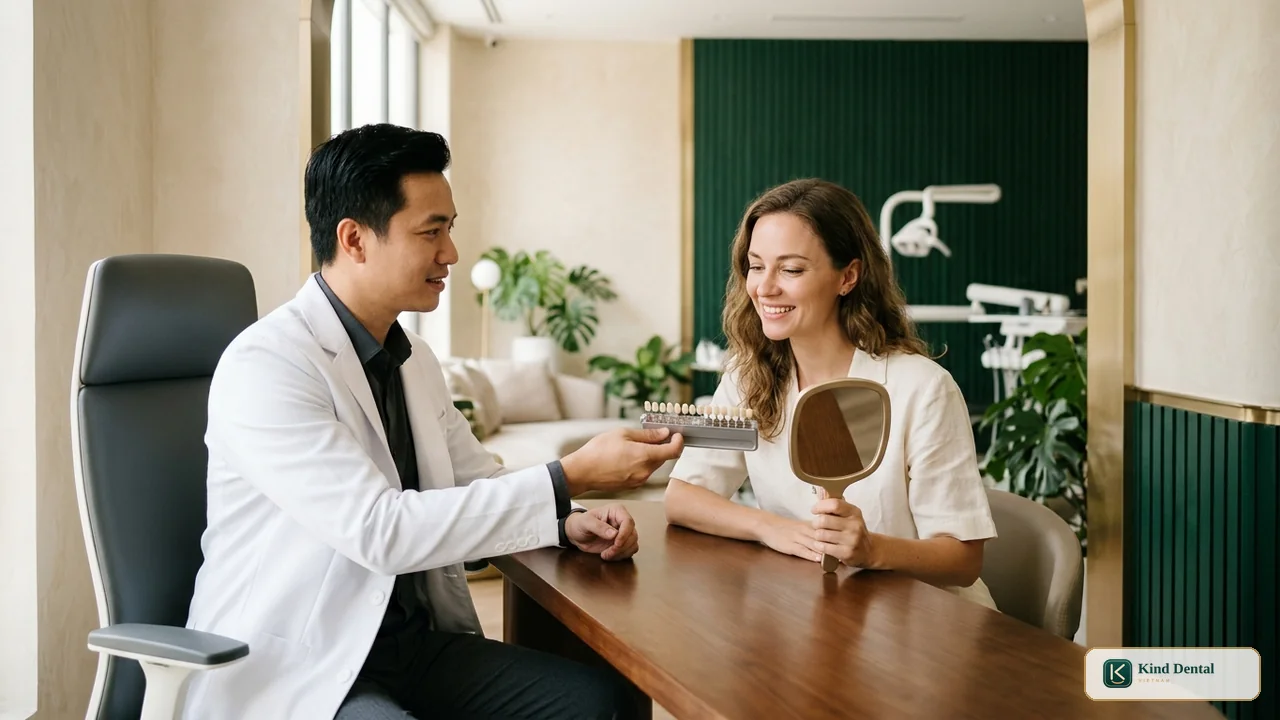
- Day 1 — Exam, Photography & Trial Smile Mock-Up: Full enamel/bite evaluation, shade consultation under natural daylight, and trial smile preview inside your mouth.
- Day 2 — Mock-Up Guided Conservative Prep & 3D Scan: Gentle 0.0–0.4 mm enamel contouring (only where needed), wireless 3D optical scan, and smooth aesthetic temporaries.
- Days 3–4 — Master Ceramic Fabrication: Free days to relax, enjoy Saigon cafés, or rest while our partner lab presses and hand-layers your genuine IPS e.max shells.
- Day 5 — Try-In & Rubber-Dam Final Bonding: Preview every veneer with try-in gel to verify shade and translucency; once 100% approved, Dr. Cuong bonds each shell individually under dry isolation.
- Days 6–7 — Bite Calibration & Protective Nightguard: Microscopic occlusion polish, flossing check, and custom nightguard fitting ($80–$120 if bruxism is present) before flying home.
7. Ethical Smile Math: Why 8 Upper Veneers + Lower Whitening Often Beats 20 Veneers
Many high-pressure cosmetic chains push 20-tooth packages automatically on every traveler. At Kind Dental Vietnam, Dr. Cuong frequently advises a far healthier, more conservative combination when lower teeth are naturally straight and sound:
- 8 to 10 Upper Minimal-Prep IPS e.max Veneers ($2,560–$4,200 USD): Refines symmetry, length, and natural incisal translucency across your full upper smile arc.
- Gentle Lower Arch Refresh ($180–$240 USD total): Swiss EMS AirFlow warm-water polishing plus sensitive-enamel whitening (Cosmetic Whitening & AirFlow) elevates natural lower teeth cleanly to harmonize with refined B1, A1, or soft BL4 upper veneers.
This biomimetic approach preserves 100% of virgin lower enamel for life while saving $2,500 to $4,000 USD instantly.

8. Honest Clinical Limitations & 15-Year Longevity Habits
Meta-analyses in the International Journal of Prosthodontics (Morimoto et al., 2016; PMID 26757327) and 2025 partial-coverage reviews (Prott et al., 2025; PMID 39558793) show that enamel-bonded glass-ceramic veneers enjoy high long-term clinical survival—often 12 to 15+ years—when patients understand honest boundaries:
- Temporary Cold Sensitivity: Mild sensitivity to iced drinks for 5–14 days post-bonding is normal and fades steadily when preparation stays strictly inside enamel.
- Bruxism & Edge Chipping: Nocturnal jaw grinding or biting hard crab shells, ice, or fingernails can fracture ultra-thin ceramic edges. Wearing a custom hard-acrylic nightguard during sleep protects your investment decisively.
- Severe Crowding Caution: Veneers should never substitute for orthodontics on severely twisted teeth; brief Invisalign alignment first avoids deep dentin cutting.
- Verify Your Surgeon Independently: Always confirm your cosmetic dentist’s credentials on the HCMC Department of Health Registry (License Verification Guide) and review travel schedules in Dental Tourism From Australia or From the USA.
9. Peer-Reviewed PubMed Clinical Evidence
Every enamel-bonding principle and veneer survival figure in this guide is anchored in peer-reviewed prosthodontic literature indexed by the U.S. National Library of Medicine:
- Klein P, Spitznagel FA, Zembic A, et al. Survival and Complication Rates of Feldspathic, Leucite-Reinforced, Lithium Disilicate and Zirconia Ceramic Laminate Veneers: A Systematic Review and Meta-Analysis. Journal of Esthetic and Restorative Dentistry. 2025 Mar. PubMed PMID: 39523553
- Prott LS, Pieralli S, Klein P, et al. Survival and Complications of Partial Coverage Restorations: A Systematic Review and Meta-Analysis. Journal of Esthetic and Restorative Dentistry. 2025 Mar. PubMed PMID: 39558793
- Komine F, Furuchi M, Honda J, et al. Clinical performance of laminate veneers: A review of the literature. Journal of Prosthodontic Research. 2024 Jul. PubMed PMID: 38220160
- De Angelis F, D’Arcangelo C, Angelozzi R, et al. Retrospective clinical evaluation of a no-prep porcelain veneer protocol. The Journal of Prosthetic Dentistry. 2023 Jan. PubMed PMID: 34059296
- Smielak B, Armata O, Bojar W. A prospective comparative analysis of the survival rates of conventional vs no-prep/minimally invasive veneers over a mean period of 9 years. Clinical Oral Investigations. 2022 Mar. PubMed PMID: 34927224
- Morimoto S, Albanesi RB, Sesma N, et al. Main Clinical Outcomes of Feldspathic Porcelain and Glass-Ceramic Laminate Veneers: A Systematic Review and Meta-Analysis. International Journal of Prosthodontics. 2016 Jan. PubMed PMID: 26757327
- Öztürk E, Bolay S. Survival of porcelain laminate veneers with different degrees of dentin exposure: 2-year clinical results. Journal of Adhesive Dentistry. 2014 Oct. PubMed PMID: 25279393
- Burke FJ. Survival rates for porcelain laminate veneers with special reference to the effect of preparation in dentin: a literature review. Journal of Esthetic and Restorative Dentistry. 2012 Aug. PubMed PMID: 22863131
10. Frequently Asked Questions: No-Prep vs. Minimal-Prep Veneers in Vietnam
Are no-prep veneers truly reversible if I ever decide to remove them later?
In practice, no-prep porcelain veneers should still be viewed as a long-term commitment. Because strong resin adhesive bonds microscopically into acid-etched tooth enamel, removing bonded ceramic cleanly without touching surface enamel is difficult—so we always preview your exact trial smile first before bonding.
How much enamel is removed for minimal-prep IPS e.max veneers at Kind Dental Vietnam?
Typically only 0.2 to 0.5 mm across the front surface—roughly the thickness of a contact lens or fingernail—guided precisely through your trial smile mock-up. The entire biting back surface of your tooth stays completely untouched, keeping bonding strictly inside the strong enamel layer.
How much do no-prep or minimal-prep IPS e.max veneers cost in Vietnam in 2026?
At Kind Dental Vietnam in District 1, Ho Chi Minh City, authentic Liechtenstein Ivoclar Vivadent IPS e.max veneers cost $320 to $420 USD per tooth (approx. A$495–A$645 or £255–£330), including Digital Smile Design, 3D optical scanning, aesthetic temporaries, rubber-dam bonding, and a 10-year written ceramic warranty.
Will my teeth be shaved down into tiny pegs like viral “Turkey Teeth” videos?
Never. “Turkey Teeth” pegs are aggressive 360-degree crowns erroneously placed onto healthy front teeth. Dr. Cuong adheres strictly to biomimetic minimal-prep veneer protocols for healthy teeth, reserving full crowns strictly for heavily damaged, cracked, or root-canal-treated teeth.
Can no-prep veneers hide dark tetracycline staining or grey root-canal teeth?
Usually not effectively. Ultra-thin 0.2 mm no-prep porcelain is highly translucent, allowing dark underlying tones to show through unless opaque white layers are added (which look chalky). Moderate-to-severe intrinsic staining achieves far more lifelike, natural aesthetics with 0.4–0.5 mm minimal-prep IPS e.max veneers.
How many days do I need in Ho Chi Minh City to complete 8 to 10 IPS e.max veneers?
Plan 5 to 7 working days in a single trip to Ho Chi Minh City. This allows unhurried Digital Smile Design, mock-up trial approval, master ceramist hand-layering, try-in shade confirmation in daylight, isolated bonding, and final bite calibration prior to departure.
Do I need veneers on my bottom teeth too, or only on my upper smile?
Most international patients do not need lower veneers if their lower teeth are straight and healthy. Dr. Cuong often pairs 8–10 upper IPS e.max veneers with gentle Swiss EMS AirFlow cleaning and lower-arch whitening ($180–$240 total)—preserving virgin lower enamel while saving $2,500–$4,000 USD.
How can I check if I am a candidate for no-prep vs. minimal-prep veneers before flying?
Take three clear daylight phone photos of your front smile and side bite profile and share them via WhatsApp (+84 853 020 003) or our online consultation desk. Dr. Cuong personally evaluates your tooth alignment, enamel thickness, and shade goals within 24 hours with a transparent written estimate.
Want Honest Clinical Advice on Your X-Ray or Quote?
Send your panoramic OPG scan or an existing treatment estimate via WhatsApp. Dr. Cuong will provide a clear, conservative comparison with zero agency markup.