
The Surgeon’s Summary (2026):
- For most back teeth, bridges and implants: monolithic 3D multilayer zirconia ($260–$350 USD per tooth in Ho Chi Minh City) is milled from one solid gradient block. With no glassy veneer layer, porcelain chipping, the commonest technical complication of layered crowns, largely disappears.
- Where glass-ceramic or layering still earns its place: a single upper front tooth that must match a very translucent natural neighbour. Here, Ivoclar Vivadent IPS e.max or careful micro-layering can look more natural than any solid block.
- On opposing enamel: well-polished monolithic zirconia tends to wear opposing teeth less than worn or chipped porcelain. Surface finish matters more than hardness.
- The honest caveat: some teeth need a different material, or no crown at all. Section 6 explains when.
2. 3D Multilayer Science
3. 4-Material Matrix
4. Bruxism & Enamel Wear
5. Tooth vs. Implant Crowns
6. Limitations & Alternatives
7. Enamel Conservation
8. 4–7 Day Digital Protocol
9. 2026 Pricing & Warranty
10. PubMed Evidence
11. Patient FAQs
If you have begun researching zirconia and all-ceramic dental crowns in Vietnam, you will already have met a confusing vocabulary. One clinic recommends “monolithic 3D zirconia”, another prefers “layered porcelain”, and a third still offers porcelain-fused-to-metal (PFM).
The choice matters more when your dentist is a long flight away. A crown that chips eighteen months after you return to Sydney or London means a local remake at many times the cost. Our 2026 crown and veneer pricing in Vietnam only makes sense alongside the engineering behind each material.
At Kind Dental Vietnam in District 1, Ho Chi Minh City (private appointment only), every crown plan is made personally by Dr. Nguyen Van Cuong, DDS, who holds Vietnam Ministry of Health Practice Licence 0003265/BL-CCHN and is a member of the ICOI and VOSA.
This guide explains, as plainly as we would chairside, why layered crowns chip, how gradient zirconia achieves natural translucency, and when a different restoration is wiser. Each clinical claim links to a peer-reviewed review on PubMed.
1. Monolithic vs. Layered Porcelain: The Structural Physics Behind Chipping
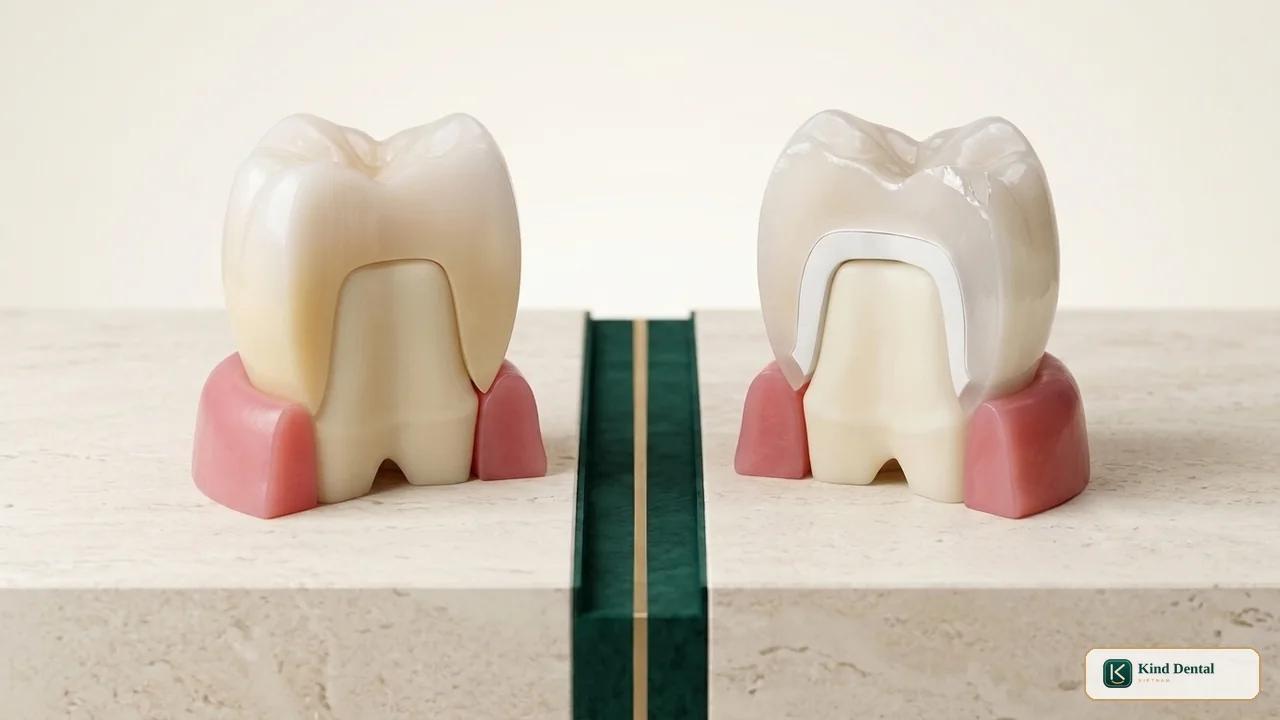
The clearest way to tell monolithic zirconia and layered porcelain crowns apart is to imagine both sliced in half. On the day they are cemented, both look smooth, glossy and convincingly tooth-coloured.
Structurally, they could hardly be more different. A layered (veneered) crown is a two-part construction: a ceramist hand-builds feldspathic porcelain, typically 80–120 MPa in flexural strength, and fires it onto a rigid zirconia or metal coping.
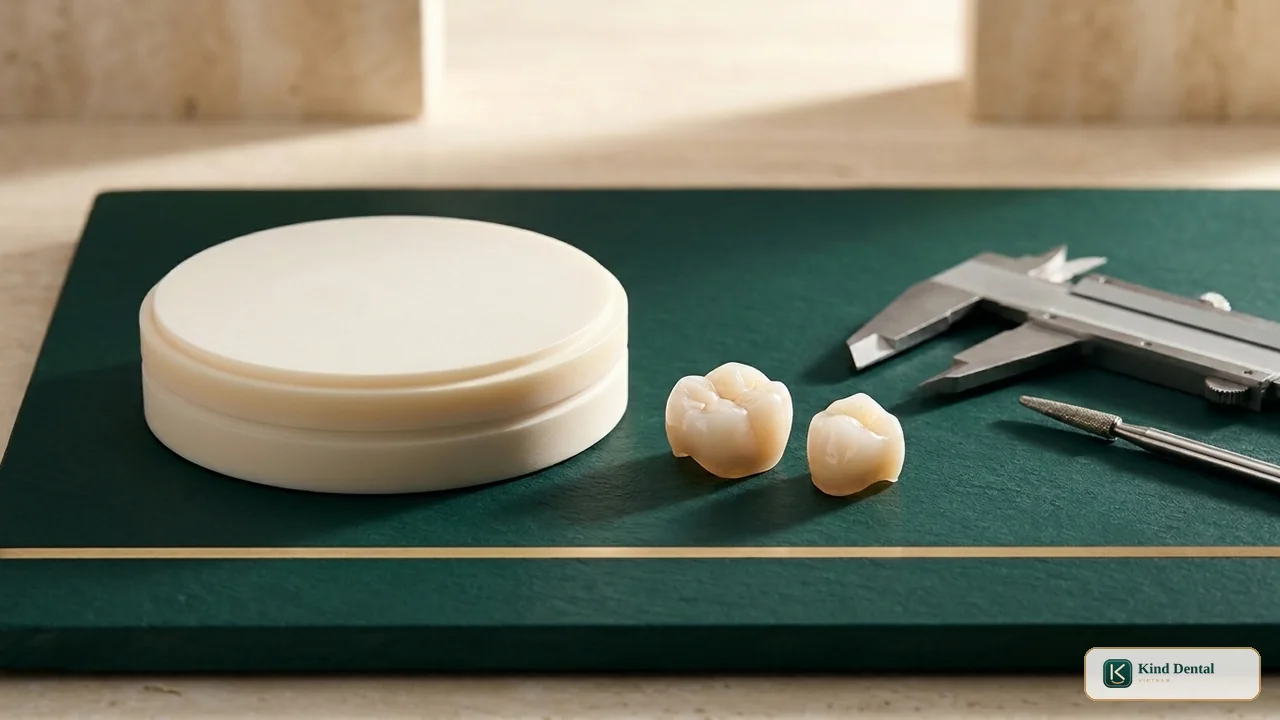
A monolithic 3D multilayer zirconia crown dispenses with that glassy jacket. A 5-axis CAD/CAM mill carves the complete tooth from a single zirconia disc whose strength and translucency change gradually from neck to biting edge.
Why Veneered Crowns Chip Even When the Core Holds
Systematic reviews in Dental Materials (Sailer et al., 2015; PMID 25842099) and Clinical Oral Implants Research (Pjetursson et al., 2018; PMID 30328190) compared all-ceramic and metal-ceramic single crowns.
Veneered zirconia crowns performed acceptably overall, but showed more ceramic chipping and loss of retention than the metal-ceramic benchmark, while framework fracture was uncommon. The weak point, in other words, is the veneer rather than the core. Three mechanical stresses explain why it flakes:
- Residual cooling stress: zirconia conducts heat slowly, so the porcelain above it can cool unevenly, locking tension into the outer glass.
- Point loading on cusps: a crusty baguette or a stray fragment of bone strikes the weaker veneer, not the far stronger core.
- Unsupported porcelain: thick porcelain over a flat, under-designed coping leaves cusps without structural backing.
A 2021 meta-analysis of implant-supported single crowns (Pjetursson et al., 2021; PMID 34642991) found veneered zirconia chipped more often than monolithic designs. The authors noted that monolithic data come from shorter follow-up, a caveat we share openly.
Dr. Cuong’s travel principle: a small porcelain chip is an inconvenience when your dentist is around the corner. When you live in Australia, the UK or North America, a crown with no veneer layer to chip protects both the tooth and your future travel plans.
2. Inside 3D Multilayer Zirconia: Retiring the “Chalky White Crown”
Patients who had monolithic zirconia a decade ago often remember exceptional toughness paired with a flat, milky look. Those crowns used uniform 3Y-TZP (3 mol% yttria-stabilised zirconia), roughly 1,100–1,200 MPa strong but rather like frosted stone in the light.
Dentists therefore layered porcelain over zirconia for teeth in the smile, accepting chipping as the price of beauty. Contemporary 3D multilayer gradient zirconia largely resolves that compromise, pressing different yttria formulations into one disc without a visible join.
How the Gradient Imitates Natural Enamel
In daylight, a natural tooth has warm, opaque dentine at the gumline and enamel that glows softly at the edge. A well-made disc imitates that transition in three zones (indicative figures; they vary by manufacturer and thickness):
- Cervical zone (3Y, approx. 1,100–1,200 MPa): carries load at the gumline, strengthens bridge connectors and helps mask a darkened root-filled tooth.
- Body zone (4Y, approx. 800–950 MPa): blends dentine colour through the crown without banding.
- Incisal and occlusal zone (5Y, approx. 600–750 MPa): richer in light-transmitting cubic crystals, yet still several times stronger than veneering porcelain.
Clinically, the strongest material sits where stress is greatest and the most translucent where it is seen. The ITI Group 2 consensus (Morton et al., 2018; PMID 30328196) regarded zirconia-based crowns as a valid alternative to metal-ceramic, flagging veneer chipping as the complication to design around.
3. The 4-Material Clinical Matrix: Choosing by Tooth Position
No single ceramic suits every tooth. The table compares monolithic 3D zirconia, layered porcelain-on-zirconia, monolithic IPS e.max and traditional PFM. For more on glass-ceramics, see our IPS e.max vs. 3D Zirconia Guide.
| Clinical Factor | Monolithic 3D Zirconia | Layered Porcelain-on-Zirconia | Monolithic IPS e.max | Traditional PFM |
|---|---|---|---|---|
| Architecture | Solid 3Y–5Y gradient block | Zirconia core + porcelain veneer | Solid, etchable glass-ceramic | Metal alloy + fired porcelain |
| Flexural Strength (indicative) | ≈600–1,200 MPa (graded) | Core ≈1,100; veneer 80–120 MPa | ≈400–500 MPa | Metal core; porcelain ≈90 MPa |
| Chipping Tendency | Low (no veneer layer) | Highest of the four in reviews | Low on front teeth and premolars | Moderate (veneer chipping) |
| Translucency | Natural gradient; good | Hand-crafted characterisation | Highest optical clarity | Lower (metal blocks light) |
| Typical Tooth Reduction | Conservative (≈0.8–1.2 mm) | Greater (≈1.5–2.0 mm) | Moderate (≈1.0–1.5 mm) | Greater (≈1.5–2.0 mm) |
| Grey Gumline Risk | No metal collar | No metal collar | No metal collar | Grey line if gums recede |
| Grinding (Bruxism) | Preferred (with nightguard) | Poor (cusp chipping) | Moderate; avoid heavy molar load | Poor to moderate |
| Best-Suited Positions | Molars, premolars, bridges, implants | Selected high-demand front teeth | Front teeth, veneers, premolars | Mainly replacing existing PFM |
Two Situations Where Dr. Cuong Chooses IPS e.max or Micro-Layering
Good prosthodontics matches the material to the tooth, its bite and its neighbours, rather than using one block everywhere. Monolithic zirconia serves back teeth, bridges and implants reliably, but two front-tooth situations often call for something else:
- A single upper central incisor: matching one front tooth beside a very translucent neighbour demands subtle internal effects. IPS e.max, or a minimal facial cut-back with the biting surface kept in zirconia, usually blends best.
- Healthy front teeth needing only cosmetic change: sound teeth should never be reduced for crowns purely to change colour. Our Minimal-Prep IPS e.max Veneers vs. Full Crowns Guide explains the conservative options.
4. Bruxism, Clenching & Opposing Enamel Wear: Polishing vs. Glazing
Night-time clenching and grinding, known as sleep bruxism, subjects crowns to heavy sideways forces, often several times those of normal chewing and sustained for long periods. Reviews of multi-unit restorations show the pattern. For tooth-supported bridges (Sailer et al., 2018; PMID 30328185), veneered zirconia chipped noticeably more often than metal-ceramic.
For posterior implant bridges (Pjetursson et al., 2023; PMID 37750526), material and design again shaped outcomes, with veneer chipping the leading technical issue. Monolithic designs fared better, though over shorter observation periods.
“Will Zirconia Wear Down My Natural Teeth?”
It is a sensible question. Many people assume something as hard as zirconia must grind away the enamel opposite it. In wear science, however, surface smoothness matters far more than hardness. Picture polished granite and coarse sandpaper sliding across glass: the polished stone glides, the grit scratches.
- Worn or chipped porcelain can be abrasive: once its thin glaze wears through, the crystalline particles in feldspathic porcelain act like fine sandpaper against enamel.
- Polished zirconia is comparatively gentle: after any bite adjustment, Dr. Cuong re-polishes the contacts through a sequence of diamond polishers to a high lustre, keeping opposing wear low.
The caveat matters: zirconia adjusted and left rough, or protected only by a glaze that wears away, loses this advantage. Polishing is not cosmetic; it is part of the clinical protocol.
Our bruxism safeguard: when the examination shows worn facets or signs of clenching, we pair zirconia crowns with a custom occlusal nightguard (optional, within our $50–$220 USD tier). A crown alone does not treat grinding.
5. Natural Teeth vs. Implant Crowns: Why Chipping Accelerates on Implants
A natural tooth is suspended in bone by the periodontal ligament, an elastic sling rich in pressure sensors that triggers a protective reflex when you bite something unexpectedly hard.
An implant fuses directly to bone without that cushion, so more of each impact passes straight into the ceramic. A review of implant bridges followed for at least five years (Pjetursson et al., 2012; PMID 23062125) found veneer chipping the most frequent technical complication.
For single implants, we generally fix monolithic zirconia to a screw-retained titanium-base abutment. A systematic review (Wittneben et al., 2014; PMID 24660192) found similar survival for screw- and cement-retained designs, with fewer complications overall for screw retention.
Screw retention also avoids residual cement under the gum and lets a dentist anywhere remove and service the crown, which matters when your follow-up care happens at home; see our Screw-Retained vs. Cemented Implant Crowns guide.
Note that a zirconia crown on a titanium implant is not a zirconia implant, which replaces the titanium root itself. That is a separate decision with its own evidence base (Mohseni et al., 2023; PMID 38135804).
6. Honest Limitations: When Monolithic Zirconia Is Not the Answer
Every material has trade-offs, and presenting only the advantages is not the full picture. These are the situations in which Dr. Cuong will recommend another material, a smaller restoration or no crown at all.
Known Limitations of Monolithic Zirconia
- Less forgiving bonding: zirconia cannot be etched like glass-ceramic, so very short teeth may do better with IPS e.max.
- Harder to adjust or remove: later root canal access, or replacing the crown, takes more time.
- A translucency ceiling: even 5Y zirconia is slightly less lifelike than the best glass-ceramics for a lone front tooth.
- Weaker translucent grades: 5Y-rich zones are unsuitable for long bridge connectors or very thin walls.
- X-ray opacity: zirconia hides decay beneath its margins on radiographs, so hygiene visits matter.
When an Alternative Treatment Is Wiser
- Healthy front teeth: whitening, bonding or IPS e.max porcelain veneers preserve far more tooth.
- A large filling with strong walls: a partial-coverage onlay may be enough.
- Active gum disease: periodontal health must come first, or any crown will fail at its margins.
- A cracked root or poor prognosis: a crown cannot rescue it; see our Single Implant vs. Dental Bridge guide.
- Untreated heavy grinding: bite assessment and a nightguard come first.
For a missing front tooth with healthy neighbours, a resin-bonded bridge may avoid both an implant and full crowns. A 2024 review of full-ceramic resin-bonded bridges (Habibzadeh et al., 2024; PMID 38706266) reported encouraging survival, with debonding the main complication.
7. Enamel Conservation: Avoiding Over-Prepared “Shark Teeth”
Photographs of healthy teeth shaved into narrow pegs, shared online as “shark teeth”, understandably make travellers cautious. How much thickness each ceramic needs explains why conservative planning protects the nerve.
PFM and layered crowns typically need around 1.5–2.0 mm of reduction to hide an opaque core beneath porcelain. Preparing that deeply brings the drill closer to the pulp, raising the risk of sensitivity and later root canal treatment.
Monolithic 3D multilayer zirconia remains reliable at roughly 0.8–1.2 mm on the biting surface, depending on the tooth and the manufacturer’s guidance. Preserved tooth structure brings real benefits:
- Healthier pulp: extra insulating dentine reduces sensitivity and the likelihood of a root canal.
- A stronger remaining tooth: thicker natural walls lower fracture risk.
- No crown unless needed: our guide to why ultra-cheap dental work abroad fails lists the warning signs to watch for anywhere.
8. Our 4–7 Day Single-Trip Digital Crown Protocol
Durable crowns in one unhurried visit depend on digital accuracy, not shortcuts. A review of complete digital workflows (Joda et al., 2017; PMID 28927393) found intraoral scanning with CAD/CAM monolithic restorations clinically acceptable and time-efficient, though long-term data are still developing.
Why We Do Not Offer 24-Hour Speed-Sintered Crowns
Some clinics advertise next-day crowns from rapid sintering furnaces. Speed cycles suit certain materials and single units, but compressed heating and cooling can compromise the translucency and consistency of multilayer zirconia unless the manufacturer’s protocol is followed precisely.
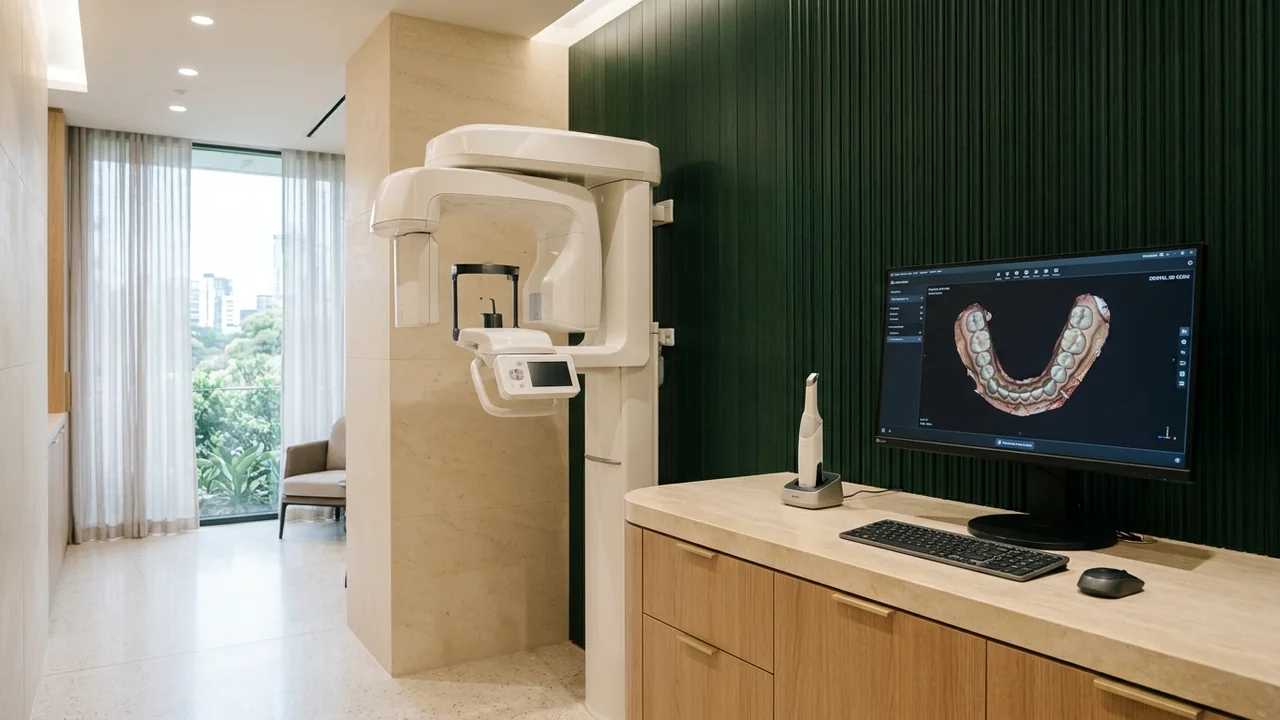
We therefore schedule 4–7 working days in District 1, allowing full-length sintering, strict European Class-B sterilisation and a daylight try-in. See our 3D digital technology and trip duration guide.
| Trip Day | In-Clinic Milestone (District 1) | Laboratory Work & Your Free Time |
|---|---|---|
| Before You Fly | OPG / CBCT review and written estimate ($0, always included) | Agree plan, material and travel dates |
| Day 1 | Examination, 3D scan, shade matching, conservative preparation | Temporaries fitted; first 50% milestone settled |
| Days 2–3 | Free days in Ho Chi Minh City | 5-axis milling and full-length sintering |
| Day 4 | Daylight try-in; margins and contacts verified | You approve colour and bite before polishing |
| Day 5 (6–7 for larger cases) | Final cementation, bite refinement, diamond polish | Remaining 50% settled; warranty issued |
9. 2026 Crown Pricing in Vietnam vs. Home Countries & Warranty
Every Kind Dental Vietnam fee below follows our published 2026 schedule, itemised on the Veneers & Crowns Cost page, with no agency commissions. Home-country figures are indicative ranges only.
| Treatment / Item (2026) | Kind Dental Vietnam (USD) | Australia / USA / UK (Indicative) | Note |
|---|---|---|---|
| Pre-Trip OPG / CBCT Review & Written Estimate | $0 (always included) | $120 – $280 USD | Included |
| In-Clinic Consultation, 3D Scan & Treatment Plan | $0 (included with treatment) | $180 – $350 USD | Included |
| 3D Multilayer Zirconia Crown (CAD/CAM) | $260 – $350 / tooth | $1,200 – $2,200 USD / tooth | Save 70%–82% |
| Porcelain Veneer (Ivoclar Vivadent IPS e.max) | $320 – $420 / tooth | $1,350 – $2,400 USD / tooth | Save 72%–80% |
| Single Implant Complete Package* | $750 – $1,550 (by brand) | $3,500 – $6,000 USD | Save 68%–78% |
| Extraction / Root Canal / Nightguard (optional) | $50 – $220 (only if needed) | $350 – $1,400 USD | Itemised in estimate |
| Swiss EMS AirFlow Cleaning & Digital Exam | $45 – $65 | $180 – $320 USD | Healthy gums first |
| Local Anaesthesia / Optional IV Sedation | Local: $0 · IV: $350 – $650 / session | IV: $850 – $1,800 | Anaesthesiologist-monitored |
*Fixture, custom abutment and zirconia crown: Osstem/Dentium $750–$950; Nobel Biocare $1,200–$1,450; Straumann BLT $1,250–$1,550 USD (see implant pricing). Crowns and veneers take one 4–7 day trip, paid 50% at the start and 50% at completion.
Where a full IPS e.max crown or a micro-layered front crown is the better choice, it is itemised individually in your written estimate before you book flights, so the complete figure is always known in advance.
Why a $120 Promotional Crown Can Cost More in the End
Certified multilayer discs, fresh milling tools, quality cements and a ceramist’s time carry real costs. Very low-priced crowns usually economise somewhere: uncertified blanks, worn burs that leave open margins, or shortened sintering cycles.
At $260–$350 USD, your crown is planned and fitted by Dr. Cuong, made from batch-traceable ceramics and backed in writing by our International Dental Warranty. You can also verify a dentist’s licence in Vietnam independently.

Would you like Dr. Cuong’s recommendation before booking flights? Send your OPG X-ray or photographs by WhatsApp (+84 853 020 003), email (kinddentalvietnam@gmail.com) or our online consultation desk for a calm written plan, usually within 24 hours.
10. Peer-Reviewed PubMed Evidence
The survival data, chipping comparisons and implant-crown principles in this guide draw on these systematic reviews and consensus reports, indexed by the U.S. National Library of Medicine:
- Sailer I, Makarov NA, Thoma DS, et al. All-ceramic or metal-ceramic tooth-supported fixed dental prostheses (FDPs)? A systematic review of the survival and complication rates. Part I: Single crowns (SCs). Dental Materials. 2015 Jun. PubMed PMID: 25842099
- Pjetursson BE, Valente NA, Strasding M, et al. A systematic review of the survival and complication rates of zirconia-ceramic and metal-ceramic single crowns. Clinical Oral Implants Research. 2018 Oct. PubMed PMID: 30328190
- Pjetursson BE, Sailer I, Latyshev A, et al. A systematic review and meta-analysis evaluating the survival, the failure, and the complication rates of veneered and monolithic all-ceramic implant-supported single crowns. Clinical Oral Implants Research. 2021 Oct. PubMed PMID: 34642991
- Morton D, Gallucci G, Lin WS, et al. Group 2 ITI Consensus Report: Prosthodontics and implant dentistry. Clinical Oral Implants Research. 2018 Oct. PubMed PMID: 30328196
- Sailer I, Strasding M, Valente NA, et al. A systematic review of the survival and complication rates of zirconia-ceramic and metal-ceramic multiple-unit fixed dental prostheses. Clinical Oral Implants Research. 2018 Oct. PubMed PMID: 30328185
- Pjetursson BE, Sailer I, Merino-Higuera E, et al. Systematic review evaluating the influence of the prosthetic material and prosthetic design on the clinical outcomes of implant-supported multi-unit fixed dental prosthesis in the posterior area. Clinical Oral Implants Research. 2023 Sep. PubMed PMID: 37750526
- Pjetursson BE, Thoma D, Jung R, et al. A systematic review of the survival and complication rates of implant-supported fixed dental prostheses (FDPs) after a mean observation period of at least 5 years. Clinical Oral Implants Research. 2012 Oct. PubMed PMID: 23062125
- Wittneben JG, Millen C, Brägger U. Clinical performance of screw- versus cement-retained fixed implant-supported reconstructions—a systematic review. The International Journal of Oral & Maxillofacial Implants. 2014. PubMed PMID: 24660192
- Mohseni P, Soufi A, Chrcanovic BR. Clinical outcomes of zirconia implants: a systematic review and meta-analysis. Clinical Oral Investigations. 2023 Dec 23. PubMed PMID: 38135804
- Habibzadeh S, Khamisi F, Mosaddad SA, et al. Full-ceramic resin-bonded fixed dental prostheses: A systematic review. Journal of Applied Biomaterials & Functional Materials. 2024 Jan-Dec. PubMed PMID: 38706266
- Joda T, Zarone F, Ferrari M. The complete digital workflow in fixed prosthodontics: a systematic review. BMC Oral Health. 2017 Sep 19. PubMed PMID: 28927393
11. Frequently Asked Questions: Monolithic 3D Zirconia vs. Layered Porcelain Crowns
Are monolithic 3D multilayer zirconia crowns natural-looking enough for front teeth?
For most smiles, yes. The translucent 4Y/5Y zones give a soft, lifelike edge rather than the flat whiteness of older zirconia. For one front tooth beside a very translucent neighbour, Dr. Cuong may recommend IPS e.max or micro-layering instead.
How much does a monolithic 3D zirconia crown cost in Vietnam in 2026?
At Kind Dental Vietnam in District 1, a CAD/CAM 3D multilayer zirconia crown is $260–$350 USD per tooth. Consultation, 3D scan and treatment plan are included with treatment, and gentle local anaesthesia is always $0.
Why do layered porcelain crowns chip more often than monolithic zirconia?
A layered crown fires relatively weak porcelain over a rigid core. Cooling stress and chewing forces concentrate at that interface, so the outer layer can flake over time. A monolithic crown has no veneer layer to separate.
Will a monolithic zirconia crown wear down my opposing natural teeth?
Not if its biting surface is properly polished. Polished zirconia generally causes less enamel wear than worn or chipped porcelain, which turns abrasive once its glaze is lost. Dr. Cuong re-polishes every adjusted contact.
Which crown material is best if I grind or clench my teeth at night?
Monolithic zirconia is our preferred choice for grinders, as there is no veneer to chip. We pair it with bite refinement and a custom nightguard (optional, within our $50–$220 USD tier), because no crown alone treats bruxism.
When would you advise against a zirconia crown?
When a veneer, onlay or whitening would suffice; when gum disease is active; when a cracked root gives a poor prognosis; or when a very short tooth needs the adhesion of IPS e.max. We explain the alternative in writing.
How many days do I need in Ho Chi Minh City for monolithic zirconia crowns?
Plan 4–7 working days in one trip: usually 4–5 days for one to four crowns, and 6–7 days for larger cases. That allows full-length sintering, a daylight try-in and careful bite refinement before you fly.
How long do monolithic zirconia crowns last, and what warranty is included?
With daily flossing, regular hygiene visits and a nightguard for grinders, well-fitted zirconia crowns can serve for many years, though no restoration lasts indefinitely. Each crown includes batch-traceable documentation and written cover under our International Dental Warranty.
This guide is general clinical education and cannot replace a personal examination; please read our Medical Disclaimer.
Want Honest Clinical Advice on Your X-Ray or Quote?
Send your panoramic OPG scan or an existing treatment estimate via WhatsApp. Dr. Cuong will provide a clear, conservative comparison with zero agency markup.