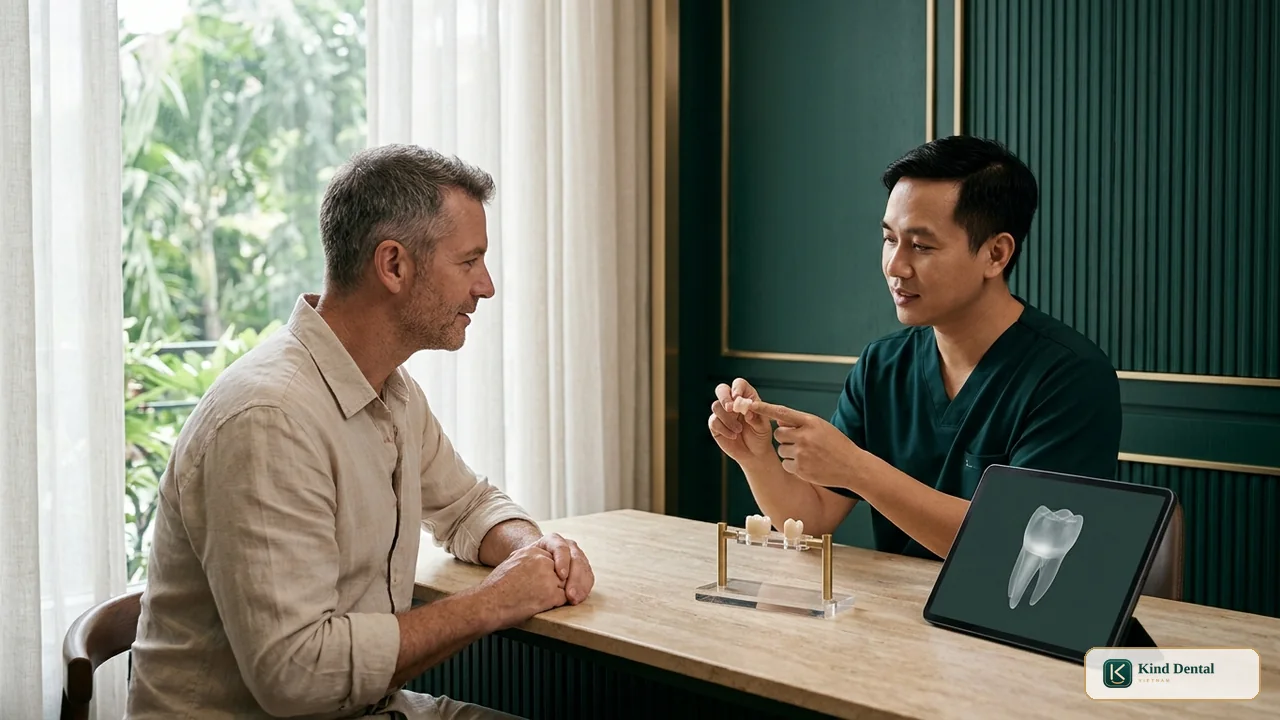

The Surgeon’s Short Answer (2026): A true porcelain veneer refines roughly 0.3–0.5 mm of enamel on the front of a tooth. The “Turkey teeth” look almost always comes from full crowns, which require grinding every surface of a healthy tooth down to a tapered core.
- Biology: Ivoclar IPS e.max veneers ($320–$420 USD per tooth) bond to living enamel, which seals far more predictably than exposed dentin.
- Honesty: Veneers are still irreversible and not right for everyone; grinders, thin enamel and crowded teeth often need another plan first.
- Logistics: One trip of 4–7 days, a reversible mock-up before any enamel is touched, and a 50%/50% milestone payment.
2. Enamel & Nerve Biology
3. Natural Aesthetics
4. Clinical Comparison
5. 4–7 Day Mock-Up Plan
6. 2026 Costs & Rescue Costs
7. When Veneers Are Wrong
8. Six Red Flags
9. PubMed Evidence
10. FAQs
Few phrases have travelled faster through social media than “Turkey teeth.” The images are familiar: healthy front teeth reduced to small, tapered stumps, then capped with bright, uniform crowns. For many travelers, that picture now defines the risk of cosmetic dentistry abroad.
The concern is legitimate, but the label is misleading. Over-preparation is a protocol failure, not a nationality. Istanbul has meticulous, ethical prosthodontists, and high-volume package clinics operate in every tourist market, Southeast Asia included. The real dividing line is whether a clinician protects living enamel.
At Kind Dental Vietnam, a private-appointment practice in District 1, Ho Chi Minh City, Dr. Nguyen Van Cuong, DDS (Ministry of Health license 0003265/BL-CCHN; member of ICOI and VOSA) reviews smiles every week from patients in Sydney, Melbourne, London, California and Singapore.
This guide explains what happens to a tooth under each approach, what the evidence says, what conservative porcelain veneers in Vietnam cost in 2026 and when veneers are the wrong answer. Material detail sits in our IPS e.max vs. zirconia guide.
1. What ‘Turkey Teeth’ Actually Means: A Veneer Is Not a Crown
Most people who regret their “Turkey teeth” never set out to buy twenty full crowns. They answered an advertisement for “20 veneers” at a bundle price, and discovered in the chair, or only afterwards, that every surface of every tooth had been reduced.
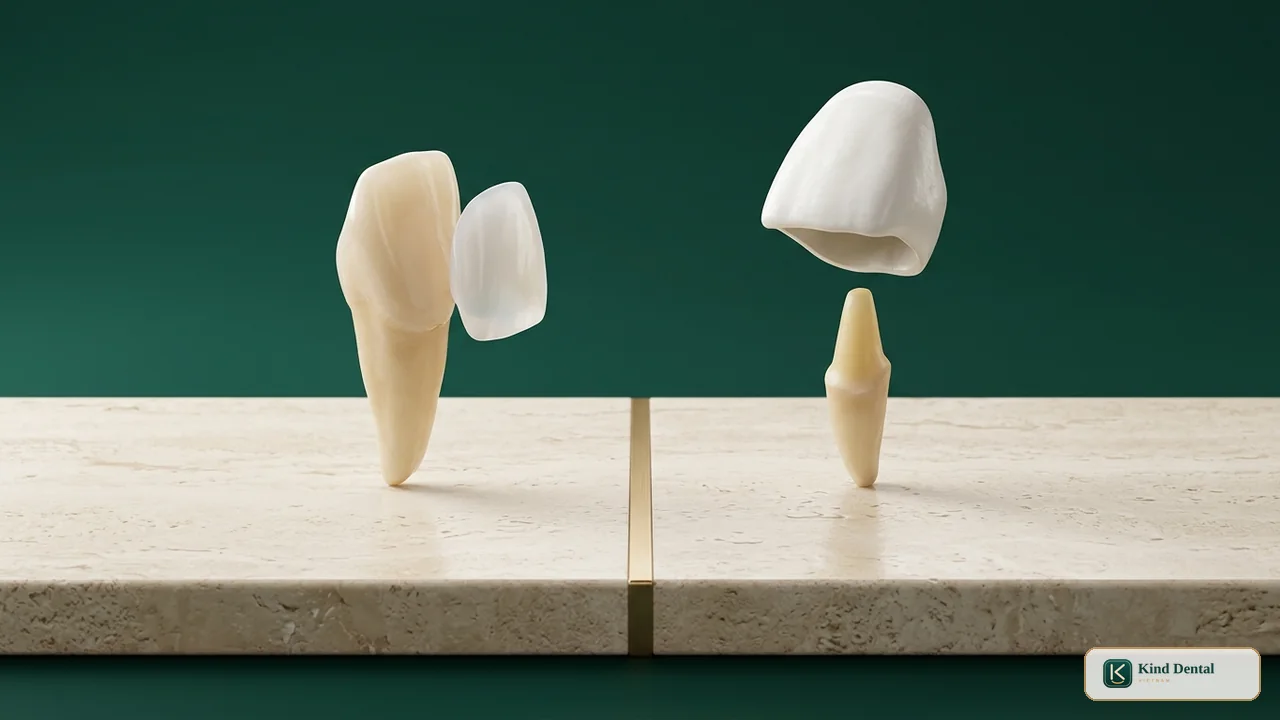
These are two very different procedures. A porcelain laminate veneer covers the visible front surface and, where needed, the biting edge. Preparation typically stays within 0.3–0.5 mm of outer enamel, roughly the thickness of a contact lens, leaving the back and sides untouched.
A full crown is a cap. To make room for it, the tooth is reduced by around 1.0–2.0 mm on every surface. Laboratory studies of upper front teeth suggest this removes roughly two-thirds of the visible tooth structure, against a small fraction for a conservative veneer.
Why Volume Clinics Prefer Crowns on Healthy Teeth
The incentive is practical. Genuine minimal-prep veneers demand magnification, depth-guided preparation, careful bonding isolation and a ceramist working one tooth at a time. Thick, opaque crowns hide crooked alignment, tolerate a looser fit and can be milled overnight. The biological bill tends to arrive years later.
The research supports a conservative starting point. A 2025 systematic review of no-prep and conventional veneers (Hameed et al., 2025; PMID 42607000) concluded that both can perform well in carefully selected cases, a reminder that removing more tooth does not automatically buy a better result.
Adhesive dentistry points the same way. A review of all-ceramic resin-bonded bridges (Habibzadeh et al., 2024; PMID 38706266), which rely on enamel bonding rather than full-coverage preparation of neighboring teeth, reported encouraging survival, showing how much a well-executed enamel bond can carry.
2. Enamel, Dentin and the Nerve: Why Over-Preparation Causes Problems Later
Enamel is the hardest tissue in the human body, and it does not regenerate. Beneath it lies dentin, a softer, porous layer threaded with microscopic fluid-filled tubules that lead toward the pulp, the living nerve and blood supply of each tooth.
When preparation stays within enamel, etched lithium disilicate forms a strong micromechanical and chemical bond. Enamel and ceramic then behave almost as one unit under chewing load, and the dentin beneath stays sealed. That is the biological core of conservative veneer dentistry.
Heavy circumferential reduction changes the picture. Once the enamel shell is removed from every surface and the bur moves deep into dentin, two problems tend to follow, sometimes within weeks and sometimes years after the patient has flown home:
- Pulp stress: Extensive grinding generates heat and opens thousands of dentinal tubules. Some teeth stay sensitive to cold; others quietly lose vitality and need root canal treatment, often drilled through a new crown.
- A weaker seal: Bonding to moist dentin is less predictable than bonding to enamel, raising the long-term risk of leakage, loosening and decay hidden at the gumline.
What Full-Crown Survival Reviews Actually Show
Fairness matters: crowns are a well-proven restoration. A review of tooth-supported single crowns (Sailer et al., 2015; PMID 25842099) found high five-year survival for all-ceramic and metal-ceramic crowns, yet complications such as loss of pulp vitality, decay and chipping persisted.
A later review of zirconia-ceramic and metal-ceramic single crowns (Pjetursson et al., 2018; PMID 30328190) reached similar conclusions. Steady biological and technical upkeep is a sensible trade for a broken-down tooth, and a poor one for a healthy front tooth.
Joining crowns adds further risk. In a review of multi-unit tooth-supported prostheses (Sailer et al., 2018; PMID 30328185), zirconia-based frameworks showed more chipping and technical complications than metal-ceramic designs. Connected units are also harder to clean.
Dr. Cuong’s Enamel-First Principle: We do not reduce healthy, unrestored front teeth to crown cores for speed or convenience. Each veneer is made and bonded individually, so you can floss between every tooth, and any single veneer can be replaced without disturbing its neighbors.
3. What Makes a Natural Smile Design Look Real
Our patients rarely want anyone to ask where they had their teeth done. They want colleagues to think they look rested and well, not to notice a row of white blocks across a dinner table. That is a matter of optics and proportion, not brightness.
The “piano-key” look usually comes from thick, opaque crowns in the brightest bleach shades, with flat surfaces, identical square corners and a ruler-straight edge. Opaque ceramic reflects light like painted plaster. Natural enamel lets light in, scatters it and returns warmth and depth.
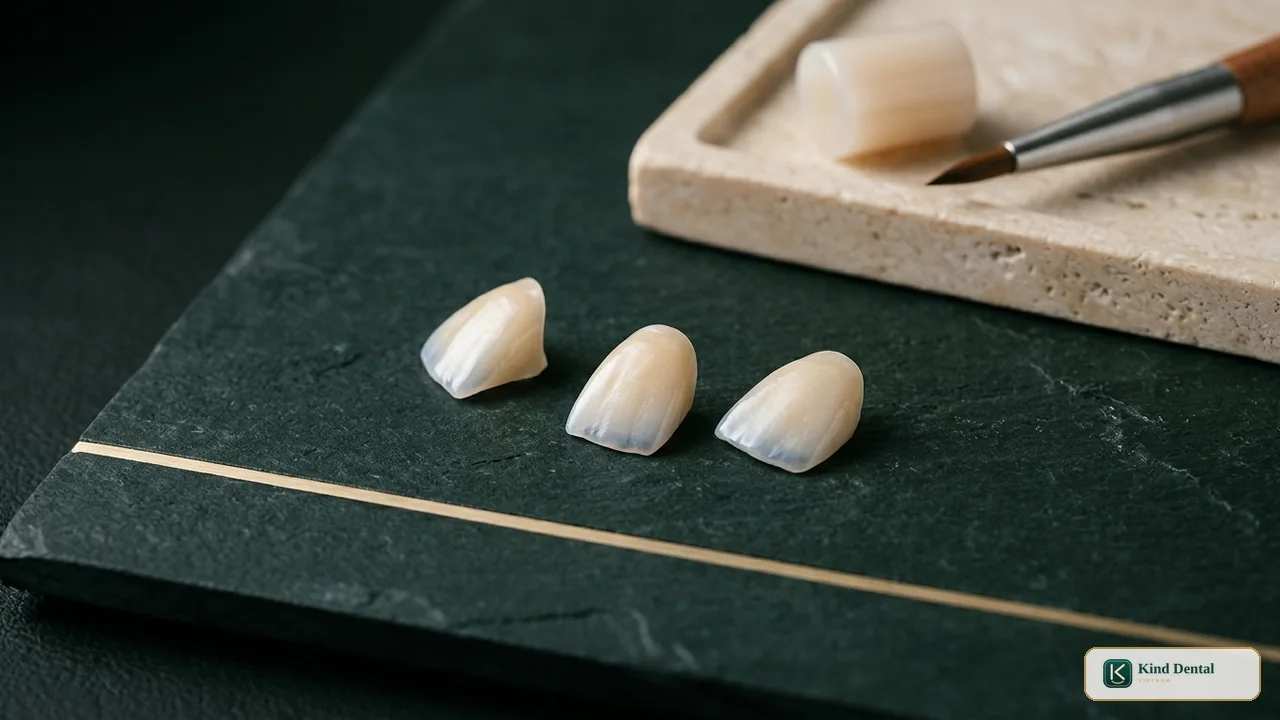
Natural smile design relies on genuine Ivoclar Vivadent IPS e.max lithium disilicate and five principles of restraint, each checked in daylight before bonding. Where a crown is genuinely needed, our guide to monolithic zirconia vs. layered porcelain crowns explains the material choice.
- Warm shade gradation: Slightly warmer near the gum, brighter through the body, translucent at the edge, usually a refined A1, B1 or soft BL4 chosen against your skin tone and the whites of your eyes.
- Edge translucency: Subtle internal character lets daylight pass through the biting edge instead of stopping at an opaque white wall.
- Surface texture: Fine vertical ridges and gentle luster scatter light as youthful enamel does; glassy over-polish looks artificial indoors.
- Individual shapes: Softer lateral incisors, canines with character, and edges that follow your lower lip rather than one rigid bar.
- Gum harmony: Thin, flush margins keep gums pink and scalloped, avoiding the inflamed tissue often seen around bulky crown edges.
Not every tooth needs preparation at all. Some small or slightly set-back teeth suit ultra-thin no-prep veneers, while others need minimal preparation to avoid bulk. The criteria, including tooth angle, spacing and enamel thickness, are set out in No-Prep vs. Minimal-Prep IPS e.max Veneers.
4. Side by Side: Conservative Veneers vs. Full-Crown Packages
The table below summarizes the structural, biological, hygiene, aesthetic and cost differences between the two approaches. Keep it to hand when comparing written quotes, from us or from anyone else, before you commit to flights or pay a deposit.
| Clinical Factor | Conservative Veneers (Kind Dental Vietnam) | Aggressive ‘Turkey Teeth’ Crown Package |
|---|---|---|
| Tooth Structure Removed | About 0.3–0.5 mm, front surface, mostly within enamel | About 1.0–2.0 mm on every surface (roughly two-thirds) |
| Primary Ceramic | Genuine Ivoclar Vivadent IPS e.max | Often opaque zirconia or unverified blocks |
| Bonding Surface | Living enamel (predictable adhesive seal) | Exposed dentin (mechanical retention and cement) |
| Nerve & Root Canal Risk | Low; pulp stays insulated | Higher risk of sensitivity and later root canals |
| Flossing & Gum Health | Each veneer separate; normal flossing | Often splinted blocks that trap plaque |
| Appearance | Warm gradation, translucent edge | Flat, bulky, opaque brightness |
| Reversibility | Irreversible but conservative; tooth stays restorable | Irreversible; tooth committed to crowns for life |
| Trial Mock-Up | Mandatory reversible mock-up on Day 1 | Rarely offered |
| 2026 Fee | $320 – $420 USD per veneer (IPS e.max) Selective 3D zirconia crown where justified: $260–$350 |
Usually a 20–28 unit bundle Low unit price, excessive scope |
5. Our 4-to-7-Day Digital Smile Design Protocol in District 1
Forty-eight-hour makeovers force compromises: no diagnostic trial, freehand preparation and shades cemented hours before a flight. We plan veneer cases as a single trip of 4 to 7 days, most settling at five or six, so craftsmanship never competes with your departure time.
The evidence broadly supports digital tools. A systematic review of complete digital workflows in fixed prosthodontics (Joda et al., 2017; PMID 28927393) reported clinically acceptable fit and better time efficiency than conventional impressions, while noting that long-term data were still limited.
The ITI consensus on prosthodontics (Morton et al., 2018; PMID 30328196), written mainly for implant dentistry, endorses restoration-driven digital planning: design the final tooth form first, then decide how little tissue must change. We apply that logic to veneers.
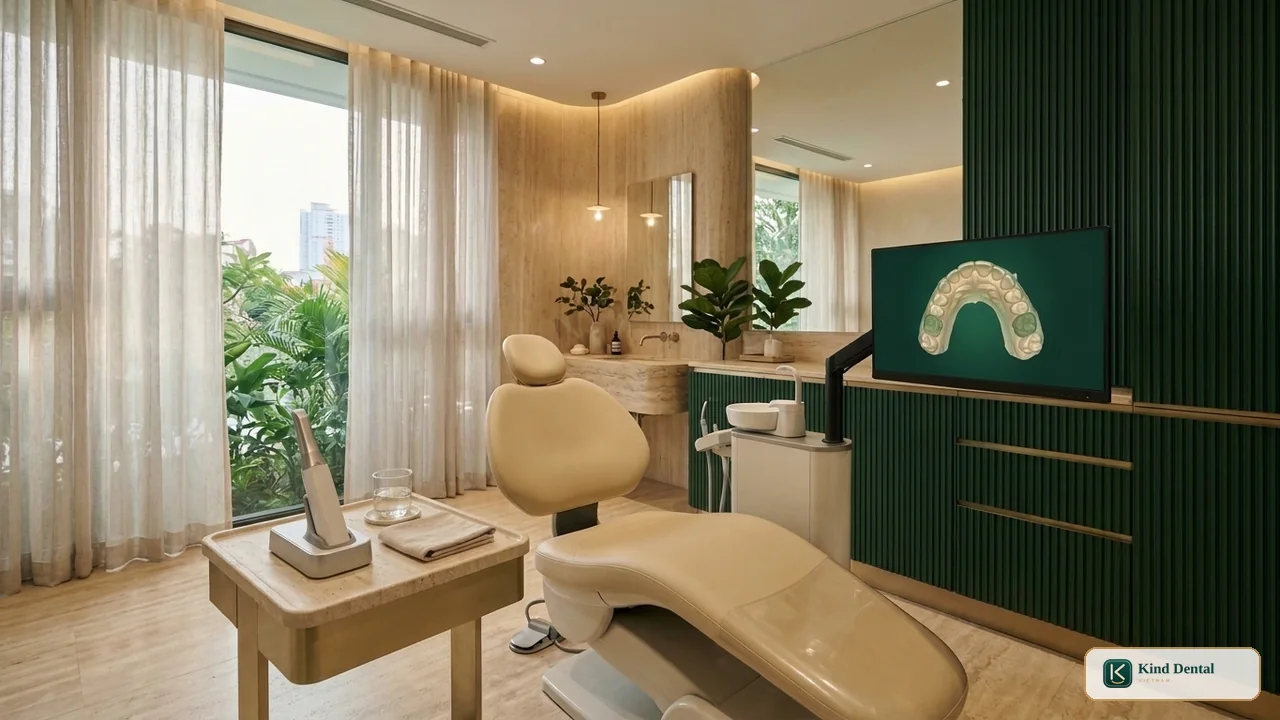
The Reversible Mock-Up: See It Before Any Enamel Is Touched
Before any preparation, we transfer your digital design onto your untouched teeth in temporary composite. You see the proposed smile in daylight, speak and laugh on video, and ask us to adjust length, fullness or shape until it genuinely feels like you.
Only after your approval does Dr. Cuong prepare through that mock-up with calibrated depth-cutting burs. Preparing to the planned shape, rather than the existing tooth, spares enamel on teeth that already sit slightly back and keeps the bond within enamel wherever anatomy allows.
| Stage | Clinical Milestone | Payment & Experience |
|---|---|---|
| Pre-Trip | Review of your OPG/CBCT and photographs; written tooth-by-tooth plan and estimate | $0 (always included) |
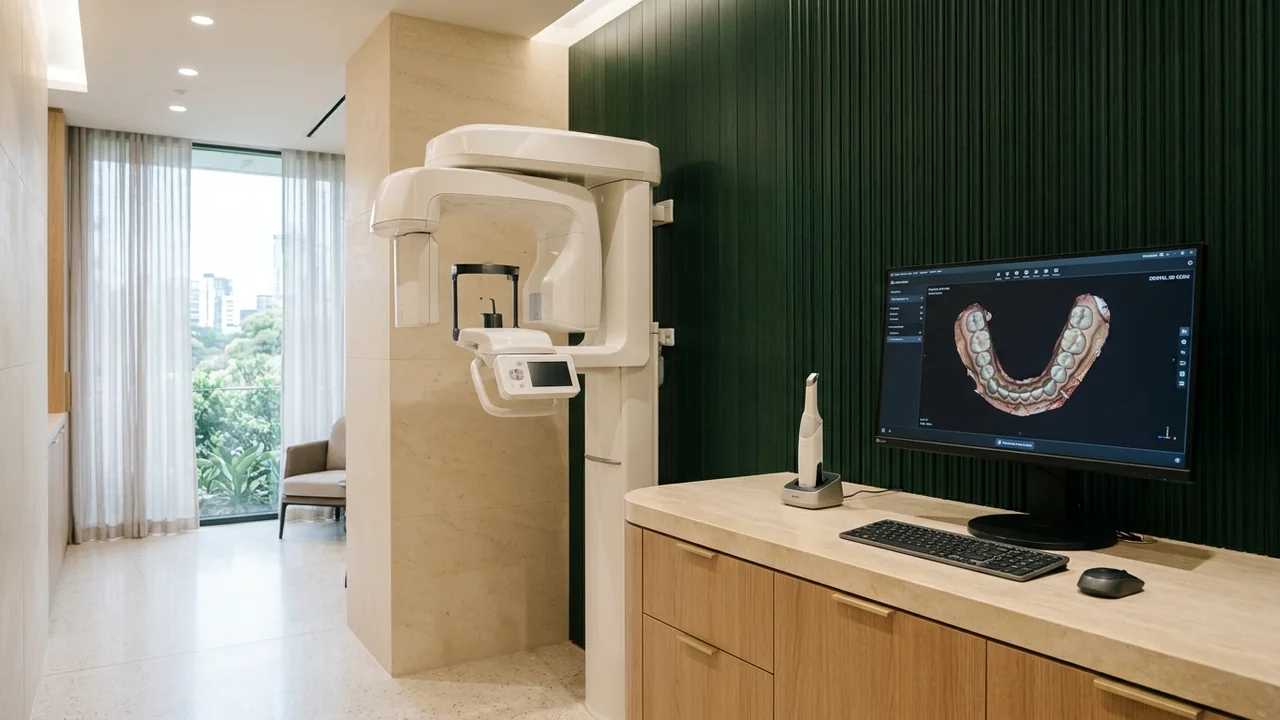
| Day 1 | Examination, 3D scan (our digital workflow), shade mapping and mock-up | $0 with treatment; no enamel touched |
| Day 2 | Mock-up-guided 0.3–0.5 mm preparation under magnification, scan and provisionals | First 50% · local anesthesia ($0) or optional IV sedation ($350–$650) |
| Days 3–4 | Ceramist pressing and hand-finishing of IPS e.max veneers | Free days in Ho Chi Minh City |
| Day 5 | Daylight try-in, isolated adhesive bonding and bite calibration | Final 50% after your approval |
| Days 6–7 | Review, bite polish, optional nightguard ($50–$220), warranty handover | Clearance to fly |
Planning flights, hotel nights and a sensible buffer? Our scheduling guide, How Many Days Do You Really Need in Vietnam?, sets out realistic timelines for veneers, crowns and implants, including when to keep a spare day for adjustments before flying home.
6. 2026 Costs: Vietnam, Package Clinics and Home, Plus the Cost of Rescue
Transparent, per-tooth pricing removes the pressure to over-treat. Instead of a fixed 20- or 28-unit package, we quote only for teeth that need treatment. For most patients that means six to ten upper veneers, often paired with whitening of the lower teeth.
| Treatment Scope (2026) | Kind Dental Vietnam (HCMC) | Crown Package Abroad | Australia / USA / UK (indicative) |
|---|---|---|---|
| Per IPS e.max Veneer | $320 – $420 USD | Rarely genuine minimal-prep e.max | About $1,200 – $2,500+ USD |
| 6 Upper Veneers | $1,920 – $2,520 USD | Often upsold to 20+ crowns | About $7,200 – $15,000+ USD |
| 8 Upper Veneers | $2,560 – $3,360 USD | Often upsold to 20+ crowns | About $9,600 – $20,000+ USD |
| 10 Upper Veneers | $3,200 – $4,200 USD | Rarely priced tooth by tooth | About $12,000 – $25,000+ USD |
| Selective 3D Zirconia Crown | $260 – $350 USD per tooth | Often placed on healthy teeth | About $1,300 – $2,200 USD |
| Long-Term Upkeep | Enamel preserved AirFlow clean & exam ($45–$65); nightguard ($50–$220) |
Higher Root canals and remakes more likely |
Similar upkeep; highest upfront cost |
Itemized fees appear on our Porcelain Veneers & Crowns Cost in Vietnam page. Pre-trip OPG or CBCT review with a written estimate is always $0; the in-clinic consultation, 3D scan and plan are $0 with treatment. Regional comparisons are in Vietnam vs. Thailand vs. Bali vs. Turkey.
The Hidden Cost of Rescuing Over-Prepared Teeth at Home
Package prices look far less attractive when a nerve flares up years later in Sydney, London or Los Angeles. Root canal treatment through a crown, a new core and a replacement crown can together cost several thousand dollars per tooth there, before time off work.
When a tapered tooth fractures at the gumline, or decay spreads beneath a margin, the root may be lost and implants become the realistic option. They perform well, but long-term reviews (Pjetursson et al., 2012; PMID 23062125; Pjetursson et al., 2021; PMID 34642991) document genuine complications and lifelong maintenance.
Design choices matter at that stage too. A review of posterior implant bridges (Pjetursson et al., 2023; PMID 37750526) found that ceramic type and prosthetic design both influence chipping. Our article Why Ultra-Cheap Dental Work Abroad Fails covers the warning signs we see most.
Some patients ask about metal-free implants. A meta-analysis of zirconia implants (Mohseni et al., 2023; PMID 38135804) reported encouraging outcomes on a shorter evidence base than titanium. Either way, an implant is a far bigger undertaking than protecting the healthy tooth in the first place.
7. Clinical Honesty: When Veneers Are Not the Right Answer
Ethical cosmetic dentistry includes saying when fewer ceramics, or none, will serve you better. Even minimal-prep veneers are an irreversible commitment: once enamel is refined, that tooth needs a restoration for life, and each veneer will eventually need replacing.
Situations Where We Advise Caution or an Alternative
- Crowded or rotated teeth: Veneering crooked teeth into line means cutting deep. Pre-aligning with Invisalign clear aligners keeps later veneers thin, or makes them unnecessary.
- Good shape, poor color: Professional whitening and a Swiss EMS AirFlow clean and digital exam ($45–$65 USD) brighten the smile without removing enamel.
- Heavily restored teeth: Large fillings, cracks or root canals leave too little enamel to bond. A 3D multilayer zirconia crown ($260–$350) is the honest choice there, beside veneers ($320–$420) on intact neighbors; see Minimal-Prep Veneers vs. Full Crowns.
- Severe grinding or edge-to-edge bites: Thin ceramic edges can chip or debond. Some patients need bite correction first, and every grinder needs a custom nightguard ($50–$220).
- Thin or eroded enamel: Reflux or acid erosion may leave too little enamel to bond within; we manage the cause first and may suggest composite bonding instead.
- Active gum disease or decay: These must be stabilized before any cosmetic work, which can mean postponing veneers to a later trip.
- Very young patients: Large nerve chambers and maturing gums mean we generally advise whitening or bonding until the smile has stabilized.
Veneers carry their own risks, even when beautifully made: temporary sensitivity, occasional debonding or chipping, and gradual gum recession that can expose a margin over the years. We discuss each in writing before treatment, alongside our medical disclaimer.
Most appointments are comfortable with gentle local anesthesia, which is always $0. For significant dental anxiety, anesthesiologist-monitored IV sedation is available as an option at $350–$650 per session, after a careful review of your medical history.
8. Six Red Flags Before Booking Any Smile Makeover Abroad
Before transferring a deposit to any clinic, in Vietnam, Turkey, Thailand, Mexico or elsewhere, check the written proposal against six non-negotiables. A reputable clinician will welcome these questions; a high-volume sales operation usually will not, and that reaction is itself informative.
- Flat 20–28 unit quotes from a sales coordinator: Twenty crowns quoted from a selfie, without an X-ray or vitality testing, is a warning sign.
- No reversible mock-up: Approving a trial smile in daylight before preparation protects you; skipping it only saves the clinic time.
- “Veneers” that are really crowns: Insist on a tooth-by-tooth plan naming each restoration, with planned reduction in millimeters.
- 48-hour full-smile claims: Genuine e.max work, shade try-in and bite verification realistically take 4 to 7 days.
- Splinting healthy teeth together: Connected blocks prevent flossing and can hide decay until several roots are affected.
- Unverified credentials, sterilization or warranty: Use How to Verify a Dentist’s License in Vietnam, and confirm Class-B sterilization and a clear written warranty.

Request a Calm, No-Obligation Pre-Trip Assessment
Would you like an honest view of how many teeth genuinely need veneers, or whether whitening or aligners would serve you better? Send smiling photographs and a recent OPG X-ray through our online consultation desk, WhatsApp +84 853 020 003, or kinddentalvietnam@gmail.com.
Dr. Cuong reviews every case personally and returns a written, tooth-by-tooth plan with a transparent 2026 cost range, usually within 24 hours. The pre-trip review is always $0, with no sales pressure or agency markup. If veneers are not in your interest, we will tell you so.
9. Peer-Reviewed PubMed Evidence
The clinical statements in this guide draw on these systematic reviews and consensus reports indexed by the U.S. National Library of Medicine. Several examine crowns, bridges and implants rather than veneers; we cite them for the complication patterns they document, not as direct veneer comparisons.
- Hameed FF, et al. Clinical Outcomes of No-prep Veneers and Conventional Veneers: A Systematic Review. J Contemp Dent Pract. 2025. PMID 42607000
- Habibzadeh S, et al. Full-ceramic resin-bonded fixed dental prostheses: A systematic review. J Appl Biomater Funct Mater. 2024. PMID 38706266
- Mohseni P, et al. Clinical outcomes of zirconia implants: a systematic review and meta-analysis. Clin Oral Investig. 2023. PMID 38135804
- Pjetursson BE, et al. Influence of prosthetic material and design on implant-supported multi-unit FDPs in the posterior area. Clin Oral Implants Res. 2023. PMID 37750526
- Pjetursson BE, et al. Survival, failure and complication rates of veneered and monolithic all-ceramic implant-supported single crowns. Clin Oral Implants Res. 2021. PMID 34642991
- Pjetursson BE, et al. Survival and complication rates of zirconia-ceramic and metal-ceramic single crowns. Clin Oral Implants Res. 2018. PMID 30328190
- Sailer I, et al. Survival and complication rates of zirconia-ceramic and metal-ceramic multiple-unit fixed dental prostheses. Clin Oral Implants Res. 2018. PMID 30328185
- Morton D, et al. Group 2 ITI Consensus Report: Prosthodontics and implant dentistry. Clin Oral Implants Res. 2018. PMID 30328196
- Joda T, et al. The complete digital workflow in fixed prosthodontics: a systematic review. BMC Oral Health. 2017. PMID 28927393
- Sailer I, et al. All-ceramic or metal-ceramic tooth-supported FDPs? Part I: Single crowns. Dent Mater. 2015. PMID 25842099
- Pjetursson BE, et al. Survival and complication rates of implant-supported FDPs after a mean observation period of at least 5 years. Clin Oral Implants Res. 2012. PMID 23062125
10. Frequently Asked Questions: Natural Veneers in Vietnam vs. ‘Turkey Teeth’
Do porcelain veneers in Vietnam require shaving teeth into pegs?
No. Minimal-prep IPS e.max veneers at Kind Dental Vietnam refine about 0.3 to 0.5 mm of front enamel, guided through a mock-up you have already approved. Teeth are only reduced into pegs when a clinic places full crowns instead of veneers.
How can I confirm I am getting veneers rather than crowns?
Ask for a written tooth-by-tooth plan naming each restoration as a laminate veneer or full crown, with planned reduction in millimeters and the ceramic brand. Then insist on approving a reversible mock-up in your own mouth before any preparation.
Do I really need 20 veneers for a natural smile?
Rarely. Six to ten upper veneers, often with whitening of healthy lower teeth, usually gives a harmonious result. The back teeth stay natural, which keeps lifetime maintenance and cost far lower than a full-mouth package.
What do IPS e.max veneers cost in Vietnam in 2026?
At Kind Dental Vietnam, genuine IPS e.max veneers are $320 to $420 USD per tooth: $2,560–$3,360 for eight, or $3,200–$4,200 for ten. Pre-trip review is always $0, the scan and plan are $0 with treatment, and payment is 50%/50%.
How many days in Ho Chi Minh City do veneers take?
Plan a single trip of 4 to 7 days: scan and mock-up approval on Day 1, minimal preparation on Day 2, two laboratory days, bonding on Day 5 and a bite review afterwards, ideally with a spare day before you fly.
Are veneers reversible?
Not in the usual sense. Minimal-prep veneers remove a thin layer of enamel, so that tooth needs a restoration for life. No-prep veneers can sometimes be removed with little change to the tooth, but suit only selected cases.
Can you repair poorly done ‘Turkey teeth’ crowns?
Often, after a 3D CBCT assessment. We test each tooth for vitality and hidden decay, provide root canal treatment where needed ($50–$220), replace splinted blocks with individual zirconia crowns ($260–$350), and plan implants only for roots that cannot be saved.
How long do enamel-bonded IPS e.max veneers last?
Bonded to intact enamel with a balanced bite, they commonly last 10 to 15 years or more, though no restoration lasts indefinitely. Daily flossing, regular hygiene visits, avoiding ice and hard shells, and a nightguard for grinders all extend their life.
Want Honest Clinical Advice on Your X-Ray or Quote?
Send your panoramic OPG scan or an existing treatment estimate via WhatsApp. Dr. Cuong will provide a clear, conservative comparison with zero agency markup.