
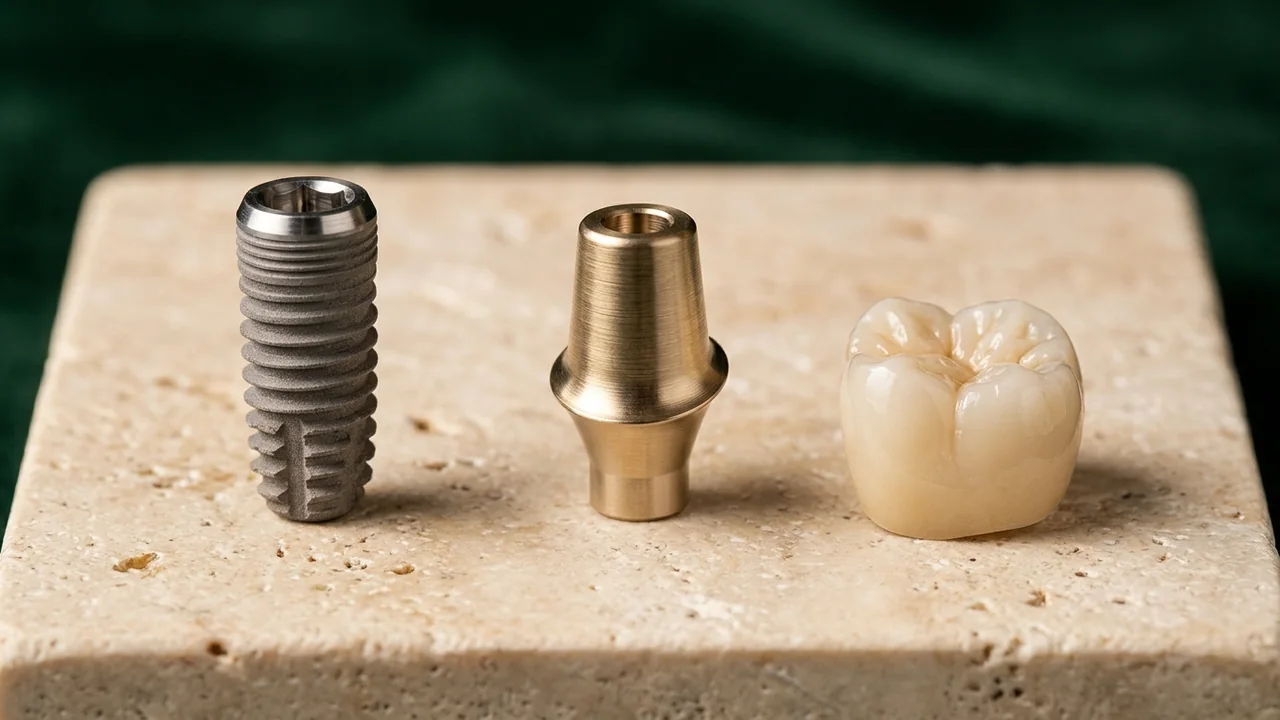
When international patients compare dental implant quotes in Vietnam, they nearly always ask about the implant brand (Straumann, Nobel Biocare, or Osstem) and the crown ceramic (multilayer zirconia). Yet there is a third engineering decision—rarely discussed on commercial clinic websites—that has a dramatic impact on whether your implant remains healthy and serviceable five, ten, or twenty years after you fly home: how the crown actually connects to the implant abutment.
In modern implant prosthodontics, there are two attachment methods: screw-retained implant crowns (secured directly through a precision internal screw channel sealed invisibly with tooth-colored composite) and cement-retained implant crowns (glued onto an abutment post inside your mouth using dental luting cement). For patients living thousands of miles from their surgical clinic, this distinction is anything but academic. At Kind Dental Vietnam in District 1, Ho Chi Minh City, Dr. Nguyen Van Cuong, DDS prioritizes screw-retained titanium-base zirconia crowns wherever anatomy permits—and here is the clinical evidence explaining why.
The Biology of Peri-Implant Gum Tissue: Why Cement Carries Hidden Risk
Patients often assume dental cement is harmless because natural-tooth crowns have been cemented successfully for over a century. However, gum tissue around a dental implant behaves very differently from gum tissue around a natural tooth root:
- Natural Teeth Have Protective Sharpey’s Fibers: Collagen fibers insert perpendicularly directly into natural root cementum, creating a tight biological seal that resists liquid cement from flowing deep down the root.
- Dental Implants Have Delicate Parallel Tissue Attachment: Soft tissue hugs an implant abutment through weaker circular fibers and hemidesmosomes—offering far less hydraulic resistance when a crown filled with wet cement is pressed down onto an abutment beneath the gumline.
Clinical studies published in leading periodontology journals (including landmark research by Wilson and Linkevicius) have demonstrated that when crown margins sit even 2 to 3 millimeters below the gumline, invisible microscopic remnants of excess cement frequently escape detection—even on dental X-rays (many resin cements are radiolucent). Over months to years, that rough hardened cement behaves like buried tartar beneath the gums, harboring anaerobic bacteria that trigger chronic inflammation, bleeding on probing, and progressive cement-induced peri-implantitis (bone loss around the implant).
With a screw-retained Ti-base zirconia crown, any bonding between the zirconia crown and the titanium base occurs outside your mouth on a clean laboratory master model under magnification. Every speck of excess adhesive is polished away to mirror smoothness before the one-piece restoration ever enters your mouth. Zero wet cement ever touches your living peri-implant gums.
Why Retrievability Matters Twice as Much When You Live Overseas
Imagine living in Melbourne, Brisbane, London, or Seattle six years after receiving your implant in Ho Chi Minh City. Because implants absorb tens of thousands of chewing cycles per year, occasional minor prosthetic maintenance is completely normal over a multi-decade lifespan—for example, a prosthetic retention screw slightly loosening, a tiny edge of layered porcelain chipping from biting an olive pit, or adjacent teeth shifting slightly so food starts catching between contacts.
Watch how differently those two designs behave in your local dentist’s chair back home:
- With a Screw-Retained Crown: You show your local dentist your Kind Dental Vietnam Implant Passport. They drill gently through the tiny tooth-colored composite plug on the biting surface, insert the exact manufacturer screwdriver (e.g., Straumann SCS or Nobel Unigrip), unscrew and lift off the intact crown in under 10 minutes, re-torque a fresh screw or polish the contact outside the mouth, and screw the exact same crown right back in. Zero destruction, minimal chair fee, full implant inspection.
- With a Cemented Crown: Because permanent cement bonds the crown blindly onto the abutment, your local dentist cannot easily locate the screw underneath if it loosens—and frequently must drill and slice the entire zirconia crown in half just to remove it, forcing you to pay $1,800–$2,500 USD locally for a brand-new abutment and crown.
Head-to-Head Prosthodontic Comparison: Screw-Retained vs. Cement-Retained
| Clinical Evaluation Factor | Screw-Retained (Ti-Base Zirconia) | Cement-Retained Implant Crown |
|---|---|---|
| Subgingival Cement Peri-Implantitis Risk | Virtually eliminated (bonded extraorally in lab) | Elevated whenever margin sits >1mm below gums |
| Ease of Maintenance Back Home | Simple non-destructive unscrewing in 10–15 mins | Difficult; often requires cutting & destroying crown |
| Minimum Vertical Bite Space Needed | Works reliably even in tight 4–5mm back-tooth spaces | Requires taller abutment walls (5–6mm+) to stay glued |
| Surgical Planning Precision Required | High — requires prosthetically driven 3D CBCT angulation | More forgiving of imprecise freehand implant angles |
| Aesthetic Access Hole Management | Invisible on back biting surface / back of front teeth (sealed with opaque composite) | No access hole (advantage only if implant tilted forward) |
| Kind Dental Vietnam Protocol | Default standard for 90%+ of single & All-on-4 restorations | Reserved only for rare anatomical exceptions with supragingival margins |
Why Some Overseas Clinics Still Default to Cemented Crowns
If screw-retained implant restorations are biologically cleaner and far easier for international travelers to maintain back home, why do many clinics abroad still deliver cemented implant crowns as their routine default? Two reasons:
- Freehand Surgical Angulation Forgiveness: Screw-retained crowns require the surgeon to plan implant trajectory backwards from the final crown using 3D CBCT software so the screw channel emerges cleanly through the center of a molar or the hidden tongue-side (palatal) surface of an upper front tooth. When an implant is placed hastily freehand without 3D prosthetic planning, it often tilts outward—forcing the restorative dentist to hide the angle with an angled stock abutment and cement.
- Lower Laboratory Component Cost: Using an inexpensive stock titanium post and standard cemented crown saves laboratory CAD/CAM design time and original Ti-base/Angulated Screw Channel hardware costs.
When Cement-Retained—or Angulated Screw Channel (ASC)—Solutions Apply
Good clinical dentistry avoids rigid dogma. In the upper aesthetic front jaw (central and lateral incisors), thin facial bone occasionally slopes steeply forward so that a straight screw trajectory would exit directly through the visible front face of the tooth—compromising aesthetics.
Modern digital implantology offers two refined clinical solutions for these anterior cases:
- Angulated Screw Channel (ASC) Technology (First Choice): Precision systems offered by leading brands (Straumann Variobase AS, Nobel Biocare ASC, and Osstem Angled Multi/Ti-bases) incorporate specialized ball-hex omnigrip screwdrivers that safely redirect the screw channel up to 25 degrees toward the hidden back of the front tooth. This gives you both pristine uninterrupted front enamel aesthetics and full screw-retained retrievability with zero intraoral cement.
- Custom Equigingival Cementation (Strict Exception Protocol): In rare severe ridge angulations exceeding 25 degrees where bone grafting was declined or anatomically limited, Dr. Cuong designs a custom milled zirconia/titanium abutment whose margin sits right at or slightly above the gumline—using minimal radiopaque retrieval-friendly cement on a vented crown, inspected meticulously under magnification and confirmed clear on post-delivery radiograph.
Global Maintenance & Emergency Readiness Comparison
Here is how choosing screw-retained design protects your convenience once you return home to Australia, North America, Europe, or Singapore.
| Real-World Event 3–10 Years Later | Screw-Retained Crown Response Back Home | Cemented Crown Response Back Home |
|---|---|---|
| Crown feels slightly loose when chewing | Local dentist opens tiny composite plug, inspects & re-torques screw in one short visit. | Crown wobbles on loose internal screw yet remains stuck on abutment; often must be drilled off. |
| Minor porcelain chip on edge | Crown unscrewed cleanly, sent to lab for repair or polished, and re-inserted intact. | Must be polished in-mouth or destroyed and remade completely. |
| Gum tenderness or food impaction | Unscrewed in minutes to inspect peri-implant tissue & widen contact point smoothly. | Impossible to inspect abutment collar without destructive crown removal. |
| Full-Arch All-on-4 Annual Deep Hygiene | Prosthesis can be unscrewed periodically for ultrasonic deep cleaning if indicated. | Never recommended as cemented for full-arch bridges due to severe hygiene risks. |
Documentation You Take Home for Global Care
Retrievability works smoothly when your local dentist knows the exact driver specification underneath the composite plug. Every implant patient leaves Kind Dental Vietnam in District 1, Ho Chi Minh City with an official Implant Prosthetic Passport detailing: (1) implant brand, dimensions, and factory LOT sticker; (2) exact Ti-base/multi-unit abutment code; (3) exact driver geometry (Straumann SCS, Nobel Omnigrip, or Osstem 1.2 Hex) and Ncm torque value; and (4) digital pre- and post-delivery radiographs alongside your written clinical warranty. To discuss a prosthetically driven 3D plan directly with Dr. Cuong, request a pre-trip review or message WhatsApp +84 853 020 003.
Frequently Asked Questions
Will I see or feel the screw hole on my screw-retained implant crown?
No. After torqueing the prosthetic screw to manufacturer specs (25–35 Ncm), the tiny 2mm channel is cushioned with sterile PTFE tape and sealed seamlessly with shade-matched composite resin. On molars it disappears inside the central groove; on front teeth it exits discreetly on the hidden tongue-side surface.
Are screw-retained zirconia crowns weaker because of the central screw channel?
Modern monolithic multilayer zirconia delivers 800–1,200 MPa flexural strength. When CAD/CAM milled with proper wall thickness around a genuine titanium base and balanced bite contacts, screw-retained zirconia crowns provide exceptional long-term fracture resistance without the veneer chipping seen on older metal-ceramic crowns.
Do screw-retained crowns loosen more often than cemented implant crowns?
Both designs rely on an internal abutment screw inside the implant. When an internal screw loosens under a screw-retained crown, your dentist re-torques it intact in ten minutes; under a cemented crown, the crown stays glued onto the wobbly post and often must be cut off. Genuine hardware and proper torqueing keep screw loosening below 2–3% over five years.
Does a screw-retained Ti-base zirconia crown cost extra at Kind Dental Vietnam?
No surprise add-ons apply. Our published all-in USD fees ($750–$950 Osstem/Dentium, $1,200–$1,450 Nobel Biocare, $1,250–$1,550 Straumann) already include the custom Ti-base abutment and screw-retained multilayer zirconia crown—except rare Angulated Screw Channel (ASC) hardware for steep anterior angles, always quoted transparently upfront.
Can a screw-retained implant crown still develop peri-implantitis without good home hygiene?
Yes. Removing subgingival cement eliminates a major clinical trigger, yet daily biofilm removal remains vital. Clean around implants daily with a water flosser, plastic-coated interdental brushes, and superfloss alongside 6-monthly professional maintenance visits back home.
Are All-on-4 full-arch bridges always screw-retained at Kind Dental Vietnam?
Yes—all of our All-on-4 and All-on-6 provisional and permanent full-arch bridges are strictly screw-retained onto precision multi-unit abutments. Cementing a 12-tooth arch risks trapped subgingival cement and prevents non-destructive professional maintenance.
Want Honest Clinical Advice on Your X-Ray or Quote?
Send your panoramic OPG scan or an existing treatment estimate via WhatsApp. Dr. Cuong will provide a clear, conservative comparison with zero agency markup.