
Surgeon’s Executive Summary (2026 Quick Verdict):
- Biological Winner for Virgin Neighboring Teeth: A single dental implant ($750–$1,550 USD all-inclusive in Ho Chi Minh City) replaces the missing root independently, preserves jawbone height, and leaves healthy adjacent teeth completely untouched.
- When a 3-Unit Zirconia Bridge Makes True Clinical Sense: A 3-unit dental bridge ($780–$1,050 USD total, finished in one single 5-day trip) can be the smarter conservative choice if both neighboring teeth already have large failing fillings or old crowns—or when medical contraindications rule out implant surgery.
- The 15-Year Cost Paradox: Upfront, a bridge in Vietnam costs roughly the same as an Osstem implant ($780–$1,050 vs. $750–$950) and saves a second flight. Over 15 years, however, replacing a worn bridge or treating decay on a shaved abutment tooth often makes the bridge significantly more expensive.
2. Jawbone Resorption Science
3. Side-by-Side Clinical Matrix
4. When a Bridge Wins Honestly
5. 2026 Vietnam & 15-Year Cost Math
6. 1-Trip vs. 2-Trip Logistics
7. Screw-Retained Crowns & Brands
8. Honest Risks & Daily Flossing
9. PubMed Clinical Evidence
10. Patient FAQs
Losing a single molar, premolar, or front tooth creates a classic crossroads for international travelers planning dental care in Vietnam. On one side stands a single dental implant—widely regarded as modern dentistry’s closest mimic of a natural root, yet typically requiring two short visits to Ho Chi Minh City.
On the other side sits a 3-unit tooth-supported dental bridge—completed smoothly in just five to six days during a single holiday, without oral surgery or a bone-healing wait.
At Kind Dental Vietnam in District 1, Ho Chi Minh City (Private Appointment Only), Dr. Nguyen Van Cuong, DDS (Vietnam Ministry of Health License 0003265/BL-CCHN, Member of ICOI & VOSA) counsels travelers from Australia, the USA, the UK, and Singapore on this exact choice every week. The honest clinical answer depends far less on initial sticker price than on three anatomical realities: the health of the two neighboring teeth, your jawbone volume on a 3D CBCT scan, and your 15-year maintenance horizon.
This surgeon-authored guide breaks down the biomechanics, bone biology, transparent 2026 fees for dental implants and zirconia crowns & bridges, and peer-reviewed PubMed survival studies so you can make a calm, conservative decision before booking flights.
1. The Biological Trade-Off: Protecting Untouched Neighboring Teeth
To understand why prosthodontists weigh single implants and bridges so carefully, look closely at what happens to the two teeth bordering your empty gap. A traditional fixed dental bridge works exactly like a highway overpass: the floating replacement tooth in the middle (called a pontic) has no root underneath, so it relies entirely on two support pillars at each end.
Those support pillars are your two healthy neighboring teeth. To fit a strong ceramic retainer crown over each abutment tooth, a dentist must irreversibly remove roughly 1.0 to 1.5 mm of outer enamel around all 360 degrees of both neighboring teeth.
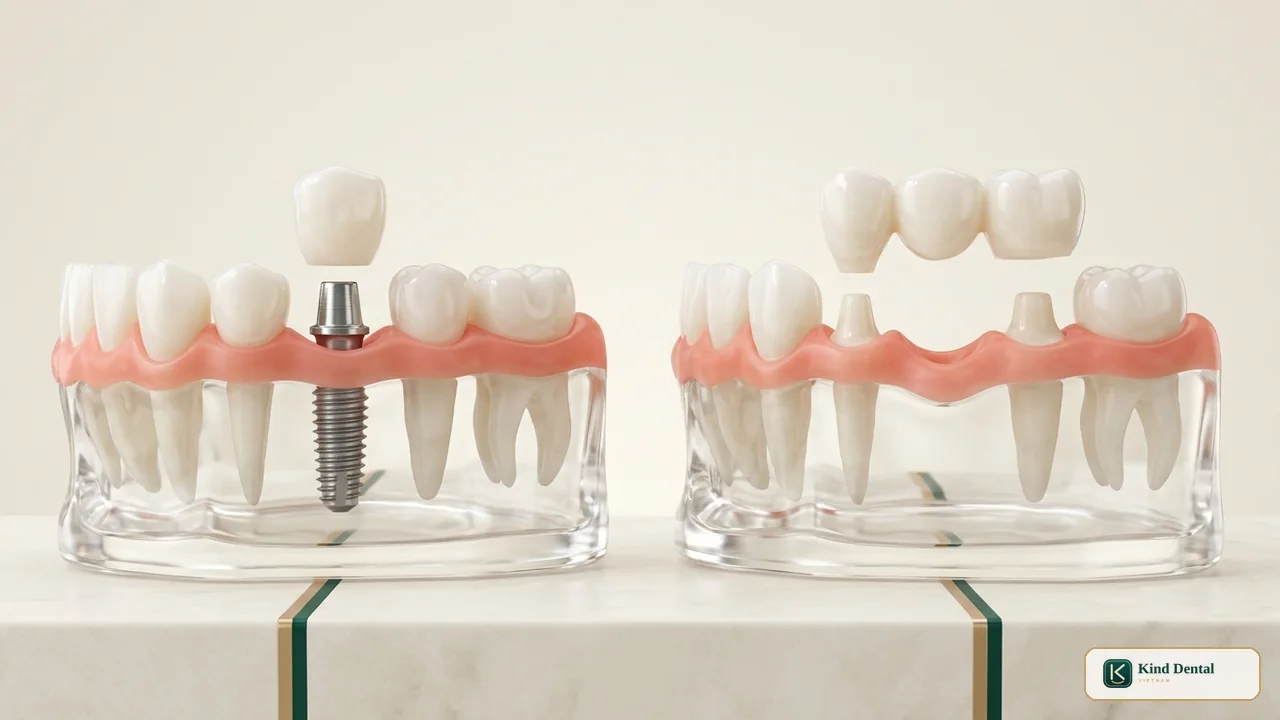
The Hidden Risk of Drilling Virgin Abutment Teeth
When both neighboring teeth are untouched, cavity-free natural teeth, turning a one-tooth problem into a three-tooth restoration introduces lifelong biological exposure. Landmark systematic reviews published in Clinical Oral Implants Research and the Journal of Oral Rehabilitation (Pjetursson et al., 2007; PMID 17594374; Pjetursson & Lang, 2008; PMID 18181936) document two major late biological complications in tooth-supported bridges:
- Loss of Abutment Nerve Vitality (~10% over 10 years): Deep circumferential tooth reduction occasionally inflames the internal dental pulp, requiring root canal therapy through the bridge crown years later.
- Secondary Decay at Bridge Margins: Because three connected teeth cannot be flossed vertically from above, microscopic plaque accumulates at the gumline edges of the supporting crowns—causing hidden recurrent decay that can jeopardize the entire three-tooth span.
By contrast, a standalone single dental implant anchors directly inside the jawbone gap. Both neighboring teeth keep 100% of their natural enamel, natural nerve vitality, and independent vertical flossing spaces.
Dr. Cuong’s Conservative Rule: Never sacrifice two completely healthy, virgin natural teeth solely to avoid a second short flight to Vietnam. Once natural enamel is ground away for a 3-unit bridge, those two anchor teeth will require full-coverage crowns for the rest of your life.
2. Jawbone Preservation: What Happens Beneath the Gumline Over 10 Years
Natural tooth roots do far more than hold crowns upright—they transmit micro-mechanical chewing vibrations into the surrounding alveolar bone every time you bite. Under Wolff’s Law of bone remodeling, that gentle mechanical signal tells your body to keep mineralizing and maintaining ridge width and height.
Once a tooth is extracted, that internal stimulation stops overnight. Clinical ridge-preservation reviews in Periodontology 2000 (Siawasch et al., 2025; PMID 39345008) and 2026 collagen/PRF evaluations (Gil-Morales et al., 2026; PMID 42051674) confirm that unstimulated extraction sockets lose substantial horizontal width and vertical height within the first 6 to 12 months—and continue resorbing gradually over years.
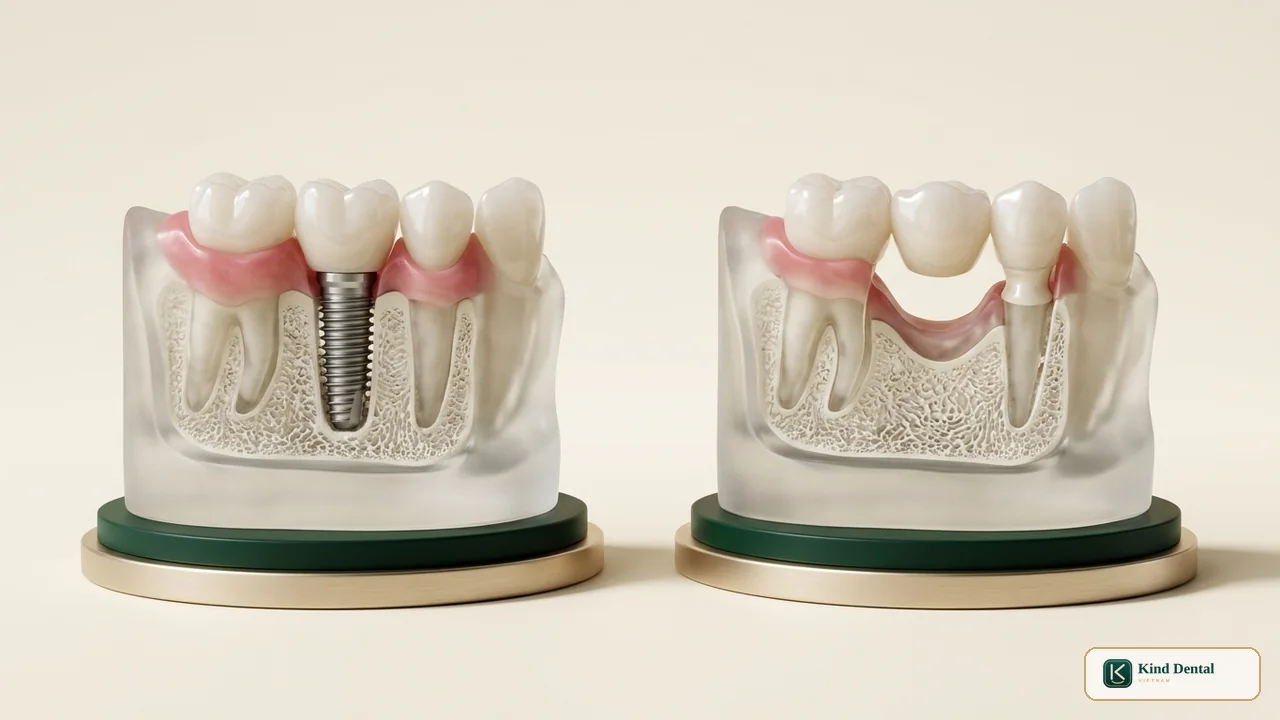
Why Ridge Shrinkage Matters Under a Bridge
A dental bridge hides the missing tooth visually on Day 1, yet it sits passively on top of the gums without stimulating the bone underneath. Five to eight years later, two practical issues often appear:
- Visible Dark Shadow & Food Trapping: As bone and gum recede beneath the middle pontic tooth, a noticeable open space develops under the bridge—trapping fibrous food and altering front-tooth aesthetics or speech airflow.
- Harder Future Implant Conversion: If the bridge eventually fails at year 12 and you decide to switch to an implant later, severe ridge thinning often requires additional bone grafting or sinus elevation that could have been avoided originally.
When Dr. Cuong extracts a hopeless root at Kind Dental Vietnam, we frequently pair atraumatic ultrasonic Piezotome removal with autologous PRF (Platelet-Rich Fibrin) or socket preservation—keeping the bony housing healthy and thick for an enduring single implant.
3. Complete Side-by-Side Clinical Comparison Matrix
Review every structural, biological, logistical, and financial difference side by side before choosing your pathway:
| Decision Factor | Single Dental Implant + Zirconia Crown | 3-Unit Monolithic Zirconia Dental Bridge |
|---|---|---|
| Impact on Neighboring Teeth | Zero drilling; adjacent natural teeth stay 100% intact | Both neighboring teeth must be reduced 360° into crown abutments |
| Jawbone Preservation | Stimulates bone via osseointegration; preserves ridge contour | No root stimulation; bone gradually shrinks beneath middle pontic |
| 10-Year Clinical Survival | ~95%–97% fixture survival (Jung et al.; Rabel et al.) | ~88%–91% prosthesis survival (higher abutment decay/nerve risk) |
| Trips Required to Vietnam | 2 trips (Trip 1: 4–7 days · Trip 2: 5–7 days, 3–5 months later) | 1 single trip (5–6 working days total, no surgical wait) |
| Oral Surgery Needed? | Yes — gentle minor guided placement under local anesthesia | No surgery (suitable when surgery is medically contraindicated) |
| Daily Cleaning & Flossing | Floss normally between every tooth like natural dentition | Requires floss threaders, super-floss, or water-flosser under pontic |
| 2026 Kind Dental Vietnam Fee | $750 – $1,550 USD all-in (Osstem / Nobel / Straumann) |
$780 – $1,050 USD total (3 units × $260–$350 Zirconia) |
| Comparable Australia / US Fee | $3,500 – $6,000 USD (A$5,200 – A$8,500) |
$4,200 – $5,700 USD (A$5,400 – A$7,500) |
4. Honest Surgeon’s Perspective: 4 Cases Where a Dental Bridge Is Actually Better
Ethical dentistry never sells one solution to every patient. Although single dental implants win biologically in roughly 75% of single-tooth gaps, Dr. Cuong openly recommends a 3-unit CAD/CAM monolithic zirconia bridge in four specific clinical scenarios:
- Both Neighboring Teeth Already Need Crowns: If the teeth on both sides of the gap already have massive old amalgam fillings, root canals, cracks, or failing crowns that need replacement anyway, linking them with a 3-unit zirconia bridge solves three problems simultaneously without surgery.
- Systemic Medical Contraindications to Implant Surgery: Patients taking high-dose intravenous bisphosphonates, undergoing active head-and-neck radiotherapy, or managing uncontrolled HbA1c diabetes face elevated surgical healing risks (read our Systemic Health & Dental Implants Guide). A non-surgical zirconia bridge restores chewing safely.
- Severe Bone Loss Where the Patient Declines Grafting: If long-standing bone loss sits dangerously close to the maxillary sinus or lower nerve canal and the patient strongly prefers avoiding bone grafting or prolonged healing, a conservative bridge avoids surgical complexity.
- Strict Single-Visit Travel Limitation for One Isolated Tooth: If you are visiting Vietnam once strictly for a single missing tooth—with strong, previously restored abutment teeth and no plan to return—a 5-day bridge avoids spending $2,400+ on a second international flight solely for one crown.
Modern systematic reviews in Materials (Saravi et al., 2021; PMID 34065202) and Journal of Dentistry (Teichmann et al., 2017; PMID 27984088) confirm that well-designed CAD/CAM all-ceramic bridges achieve reliable 10-year performance when abutment teeth are structurally robust and bite loads are properly calibrated.
5. 2026 Vietnam Pricing & The 15-Year Lifecycle Cost Reality
Comparing Day 1 prices alone can mislead dental travelers. Look closely at both upfront fees in District 1 (matching our Dental Implants Cost Breakdown and Crowns Cost Schedule) and projected 15-year total ownership costs:
| Financial Horizon | Single Implant — Osstem TS III | Single Implant — Straumann BLT | 3-Unit Monolithic Zirconia Bridge |
|---|---|---|---|
| Day 1 Clinical Package (Vietnam) | $750 – $950 USD | $1,250 – $1,550 USD | $780 – $1,050 USD |
| Indicative AUD Equivalent* | A$1,155 – A$1,465 | A$1,925 – A$2,390 | A$1,200 – A$1,615 |
| Optional Localized Bone Graft (If Needed) | $180 – $300 USD | $180 – $300 USD | $0 (Not applicable) |
| Expected Clinical Service Life | Fixture: 20+ yrs / Crown: 12–15+ yrs | Fixture: 20+ yrs / Crown: 12–15+ yrs | Average 10–12 years before margin renewal |
| Likely 15-Year Replacement / Repair Exposure (Home Country) | Minimal (occasional screw check or single crown swap ~$1,200–$1,800) | Minimal (universal Swiss parts worldwide) | Full 3-unit bridge replacement ($4,200–$5,700) + possible abutment root canal ($1,200+) |
| 15-Year Total Value Verdict | Lowest Lifetime Cost | Premium Global Value | Lower Trip 1 travel cost; higher 15-yr renewal cost |
*Indicative AUD at ~1.54 AUD/USD. Every Kind Dental Vietnam single-implant fee strictly covers all three essential components—never fixture-only teaser ads.
The Flight-Amortization Rule for Dental Travelers
Because returning for Trip 2 adds flight and hotel expenses ($1,200–$1,600 per trip from Australia or the US West Coast), think strategically about travel math. If you only need one single tooth and are not planning a second holiday in Southeast Asia, factor in whether you can have your local prosthodontist place the final crown—or combine your Trip 1 implant with other restorative care such as porcelain veneers, old crown replacements, or a second implant.
Once you require two or more dental implants, your net savings after two holidays in Ho Chi Minh City jump cleanly to $6,900–$20,000+ USD compared to Australia, the USA, or the UK.
6. Travel Logistics: 1-Trip Bridge (5 Days) vs. 2-Trip Implant Protocol
Planning realistic chair-time protects biological healing and prevents rushed laboratory work. Review exact day-by-day timelines in District 1 (detailed further in How Many Days Do You Really Need in Vietnam?):
| Clinical Phase | 3-Unit Zirconia Bridge (1 Trip · 5–6 Days) | Single Dental Implant (2 Trips · 4–7 Days Each) |
|---|---|---|
| Day 1 | Exam, X-rays, digital shade match & conservative abutment prep + 3D scan + smooth temporary bridge | 3D CBCT scan, nerve/sinus virtual mapping & surgical guide verification |
| Day 2 | CAD/CAM master laboratory milling & multilayer glazing (free sightseeing day) | Gentle 45-minute guided implant placement under local anesthesia (~65% Trip 1 milestone) |
| Days 4–6 | Try-in, bite calibration, permanent cementation & final polish — fly home Day 6 | Suture inspection, healing check & fit-to-fly clearance (temporary flipper for front teeth) |
| Healing Interval | None — treatment finished completely in Trip 1 | 3–5 months biological osseointegration at home (6–8 weeks in selected Straumann SLActive sites) |
| Trip 2 (Days 1–6) | Not required | Wireless 3D scan, custom Ti-base abutment & screw-retained zirconia crown (~35% Trip 2 milestone) |
7. Engineering Longevity: Screw-Retained Ti-Base Crowns & Authentic Platforms
The longevity of a single dental implant depends heavily on prosthetic engineering—not just placing the titanium root straight. A 2024 four-year retrospective study in the Journal of Dentistry (Fiore et al., 2024; PMID 39321738) and a systematic meta-analysis in Clinical Oral Implants Research (Rabel et al., 2018; PMID 30306684) confirm excellent survival rates for all-ceramic monolithic zirconia single implant crowns mounted onto prefabricated titanium-base abutments.
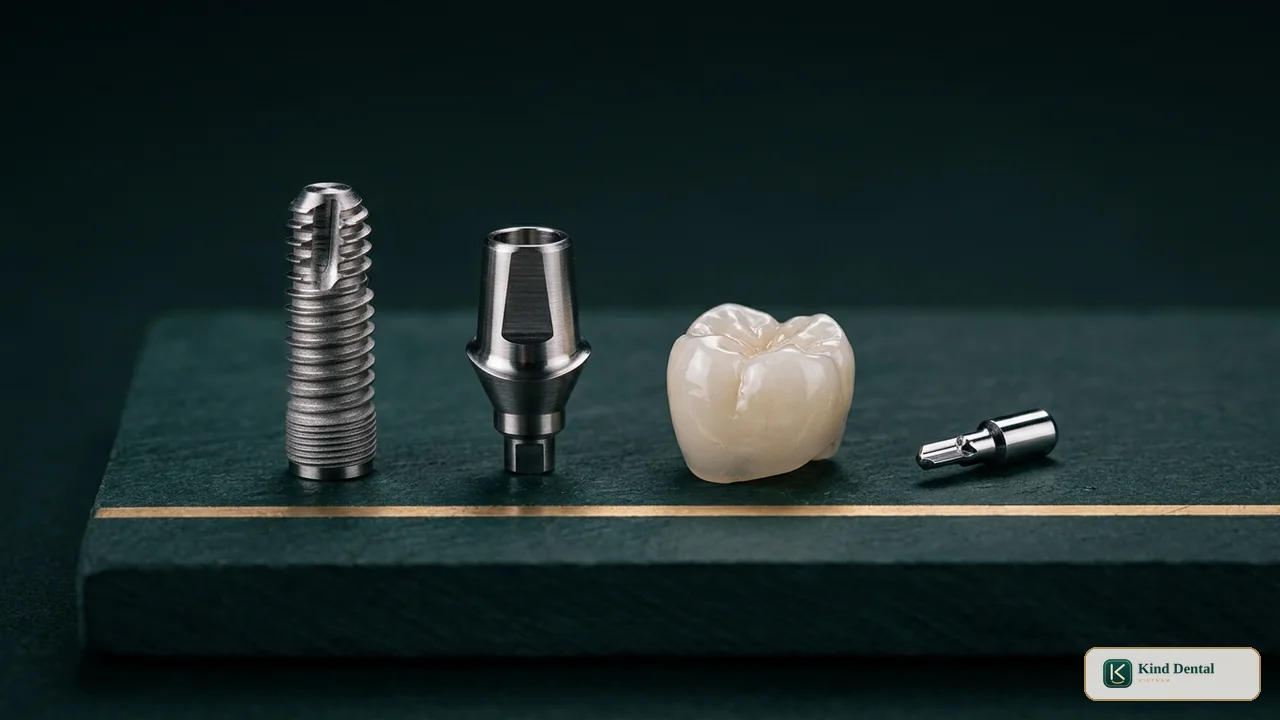
Why Kind Dental Vietnam Prioritizes Screw-Retained Single Crowns
- Zero Residual Cement Risk: Traditional cemented implant crowns can push invisible excess cement beneath the gum collar, triggering chronic peri-implant bone loss years later (see our Screw-Retained vs. Cemented Implant Guide).
- Effortless Worldwide Serviceability: If a prosthetic screw ever loosens gently after 8 years back in Sydney, Los Angeles, or London, any dentist can access and retorque it cleanly in 10 minutes without drilling off your crown.
- Factory-Sealed Traceability: Dr. Cuong opens unopened Straumann, Nobel Biocare, or Osstem sterile boxes in front of you and records every batch sticker inside your permanent Implant Authenticity Passport (compare platforms in Straumann vs. Nobel vs. Osstem).
8. Honest Clinical Risks, Daily Hygiene & Post-Trip Maintenance
Every restorative option carries defined biological and technical trade-offs documented across 5-to-10-year meta-analyses (Jung et al., 2012; PMID 23062124). Transparent pre-trip planning keeps surprises off the table:
- Single Implant Risks: Early non-integration (~2%–3%, higher in heavy smokers or uncontrolled diabetes), minor screw loosening, or late peri-implant mucositis if plaque accumulates around the gum collar. Prevention: 3D CBCT guided placement, strict European Class-B sterilization, calibrated torque wrenches, and routine twice-daily flossing.
- 3-Unit Dental Bridge Risks: Post-preparation tooth sensitivity, abutment nerve inflammation requiring root canal treatment, ceramic veneer chipping if fragile layered porcelain is used on back molars, or hidden decay beneath crown edges. Prevention: Conservative enamel preservation, high-strength monolithic 3D zirconia, daily super-floss/water-flossing beneath the pontic, and a custom nightguard for clenchers.

Before booking with any dental clinic abroad, always verify your surgeon’s official license independently through the Ho Chi Minh City Department of Health Practitioner Registry (step-by-step instructions in How to Verify a Dentist’s License in Vietnam), and compare direct-surgeon pricing against broker markups in Booking Direct vs. Dental Agencies.
9. Peer-Reviewed PubMed Clinical Evidence
All survival figures, ridge-preservation findings, and complication benchmarks in this guide are grounded in peer-reviewed prosthodontic literature indexed by the U.S. National Library of Medicine:
- Gil-Morales J, Galletti C, Flores-Fraile J, et al. Evaluation of alveolar ridge preservation using collagen and platelet-rich fibrin: A systematic review. Journal of Clinical and Experimental Dentistry. 2026 Feb. PubMed PMID: 42051674
- Siawasch SAM, Yu J, Castro AB, et al. Autologous platelet concentrates in alveolar ridge preservation: A systematic review with meta-analyses. Periodontology 2000. 2025 Feb. PubMed PMID: 39345008
- Fiore AD, Stellini E, Monaco C, et al. Clinical outcome of monolithic zirconia on bonded or mechanically retained prefabricated titanium-base: A 4-year retrospective study. Journal of Dentistry. 2024 Nov. PubMed PMID: 39321738
- Saravi B, Vollmer A, Hartmann M, et al. Clinical Performance of CAD/CAM All-Ceramic Tooth-Supported Fixed Dental Prostheses: A Systematic Review and Meta-Analysis. Materials. 2021 May. PubMed PMID: 34065202
- Rabel K, Spies BC, Pieralli S, et al. The clinical performance of all-ceramic implant-supported single crowns: A systematic review and meta-analysis. Clinical Oral Implants Research. 2018 Oct. PubMed PMID: 30306684
- Teichmann M, Göckler F, Weber V, et al. Ten-year survival and complication rates of lithium-disilicate tooth-supported crowns, implant-supported crowns, and fixed dental prostheses. Journal of Dentistry. 2017 Jan. PubMed PMID: 27984088
- Jung RE, Zembic A, Pjetursson BE, et al. Systematic review of the survival rate and complications of single crowns on implants. Clinical Oral Implants Research. 2012 Oct. PubMed PMID: 23062124
- Pjetursson BE, Brägger U, Lang NP, et al. Comparison of survival and complication rates of tooth-supported fixed dental prostheses (FDPs) and implant-supported single crowns. Clinical Oral Implants Research. 2007 Jun. PubMed PMID: 17594374
10. Frequently Asked Questions: Single Implant vs. Dental Bridge in Vietnam
Is a single dental implant cheaper or more expensive than a 3-unit bridge in Vietnam?
In clinical fees alone at Kind Dental Vietnam, an all-inclusive Osstem single implant ($750–$950 USD) costs virtually the same as a 3-unit monolithic zirconia bridge ($780–$1,050 USD), while a Swiss Straumann single implant runs $1,250–$1,550 USD. A bridge only costs less upfront if you factor in saving a second flight strictly for one isolated tooth; over 15 years, a standalone implant usually delivers lower lifetime cost.
Why does Dr. Cuong advise against drilling healthy teeth for a dental bridge?
To fit a 3-unit bridge, both adjacent teeth must be permanently reduced around all sides by 1.0–1.5 mm. Clinical 10-year studies show roughly 10% of prepared vital abutment teeth eventually need root canal therapy, and connected bridge margins carry higher recurrent decay risk. A single implant leaves virgin neighboring teeth completely untouched.
Can I get a single dental implant placed in Vietnam and have the final crown placed back home?
Yes. Because Kind Dental Vietnam exclusively places globally standardized Straumann, Nobel Biocare, and Osstem systems with complete factory serial stickers and torque documentation, any qualified prosthodontist in Australia, the USA, the UK, or Canada can restore your healed implant. However, returning for Trip 2 typically saves $1,200–$1,800 per crown under one unified clinic warranty.
How long can I safely wait between losing a tooth and getting a single implant?
Alveolar bone narrows fastest during the first 6 to 12 months after extraction, while neighboring teeth slowly tilt into the gap. Placing an implant within 3 to 6 months of extraction—or preserving the socket with collagen/PRF at extraction—maximizes natural bone volume and minimizes the chance of needing bone grafting later.
Will I have to travel home with a visible gap if my missing tooth is in the front smile zone?
Never. For front aesthetic implants during the 3-to-4-month osseointegration period, Dr. Cuong provides either a smooth, discreet aesthetic flipper/Essix provisional retainer ($80–$180) or—when primary torque and bite clearance are ideal—an immediate non-loading temporary crown so you smile naturally throughout healing.
Which lasts longer clinically: a single dental implant or a porcelain dental bridge?
Long-term systematic reviews report roughly 95%–97% 10-year implant survival compared to ~88%–91% 10-year survival for conventional tooth-supported bridges. While a porcelain crown on an implant can be unscrewed and refreshed independently after 12–15+ years, the titanium root beneath routinely functions for 20 years to a lifetime with good hygiene.
Is a single dental implant painful to place in Ho Chi Minh City?
Placing a single guided implant is surprisingly gentle—most patients tell Dr. Cuong it feels calmer and causes less soreness than a routine tooth extraction. Performed under pain-conscious local anesthesia in 30–45 minutes, minor gum tenderness settles within 2 to 3 days using standard over-the-counter anti-inflammatories.
How can I find out if I have enough bone for a single implant before flying to Vietnam?
Visit any local dental imaging center in your home city for a panoramic OPG X-ray or 3D CBCT scan and send the digital file via WhatsApp (+84 853 020 003) or our online consultation desk. Dr. Cuong personally evaluates your bone height, nerve clearance, and neighboring tooth health within 24 hours with zero obligation.
Want Honest Clinical Advice on Your X-Ray or Quote?
Send your panoramic OPG scan or an existing treatment estimate via WhatsApp. Dr. Cuong will provide a clear, conservative comparison with zero agency markup.