

Surgeon’s Summary (2026 Quick Verdict): For most international patients who cannot easily fly back for repairs, a well-designed monolithic zirconia bridge is the more durable long-term choice. A titanium-acrylic hybrid remains the wiser option in a few specific situations, which we set out honestly below.
- Durability: A monolithic multilayer zirconia All-on-4 bridge resists tooth debonding, wear and staining far better than acrylic resin.
- When acrylic is wiser: A titanium-bar acrylic hybrid still suits severe bone loss, fragile opposing natural teeth, or a staged budget.
- The 10-year cost reality: Complete two-trip All-on-4 packages at Kind Dental Vietnam run $5,800–$9,800 USD per arch (see the full fee schedule). A single home-country acrylic re-teething can erase the upfront saving.
2. 10-Year Wear & Fractures
3. Clinical Matrix
4. When Acrylic Wins
5. Passive Fit & Ti-Bases
6. 10-Year Cost Math
7. Two-Trip Workflow
8. Daily Hygiene & Guard
9. PubMed Evidence
10. FAQs
Most patients planning full-arch treatment abroad spend weeks comparing implant brands. That research matters. Yet once four implants have integrated with your jawbone, the component you actually live with, the one you chew with, smile through and clean every evening, is the definitive bridge above the gums.
Whether that bridge is monolithic zirconia or a titanium-acrylic hybrid shapes far more than its delivery-day appearance. It decides how quickly the teeth wear, how they cope with coffee and curry, and whether a repair bill awaits you in Sydney, Los Angeles or London.
At Kind Dental Vietnam in District 1, Ho Chi Minh City, Dr. Nguyen Van Cuong, DDS (Ministry of Health License 0003265/BL-CCHN; ICOI, VOSA) reviews international All-on-4 quotes weekly. Many low prices quietly assume an acrylic final bridge; this guide sets out the evidence and our 2026 Vietnam costs plainly.
1. Bridge Architecture: What Sits Inside Each All-on-4 Prosthesis?
On delivery day, a monolithic zirconia bridge and a titanium-acrylic hybrid can look remarkably alike. After years of chewing, however, they behave like two different classes of material, because structurally that is exactly what they are.
A titanium-acrylic hybrid begins with a CAD/CAM-milled Grade 5 titanium bar that serves as an internal spine. A technician then processes heat-cured pink polymethyl methacrylate (PMMA) around the bar and sets roughly twelve prefabricated acrylic denture teeth into that pink base, one tooth at a time.
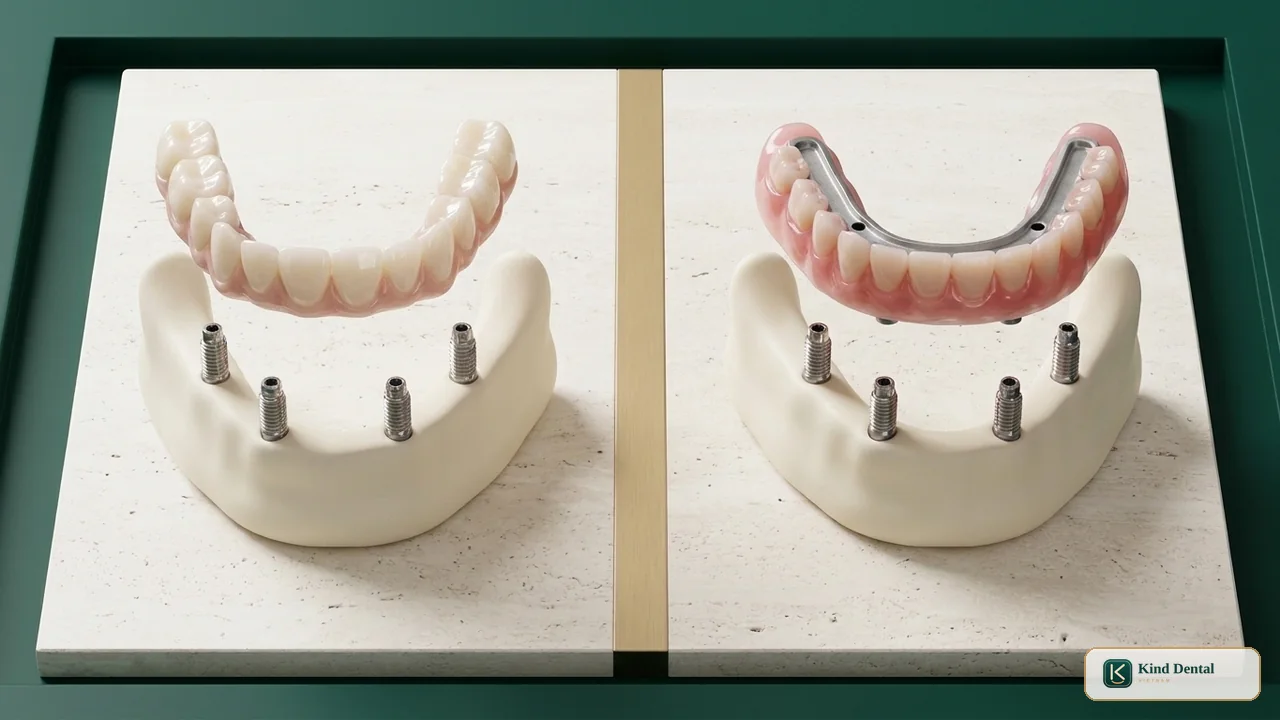
A monolithic multilayer zirconia bridge takes the opposite route. A 5-axis mill shapes the teeth and gum contour from a single disc of yttria-stabilized zirconia, which is then sintered at high temperature, characterized with subtle stains and glazed. Titanium bases are bonded into every screw channel before delivery.
Do Not Confuse Your Trip 1 Provisional With a Final Hybrid
Patients sometimes hear the word “acrylic” during surgical planning and assume they are being offered a lower-tier final bridge. In fact, our immediate-load same-day teeth protocol deliberately uses a lightweight milled PMMA provisional during the four-to-six-month healing period after surgery.
That provisional absorbs gentle early forces while the surgical gums shrink and mature, and it lets you test tooth shape and speech in everyday life. The zirconia-versus-acrylic decision applies only to the definitive bridge delivered on Trip 2, which is engineered for long-term service.
Dr. Cuong’s engineering rule: A titanium-acrylic hybrid depends on bonded junctions between metal, pink resin and individual denture teeth, and each junction is a potential point of failure. Monolithic zirconia removes most of those junctions by forming the entire visible arch from one piece of ceramic.
2. 10-Year Wear, Tooth Debonding & Fracture Rates (PubMed Review)
Judging full-arch materials fairly means separating two outcomes that are often blurred together: implant survival in the bone, and complication-free survival of the prosthesis above it. Four implants can remain perfectly stable for many years while the acrylic teeth they carry chip, wear and need repeated attention.
The long-term literature indexed by the U.S. National Library of Medicine points in a fairly consistent direction. Over five years or more, resin-based hybrids generally need more maintenance than well-designed monolithic zirconia, although zirconia carries its own, different failure modes:
- Head-to-head review (2026): Marinkovic et al., 2026; PMID 42434215 pooled complications of metal-zirconia versus metal-acrylic complete-arch prostheses, the most direct comparison available for this decision.
- 2,039-prosthesis cohort: Bidra et al., 2018; PMID 28689903 reported high survival and a low structural fracture rate across one of the largest zirconia full-arch datasets published.
- Up to eight years: Papaspyridakos et al., 2026; PMID 42750068 reported favorable outcomes across 140 zirconia full-arch jaws in private practice.
- Five to thirteen years: Luo et al., 2025; PMID 39655784 followed monolithic zirconia-based cross-arch frameworks over one of the longest periods available.
- Material and design: Pjetursson et al., 2023; PMID 37750526 confirmed that prosthetic material and design both shape technical complication rates.
Three Predictable Failure Patterns in Acrylic Hybrids
Acrylic denture teeth have a flexural strength of roughly 80–120 MPa. Zirconia used for full-arch bridges ranges from around 600 MPa for the most translucent grades to well over 1,000 MPa for stronger grades. In practice, three maintenance issues tend to surface between years three and seven:
- Tooth debonding: Repeated sideways chewing forces fatigue the bond between individual denture teeth and the pink base, so a tooth can loosen or detach during a crunchy meal such as sourdough crust or roasted nuts.
- Bite flattening: Acrylic cusps gradually wear flat, reducing chewing efficiency and altering facial height. Eventually the laboratory must strip the old resin from the titanium bar and re-tooth the entire arch.
- Porosity and staining: Microscopic pores in acrylic absorb coffee, tea, red wine and spices and harbor bacterial biofilm, which dulls the surface over time and can contribute to odor compared with glazed zirconia.
Where Monolithic Zirconia Can Still Fail
No responsible prosthodontist describes any ceramic as indestructible. The reviews and cohorts by Wong et al., 2019; PMID 29665177, Pieralli et al., 2018; PMID 30306694, Tischler et al., 2018; PMID 29559219 and Tang et al., 2023; PMID 37099585 show complications are common enough to plan for.
For zirconia, the usual culprits are insufficient restorative space (generally under about 10–12 mm), long cantilevers behind the tilted back implants, thin connectors, layered porcelain over chewing cusps, and grinding without a nightguard. Each is assessed on your scans before we recommend ceramic.
One honest caveat: a chipped acrylic tooth can be repaired by almost any dental laboratory in your home city, often within a day. A fractured zirconia arch cannot be patched chairside; it must be re-milled from the saved design file, which may mean a remake visit.
3. Side-by-Side Prosthodontic Matrix: Zirconia vs. Titanium-Acrylic
Laying the structural, acoustic, hygiene and cost variables side by side clarifies which design suits your jaw. We also include metal-bar reinforced zirconia, a hybrid approach described for demanding cross-arch spans (Bidra, 2020; PMID 32237248):
| Clinical Factor | Monolithic Multilayer Zirconia (Ti-Bases) | Metal-Bar Reinforced Zirconia | Titanium-Acrylic Hybrid (Ti Bar + PMMA) |
|---|---|---|---|
| Core Build | Solid CAD/CAM zirconia on titanium-base collars | Titanium or cobalt-chromium bar under monolithic zirconia | Titanium bar wrapped in pink acrylic and denture teeth |
| Strength & Chipping | ~600–1,200 MPa by grade; no individual teeth to debond | Highest rigidity for long spans and heavy clenchers | Rigid bar, but acrylic teeth (~80–120 MPa) chip and debond more readily |
| Restorative Space Needed | Least; roughly 10–12 mm minimum | More than monolithic (bar plus ceramic) | Most; often around 15 mm for bar, resin and teeth |
| 10-Year Wear | Minimal; bite height largely maintained | Minimal; low routine repair rate | Noticeable flattening; re-teething often due at 5–7 years |
| Stain & Odor | Non-porous glaze resists stains and biofilm | Non-porous ceramic tissue surface stays clean | Porous resin gradually absorbs stains and odors |
| Weight & Sound | Slightly heavier; faint tap if opposing another zirconia arch | Solid, weighted feel; firm chewing feedback | Lightweight; softer, quieter, cushioned bite |
| Repairability | Minor edges polished; major fracture re-milled from saved STL | Overlay sections serviceable in some designs | Chipped tooth repairable by most local labs |
| Typical 2026 KDV All-on-4 Package | $7,600 – $9,200 USD / arch (Complete 2-Trip Package) |
$8,600 – $9,800 USD / arch (Complete 2-Trip Package) |
$5,800 – $7,400 USD / arch (Complete 2-Trip Package) |
These bands are typical positions within our published 2026 schedule of $5,800–$9,800 USD per arch (provisional plus definitive). Your exact figure depends on implant brand, whether Osstem/Dentium, Nobel Biocare or Straumann BLT, and on final bridge design, and is confirmed in writing before you travel.
4. Honest Surgeon’s View: When Titanium-Acrylic Still Wins
Most overseas patients at Kind Dental Vietnam choose monolithic zirconia, largely to minimize repair visits once they are home. Even so, no single material suits every mouth, and recommending one by default would not be honest prosthodontics.
Before recommending ceramic, Dr. Cuong reviews your opposing teeth, bone loss, lip support, grinding habits and budget. In four defined situations, he will openly advise a titanium-acrylic hybrid instead and explain the trade-offs in writing:
- Heavy grinding against fragile natural teeth: Against thin, worn natural teeth, harder ceramic can accelerate enamel wear unless a nightguard is worn faithfully. Acrylic acts as a softer, sacrificial surface.
- Severe vertical bone loss needing bulky lip support: Long-term denture wearers sometimes need tall pink flanges to support a collapsed upper lip. Solid zirconia at that volume becomes heavy and bulky, whereas acrylic over titanium stays light.
- Sensitivity to dual-arch ceramic contact: A few patients with zirconia on both arches notice a crisp tap when the teeth meet. Pairing one zirconia arch with a resin-based opposing arch usually softens this.
- Prioritizing premium implants now, upgrading later: Never compromise on the implants anchored in your bone. Authentic fixtures with a titanium-acrylic bridge today allow a non-surgical upgrade to zirconia years later on the same abutments.
Who Should Pause, or Choose a Different Route Altogether
Material choice is secondary if the foundations are not right. Fixed full-arch treatment of any kind carries real risks, including implant failure, peri-implantitis, screw loosening, nerve irritation and, in the upper jaw, sinus complications. Some patients are better served by delaying treatment or choosing a simpler design:
- Medical risk factors: Uncontrolled diabetes, heavy smoking, intravenous bisphosphonates and prior head-and-neck radiotherapy raise failure risk (see our implant medication guide).
- Limited dexterity: If cleaning under a fixed bridge would be difficult, a removable snap-in overdenture ($2,600–$4,800 USD/arch) may protect your implants better.
- Inadequate bone or strong bite: A sinus lift or graft, or All-on-6 ($7,400–$11,200 USD/arch), may be safer than four implants.
5. Inside the Prosthodontic Lab: Passive Fit, Ti-Bases & Traceable Hardware
Even premium German or Japanese multilayer zirconia can fracture, or loosen its screws, if the bridge seats under tension across four implants. In full-arch prosthodontics, a verified passive fit protects the ceramic, the screws and the bone around each implant at the same time.
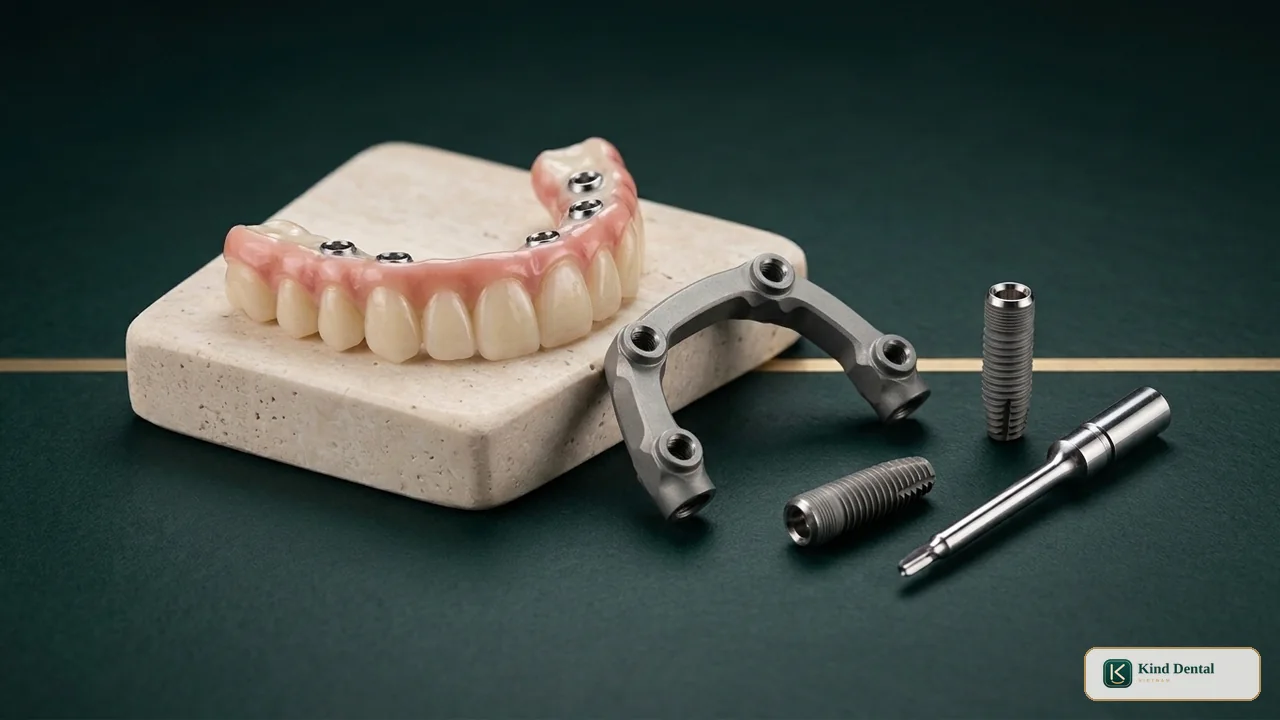
Every international patient deserves to know what happens behind the laboratory door. Three engineering safeguards, none of them optional in our practice, separate a decade-long zirconia bridge from the shortcuts sometimes taken in full-arch work abroad:
- Bonded titanium-base collars: Zirconia dislikes concentrated stress inside small screw seats, so machined titanium sleeves bonded into every channel provide a durable metal-to-metal connection.
- Physical passive-fit verification: Alongside optical scanning, Dr. Cuong confirms cross-arch accuracy with a rigid splinted verification jig and a 3D-printed try-in before final milling, minimizing strain transferred to your implants.
- Authentic hardware and a saved design file: We place only factory-sealed Osstem, Dentium, Nobel Biocare and Straumann systems (compare implant brands). You receive batch stickers in your International Implant Passport and a digital STL copy of your final bridge.
6. 2026 Vietnam Pricing & The 10-Year Total Cost Paradox
Dental tourism advertising sometimes hides a material downgrade, quoting a low All-on-4 fee built on an acrylic hybrid and charging considerably more for zirconia. Peer-reviewed health economics explains why the lower upfront figure is not always the cheaper path.
In a retrospective analysis of long-term outcomes and cost-effectiveness, Barootchi et al., 2020; PMID 32142577 compared zirconia-based and metal-acrylic full-arch prostheses, highlighting how maintenance and repairs, not the initial fee, drive true lifetime cost.
| 10-Year Financial Metric (Per Arch) | Titanium-Acrylic All-on-4 (Vietnam) | Monolithic Zirconia All-on-4 (Vietnam) | Zirconia All-on-4 (Australia / USA / UK) |
|---|---|---|---|
| 2026 Complete 2-Trip Package | $5,800 – $7,400 USD (Osstem / Nobel / Straumann) |
$7,600 – $9,800 USD (Osstem / Nobel / Straumann) |
$22,000 – $35,000 USD (approx. A$33,000 – A$53,000) |
| Pre-Trip OPG / CBCT Review & Written Estimate | $0 (Always Included) | $0 (Always Included) | $350 – $900 USD |
| Trip 1 Milled PMMA Provisional | Included | Included | Often billed separately |
| Estimated 10-Year Repairs & Maintenance | $3,000 – $6,500 USD (Chip repairs + re-teething at 5–7 yrs) |
$400 – $1,200 USD (Annual hygiene & screw checks) |
$600 – $1,800 USD (Annual hygiene & screw checks) |
| Projected 10-Year Clinical Total (excl. travel) | ~$8,800 – $13,900 USD | ~$8,000 – $11,000 USD | ~$22,950 – $37,700 USD |
Consider the repair trap. Choosing zirconia over titanium-acrylic in District 1 typically adds about $1,800–$2,400 USD. At home in Perth, Dallas or London, re-teething a worn acrylic arch commonly costs $3,500–$5,500 USD, plus days without fixed teeth.
In fairness, neither Vietnam column includes airfares and accommodation for two trips, which you should budget realistically. Nor do the figures allow for a zirconia remake after accidental trauma, uncommon but possible. Treat repair estimates as indicative ranges.
Transparent Optional Add-Ons & Milestone Billing (2026)
Your pre-trip OPG or CBCT review and written estimate cost $0; the in-clinic consultation, 3D scan and treatment plan are included with treatment. Optional additions are itemized upfront, with milestones of ~65% on Trip 1 and ~35% on Trip 2:
- Anesthesia and comfort: Gentle local anesthesia is always $0. Optional anesthesiologist-monitored IV sedation is $350–$650 USD per session.
- Optional surgical preparation and guard: Atraumatic extractions or a custom nightguard run $50–$220 USD; a localized particulate bone graft with collagen membrane is $180–$300 per site; an internal or lateral sinus lift is $350–$650 per side.
- Maintenance and paperwork: A Swiss EMS AirFlow cleaning and digital exam is $45–$65 USD on future visits, and itemized invoices support eligible claims (see our superannuation and insurance guide).
7. How We Engineer & Test Your Final Bridge Across Two Trips
Some high-volume clinics abroad promote a “one-trip permanent zirconia” bridge delivered within days of extractions. Dr. Cuong declines that shortcut on biological grounds: after extraction and implant surgery, the gums and underlying bone commonly remodel by one to three millimeters over the following months.
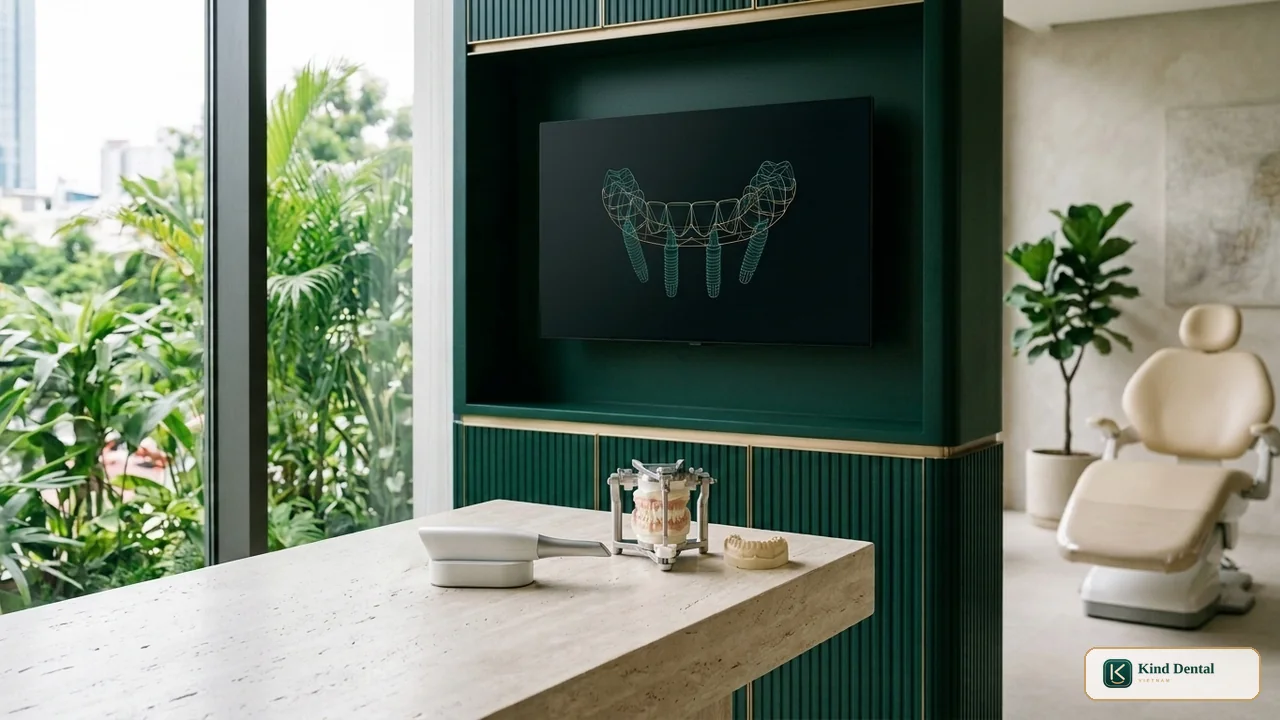
A permanent zirconia arch fitted to swollen early tissue is likely to leave a food-trapping gap once healing is complete. Our unhurried two-trip workflow, carried out in a Class B sterilized, fully digital suite, is designed to avoid that problem:
| Phase | Duration | Clinical & Prosthodontic Milestones |
|---|---|---|
| Pre-Trip Review | Before Booking | Send your OPG or CBCT ($0). Dr. Cuong assesses bone and restorative space and provides a written estimate. |
| Trip 1: Surgery & Provisional | 7–10 Days (~65% Milestone) |
Guided placement of four authentic implants, multi-unit abutments, a milled PMMA provisional where stability allows (typically ≥35 Ncm), and fit-to-fly review. |
| Healing & Smile Test Drive | 4–6 Months at Home | Implants integrate while gums settle; you evaluate speech, tooth shape and lip support daily. |
| Trip 2 (Days 1–4): Prototype | First Half of Visit | 3D scan, physical verification jig, digital bite record and printed try-in to check shade, midline and “F”, “V” and “S” sounds. |
| Trip 2 (Days 5–10): Final Arch | Second Half of Visit (~35% Milestone) |
Milling of your approved bridge, titanium-base bonding, calibrated torque, bite refinement and nightguard. |
Before booking return flights after Trip 1, review post-operative swelling timelines, cabin-pressure precautions after sinus procedures and recommended recovery days in our guide to flying home safely after dental implants or All-on-4 surgery, so both trips stay calm and unhurried.
8. Daily Hygiene, Nightguards & Living Well After Delivery
Both zirconia and titanium-acrylic bridges sit above living gum tissue that can become inflamed if plaque is left undisturbed. The glazed, convex underside of a well-designed zirconia bridge, however, is smoother and considerably easier to keep clean than acrylic that has aged and roughened.

Long-term health around your implants depends far more on gentle consistency than on complicated tools. Four simple habits, taking only minutes each day, protect your implants, abutment screws and definitive bridge over the coming decade:
- Water flosser, morning and night: Direct a warm, medium-pressure jet beneath the bridge and around each abutment.
- Super-floss and a soft brush: Thread implant floss under the bridge daily and brush with low-abrasion paste, avoiding gritty charcoal powders.
- Custom nightguard ($50–$220): A slim guard protects screws, ceramic connectors and the opposing arch from nocturnal clenching.
- Annual professional review: Keep yearly examinations at home, or pair a $45–$65 USD Swiss EMS AirFlow cleaning with a future Saigon visit.
Request Your Free Pre-Trip CBCT Evaluation
Send your OPG or CBCT through our online consultation desk, WhatsApp +84 853 020 003, or email kinddentalvietnam@gmail.com. Dr. Nguyen Van Cuong, DDS personally reviews your bone and restorative space, usually replying within 24 hours, at no cost and with no obligation.
9. Peer-Reviewed PubMed Clinical Evidence
The survival trends, wear patterns and cost comparisons in this guide draw on the peer-reviewed studies below. Published averages cannot predict any individual result, and this guide does not replace an examination (see our medical disclaimer):
- Papaspyridakos P, Bidra AS, Bedrossian A, et al. Zirconia full-arch implant-supported prostheses: An up to 8-year retrospective study with 140 jaws from private practice. Journal of Prosthodontics. 2026 Sep 16. PMID 42750068
- Marinkovic D, Gutiérrez R, Frey M, et al. Prosthetic and Biological Complications of Metal-Zirconia versus Metal-Acrylic Implant-Supported Screw-Retained Complete-Arch Prostheses: A Systematic Review and Meta-Analysis. Journal of Clinical and Experimental Dentistry. 2026 Apr. PMID 42434215
- Luo J, Zhang Y, Yu Z, et al. A retrospective single cohort study on the 5-13 year clinical outcomes of implant-supported cross-arch fixed dental prostheses with monolithic zirconia-based frameworks. Journal of Prosthodontics. 2025 Apr. PMID 39655784
- Pjetursson BE, Sailer I, Merino-Higuera E, et al. Systematic review evaluating the influence of the prosthetic material and prosthetic design on the clinical outcomes of implant-supported multi-unit fixed dental prosthesis in the posterior area. Clinical Oral Implants Research. 2023 Sep. PMID 37750526
- Tang Y, Yu H, Wang J, et al. Implant Survival and Complication Prevalence in Complete-Arch Implant-Supported Fixed Dental Prostheses: A Retrospective Study with a Mean Follow-up of 5 Years. International Journal of Oral & Maxillofacial Implants. 2023 Jan-Feb. PMID 37099585
- Bidra AS. Complete Arch Monolithic Zirconia Prosthesis Supported By Cobalt Chromium Metal Bar: A Clinical Report. Journal of Prosthodontics. 2020 Aug. PMID 32237248
- Barootchi S, Askar H, Ravidà A, et al. Long-term Clinical Outcomes and Cost-Effectiveness of Full-Arch Implant-Supported Zirconia-Based and Metal-Acrylic Fixed Dental Prostheses: A Retrospective Analysis. International Journal of Oral & Maxillofacial Implants. 2020 Mar/Apr. PMID 32142577
- Wong CKK, Narvekar U, Petridis H. Prosthodontic Complications of Metal-Ceramic and All-Ceramic, Complete-Arch Fixed Implant Prostheses with Minimum 5 Years Mean Follow-Up Period. A Systematic Review and Meta-Analysis. Journal of Prosthodontics. 2019 Feb. PMID 29665177
- Pieralli S, Kohal RJ, Rabel K, et al. Clinical outcomes of partial and full-arch all-ceramic implant-supported fixed dental prostheses. A systematic review and meta-analysis. Clinical Oral Implants Research. 2018 Oct. PMID 30306694
- Tischler M, Patch C, Bidra AS. Rehabilitation of edentulous jaws with zirconia complete-arch fixed implant-supported prostheses: An up to 4-year retrospective clinical study. Journal of Prosthetic Dentistry. 2018 Aug. PMID 29559219
- Bidra AS, Tischler M, Patch C. Survival of 2039 complete arch fixed implant-supported zirconia prostheses: A retrospective study. Journal of Prosthetic Dentistry. 2018 Feb. PMID 28689903
10. Frequently Asked Questions: Zirconia vs. Titanium-Acrylic All-on-4
How long do titanium-acrylic hybrid teeth last before needing replacement?
The milled titanium bar itself can serve for many years, but the acrylic teeth bonded to it commonly flatten, stain or chip within five to seven years. At that point the laboratory strips the old resin and re-teeths the arch, usually requiring several days without your fixed bridge.
How much more does monolithic zirconia cost than titanium-acrylic in Vietnam?
Complete two-trip All-on-4 packages at Kind Dental Vietnam span $5,800–$9,800 USD per arch: typically $5,800–$7,400 for titanium-acrylic and $7,600–$9,800 for monolithic or bar-reinforced zirconia, depending on implant brand. The difference is often less than one re-teething at home.
Can I start with a titanium-acrylic hybrid and upgrade to zirconia years later?
Yes. Both bridges attach to the same integrated implants and multi-unit abutments. When the acrylic wears, a qualified prosthodontist with your Implant Passport can scan the abutments and fabricate a zirconia bridge without further surgery, provided the implants and gums remain healthy.
Does monolithic zirconia look unnaturally bright white or fake?
Not when it is milled from multilayer zirconia discs and characterized by a skilled technician. Gradient ceramics reproduce warmer tones near the gums and gentle translucency at the biting edges, while subtle pink gingival staining resists coffee discoloration far better than acrylic resin does over time.
Do I still need a nightguard with a monolithic zirconia All-on-4 bridge?
In most cases, yes. Dr. Cuong recommends a slim custom nightguard ($50–$220 USD) for nearly all full-arch patients, especially clenchers and those with zirconia on both arches. Because implants lack natural ligament cushioning, the guard protects screws, ceramic connectors and your jaw joints.
Which bridge is easier to keep clean day to day?
Highly polished monolithic zirconia resists plaque and odor build-up better than porous acrylic resin. Either way, the daily routine is the same: a water flosser and soft brush under the bridge, plus a professional maintenance visit every six months, when the bridge may be removed for deep cleaning.
How many trips to Vietnam do I need for either bridge?
Both options usually follow the same two-trip plan. On the first visit you receive implants and a fixed provisional bridge within days. After roughly four to six months of healing, you return for scanning, try-in and delivery of your final zirconia or titanium-acrylic bridge.
Want Honest Clinical Advice on Your X-Ray or Quote?
Send your panoramic OPG scan or an existing treatment estimate via WhatsApp. Dr. Cuong will provide a clear, conservative comparison with zero agency markup.