
Surgeon’s Summary (2026 Clinical Verdict):
- What “same-day teeth” really means: Genuine immediate-load dental implants in Vietnam carry a fixed, screw-retained provisional bridge, or a non-biting front crown, within 24–72 hours. Definitive zirconia follows on Trip 2, after 3–6 months of healing.
- The green light is measured, not promised: Insertion torque of ≥35 Ncm, an ISQ of ≥65–70, and bite forces controlled by cross-arch splinting or by keeping the tooth out of contact.
- When waiting is wiser: Soft upper-jaw bone (Type D4), torque below 30 Ncm, extensive grafting, heavy grinding or compromised healing all favor implants resting quietly under healing caps.
2. Torque ≥35 Ncm & ISQ
3. Loading Matrix
4. Single vs. All-on-4
5. Risks & When to Wait
6. Implants & Surfaces
7. 3D Guided Workflow
8. 2026 Pricing
9. Travel & Soft Diet
10. PubMed Evidence
11. FAQs
If you have been researching immediate-load dental implants in Vietnam, you will have met the phrase “Teeth in a Day,” often offered before anyone has looked at a scan of your jaw. From Sydney, London or San Diego the appeal is obvious: one flight, one operation, a new smile.
Bone, however, keeps its own calendar. Whether you are weighing All-on-4 and All-on-6 full-arch implants or a single dental implant in Vietnam, fixing teeth to freshly placed titanium is a biomechanical decision made in the surgical chair, not an option chosen from a menu.
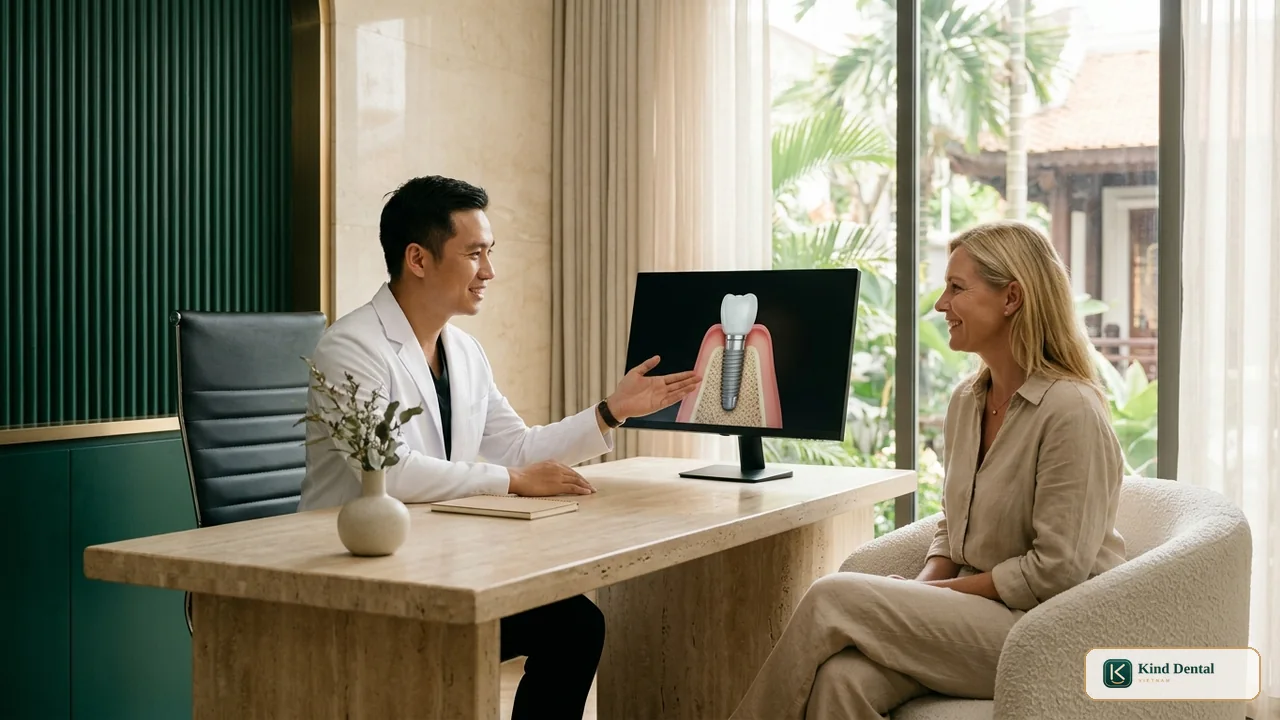
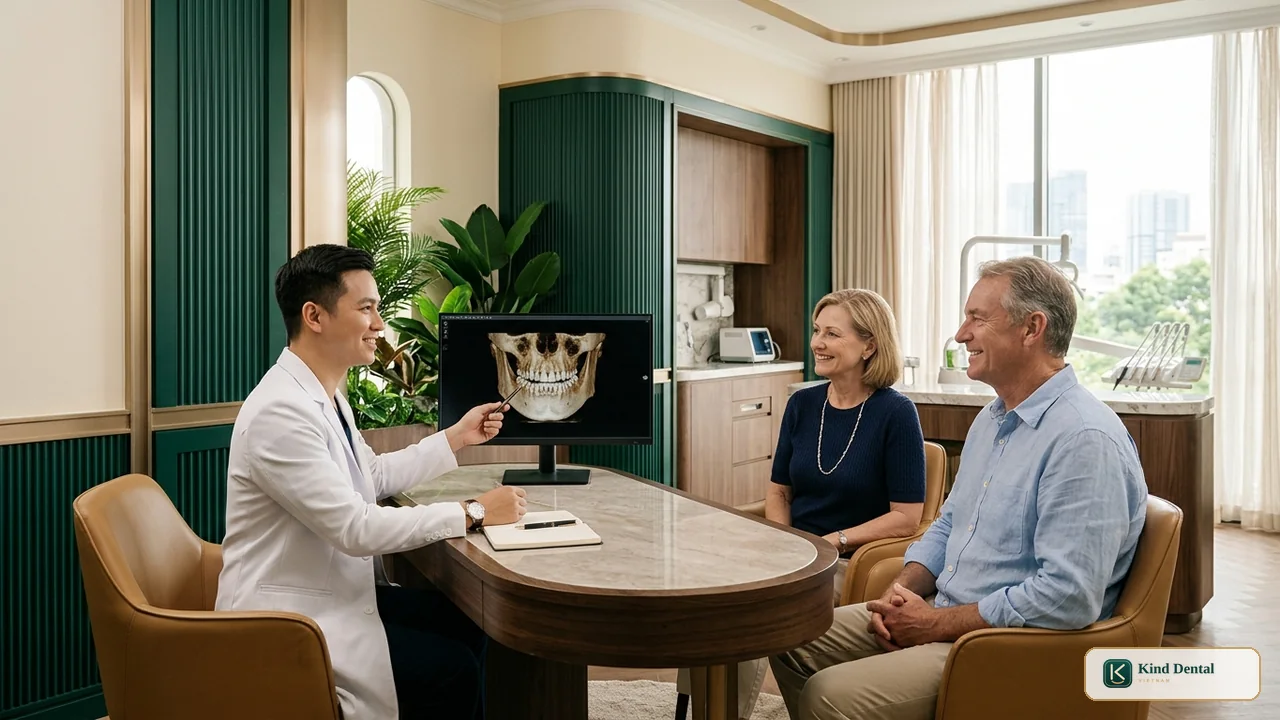
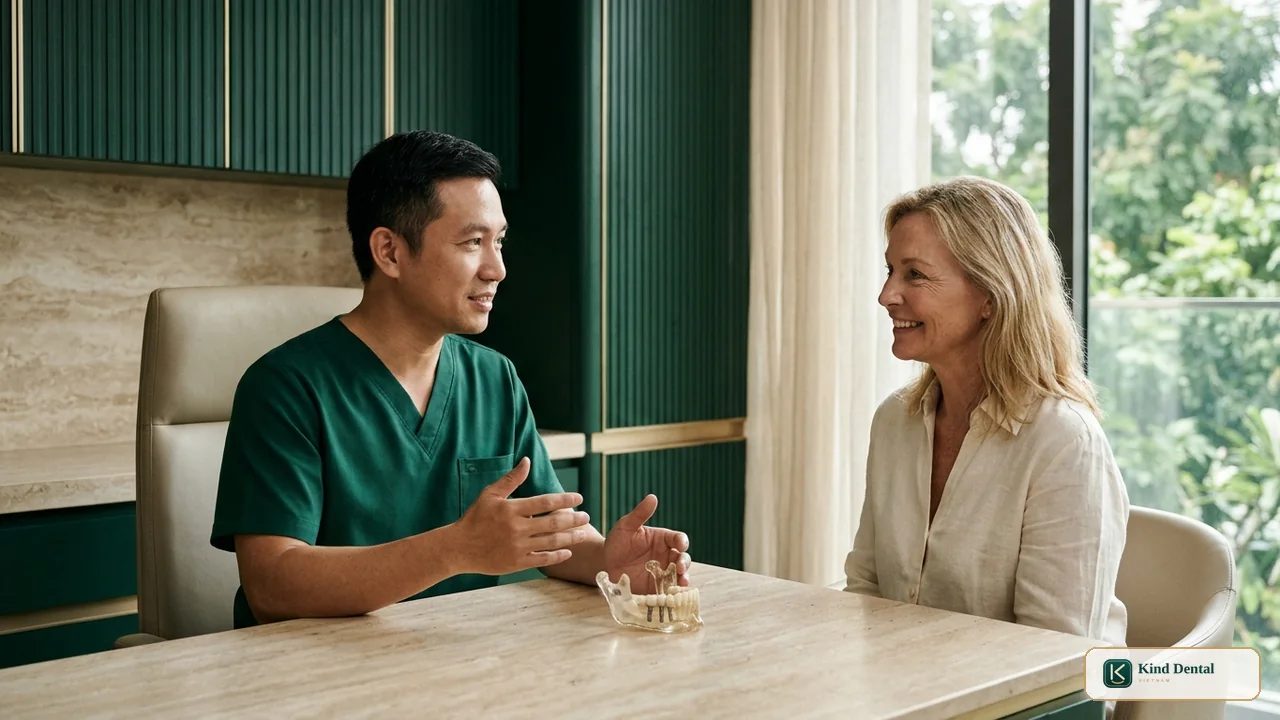
At Kind Dental Vietnam in District 1, Ho Chi Minh City (Private Appointment Only), Dr. Nguyen Van Cuong, DDS (Vietnam Ministry of Health Practice License 0003265/BL-CCHN; Member of ICOI & VOSA) applies measurable surgical thresholds before approving any same-day provisional prosthesis.
1. “Same-Day Teeth” Marketing vs. Osseointegration Biology
Before comparing treatment plans in Ho Chi Minh City, it helps to separate three distinct milestones that advertising tends to blur into one:
- Immediate placement: An implant is inserted into a fresh extraction socket. It may still heal submerged beneath the gum.
- Immediate loading (“same-day teeth”): A fixed provisional bridge or non-biting front crown is attached within 24–72 hours.
- Definitive prosthesis: Your final CAD/CAM monolithic zirconia bridge or crown, delivered after 3–6 months of bone fusion.
The Group 2 ITI Consensus Report in Clinical Oral Implants Research (Morton et al., 2018; PMID 30328196) gives these terms precise meaning: immediate loading takes place within one week of surgery, early loading between one week and two months, and conventional loading after two months.
Mechanical Grip on Day One, and the Stability Dip That Follows
On the day of surgery, an implant is held purely by mechanical friction, much like a well-cut screw seated in hardwood. No living bone has yet bonded to its surface. Between Weeks 2 and 6, that compressed bone remodels and grip briefly falls, a phase known as the stability dip.
If chewing forces move a healing fixture by more than roughly 100–150 micrometers, bone cells cannot bridge the gap. Fibrous scar tissue forms instead and the implant fails to integrate. Every rule that follows exists to keep movement safely below that threshold.
2. Objective Surgical Thresholds: Torque (≥35 Ncm) & ISQ Stability
Whether bone can carry teeth on the first day is never a matter of instinct. In the District 1 surgical suite, Dr. Cuong checks four objective criteria before any immediate provisional is attached.
1. Calibrated Insertion Torque (≥35 Ncm)
As each fixture seats, a calibrated surgical motor and torque wrench record rotational resistance in Newton-centimeters (Ncm). For splinted immediate loading, the working minimum is 35 Ncm per implant. Too much torque is also unwelcome.
Driving an implant beyond 55–60 Ncm in very dense lower-jaw bone can compress the blood supply at the crest of the ridge. Seating between roughly 35 and 50 Ncm offers the best balance of grip and biology.
2. Resonance Frequency Analysis (ISQ ≥65–70)
Torque measures tightness at the moment of placement. The Implant Stability Quotient (ISQ), read with a small magnetic sensor, measures lateral stiffness on a scale of 1 to 100. An ISQ of 65–70 or above, with adequate torque, indicates the implant can resist tongue, lip and light chewing pressure.
3. Jawbone Density (D1–D4) & Tilted Anchorage
Density varies across the mouth. The front of the lower jaw usually offers dense D1–D2 bone that grips threads firmly, while the upper back jaw beneath the sinus is often softer D3–D4 bone, closer in texture to balsa than to oak.
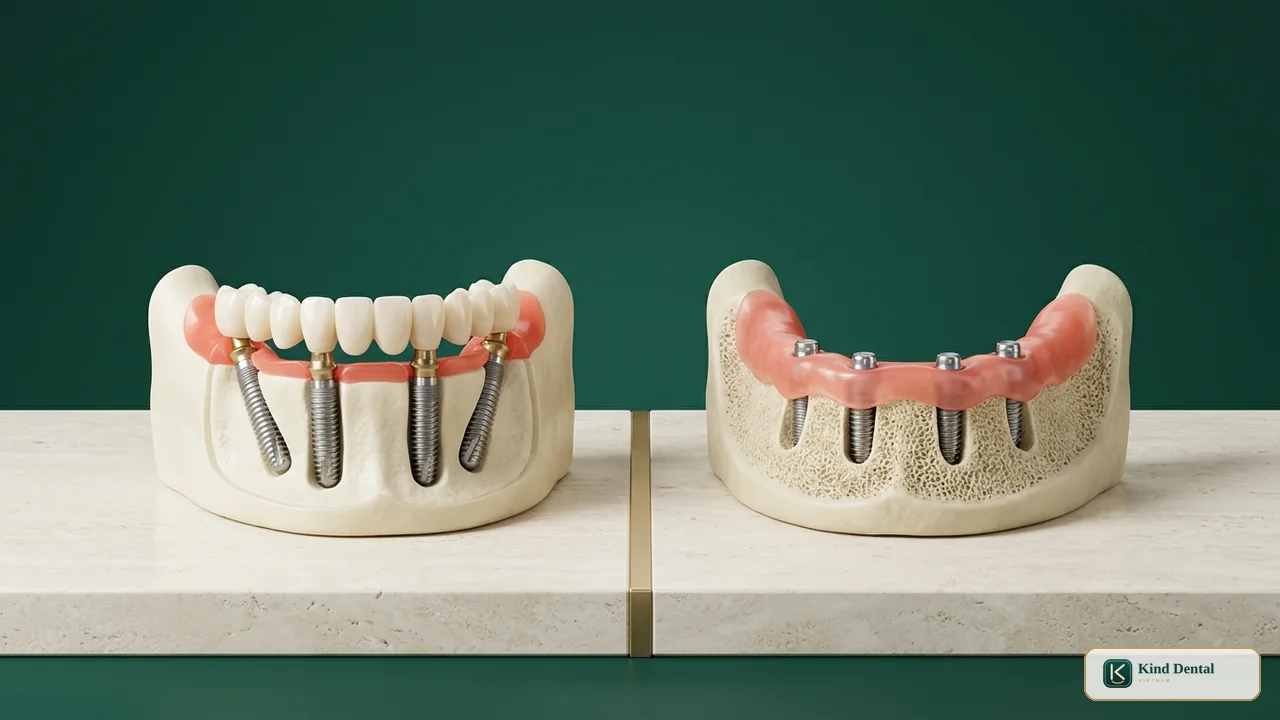
In All-on-4 surgery, the rear implants are angled 30–45 degrees to avoid the sinus and engage denser bone further forward. A systematic review (Del Fabbro & Ceresoli, 2014; PMID 24977252) found marginal bone loss around tilted implants comparable to that around conventional upright implants.
4. Restoration Type & Rigid Cross-Arch Splinting
A systematic review in Clinical Oral Implants Research (Sanz-Sánchez et al., 2015; PMID 24917174) compared immediate and conventional loading by restoration type. Immediate loading performed well under strict selection, though immediately loaded single crowns carried a somewhat higher failure risk. Splinting is much of what makes full-arch loading predictable.
Dr. Cuong’s Verification Rule: A pre-trip CBCT scan tells us whether immediate loading is likely; it cannot confirm it. The final decision is made in the chair, once torque and ISQ are measured in living bone, and every patient hears this before booking flights.
3. Clinical Decision Matrix: Immediate vs. Early vs. Delayed Loading
The three evidence-based loading pathways, compared side by side for biology, restoration limits and travel:
| Clinical Parameter | Immediate Loading (24–72h) | Early Loading (6–8 Weeks) | Delayed Loading (3–6 Months) |
|---|---|---|---|
| Prosthesis Attachment | 24–72 hours (within 7 days) | 6–8 weeks (hydrophilic surface) | 3–4 months (lower) · 4–6 months (upper) |
| Minimum Insertion Torque | ≥35 Ncm (35–50 Ncm ideal) | ≥25–35 Ncm in native bone | <30 Ncm safely tolerated |
| Target ISQ Stability | ≥65–70 ISQ verified | ≥60–65 ISQ at loading | Re-checked ≥65 before Trip 2 |
| Best Indications | All-on-4 / All-on-6 arches; selected front teeth | Native-bone sites, hydrophilic surfaces (e.g. Straumann SLActive) | Soft D4 bone, sinus lifts, grafts, single molars, grinders |
| Bite Contact | Light, balanced (full arch) or none (front tooth) | Progressive functional bite | Full zirconia function from Trip 2 |
| Diet & Travel | Strict 12-week soft diet · 2 trips | Moderate soft diet · 2 trips | Lowest overload risk · 2 trips |
One practical point stands out: even with immediate-load full-arch teeth, two visits to Ho Chi Minh City are still required. Gums and bone commonly remodel by 1.5–3.0 mm in the months after extractions, so the definitive bridge is made on Trip 2, against tissue that has settled.
4. Full-Arch All-on-4 vs. Single Tooth vs. Overdentures
Many patients reason that if four implants can carry a full bridge on day one, a single molar implant should comfortably carry one crown. In prosthodontic mechanics, the opposite is true.
Full-Arch All-on-4 & All-on-6 Fixed Bridges
When four to six implants are joined by a rigid screw-retained provisional bridge, each braces the others against sideways leverage, much as a frame steadies the legs of a table. Our All-on-4 vs. All-on-6 Guide explains how that load is shared.
A one-year prospective pilot study in the Journal of Periodontology (Pieri et al., 2009; PMID 19254125) reported favorable early outcomes when immediately placed full-arch implants were rigidly splinted and the bite carefully balanced, albeit in a small cohort.
Single Front Implants (No Bite Contact)
When a visible front tooth is lost, good bone and torque of 35 Ncm or more often allow a screw-retained temporary crown within 24–48 hours. It is shaped so that opposing teeth never touch it; its role is to look natural and support the gum, not to bite.
A systematic review of patient-reported outcomes (Huynh-Ba et al., 2018; PMID 30328205) found high satisfaction with immediate provisionals, while cautioning that evidence remains limited. Placement itself is technique-sensitive: a 2022 meta-analysis (Salem et al., 2022; PMID 35748456) shows how strongly the thin outer bone wall shapes the long-term gum line.
For several missing teeth in a row, a meta-analysis (Schrott et al., 2014; PMID 24660201) examined loading protocols for extended gaps and stressed that immediate loading there depends on careful case selection and bite control.
Single Back Molars & Lower-Jaw Overdentures
A lone back molar can face several hundred newtons of grinding force with no neighboring implants to share the load. Leaving that implant beneath a healing cap for three to four months costs nothing visible in your smile, and meaningfully protects the outcome.
For snap-in arches, a meta-analysis of randomized trials (Ye et al., 2022; PMID 33206979) found immediate and conventional loading of lower-jaw overdentures both performed well in suitable bone. Where anchorage is borderline, a conventional timeline remains prudent (see Implant-Supported Overdentures in Vietnam).
5. Honest Surgeon’s Guide: Risks, Contraindications & When to Wait
One reliable sign of an ethical clinic is a surgeon willing to say no to same-day teeth. Dr. Cuong recommends protected, unloaded healing for three to six months whenever any of these six factors is present:
- Low torque (<30–35 Ncm) or soft D4 bone: Common in long-term upper denture wearers; early loading risks loosening implants.
- Major grafting or a simultaneous sinus lift: Grafts need undisturbed blood supply to mature (see Sinus Lift & Bone Grafting).
- Acute infection or a missing outer bone wall: Staged reconstruction heals far more predictably.
- Heavy night-time grinding: Bruxism can fracture provisionals and disturb bone healing.
- Systemic healing constraints: Heavy smoking, poorly controlled diabetes or antiresorptive medication (see Systemic Health & Implants).
- Difficulty keeping to a 12-week soft diet: Immediate bridges are healing splints, not instruments for steak.
Choosing delayed healing never means leaving Ho Chi Minh City without teeth. Patients receive a lightweight clear retainer or a soft-relined transitional denture, carefully adjusted so it rests clear of the healing caps beneath.
Risks Every Patient Should Hear Before Consenting
Immediate loading is well supported by evidence, but it remains surgery, and no protocol removes risk entirely. These are the complications Dr. Cuong discusses openly at every consultation:
- Early implant failure: A non-integrating implant usually declares itself within months. It is removed, the site heals, and a replacement follows on a delayed protocol.
- Provisional fracture or screw loosening: Acrylic provisionals are deliberately lighter than zirconia and can crack under heavy biting.
- Nerve and sinus complications: Uncommon with 3D-guided planning, yet altered lip sensation and sinus irritation are recognised risks.
- Long-term maintenance: A review of implant bridges followed for at least five years (Pjetursson et al., 2012; PMID 23062125) reported high survival alongside frequent technical complications such as chipping and screw loosening.
After head and neck radiotherapy, during or after intravenous antiresorptive therapy, or with poorly controlled diabetes, immediate loading is usually inappropriate. In some of these situations, implant surgery itself first requires clearance from your physician.
When a Different Treatment Is the Wiser Choice
Sometimes the best decision is to slow down, or not to use an implant at all. A tooth that can be predictably saved with root canal treatment and a zirconia crown often serves you better than extraction and same-day surgery.
Where neighboring teeth already need crowns, a conventional bridge can be entirely reasonable (see Single Dental Implant vs. Dental Bridge). For limited bone or a tighter budget, a snap-in overdenture on two to four implants offers secure function, often without major grafting.
6. Tapered Implant Geometry, Active Surfaces & Screw-Retained Craft
Immediate-load reliability depends heavily on implant design and surface chemistry, precisely where unbranded fixtures fall short. Dr. Cuong places only factory-sealed Straumann BLT SLA / SLActive (Swiss), Nobel Biocare (Swedish/US) and Osstem / Dentium (Korean) systems, whose tapered bodies condense softer bone as they seat.
Compare each system in our Implant Brands Guide and the detailed Straumann vs. Nobel vs. Osstem analysis, including how readily components can be sourced abroad.
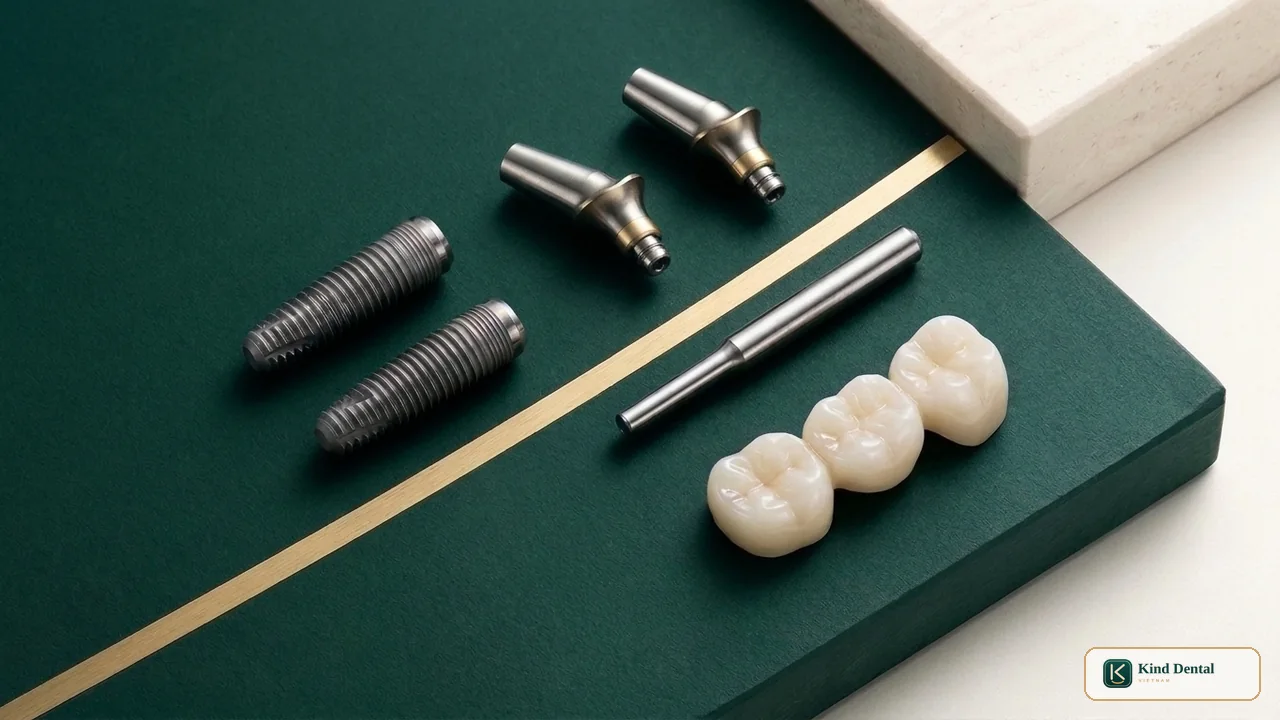
Active Surfaces & Definitive Multi-Unit Prosthetics
Modern micro-roughened and hydrophilic surfaces attract blood proteins quickly, which may help narrow the stability dip. A 2021 meta-analysis (Nagay et al., 2021; PMID 34352130) reported high survival and stable bone levels for anodized-surface implants across immediate, early and conventional loading.
On Trip 2, the lightweight PMMA provisional gives way to a CAD/CAM monolithic zirconia bridge. A 2023 systematic review (Pjetursson et al., 2023; PMID 37750526) showed that prosthetic material and framework design influence chipping and other technical complications in multi-unit implant bridges.
For overseas patients we favor screw-retained designs, which avoid hidden cement beneath the gum and can be removed for maintenance at home (see Screw-Retained vs. Cemented Crowns and our Traceable Implant Passport & Warranty).
7. 3D CBCT Guided Surgery, Optical Scanning & Calm Comfort
Predictable immediate loading begins well before surgery day. By merging 3D CBCT data with intraoral scans in our 3D Digital Dental Technology suite, Dr. Cuong maps nerve canals, sinus floors and abutment angles in sub-millimeter detail.
A systematic review in BMC Oral Health (Joda et al., 2017; PMID 28927393) concluded that complete digital workflows are a viable alternative to conventional impressions in fixed prosthodontics, while noting that long-term clinical data were still emerging.
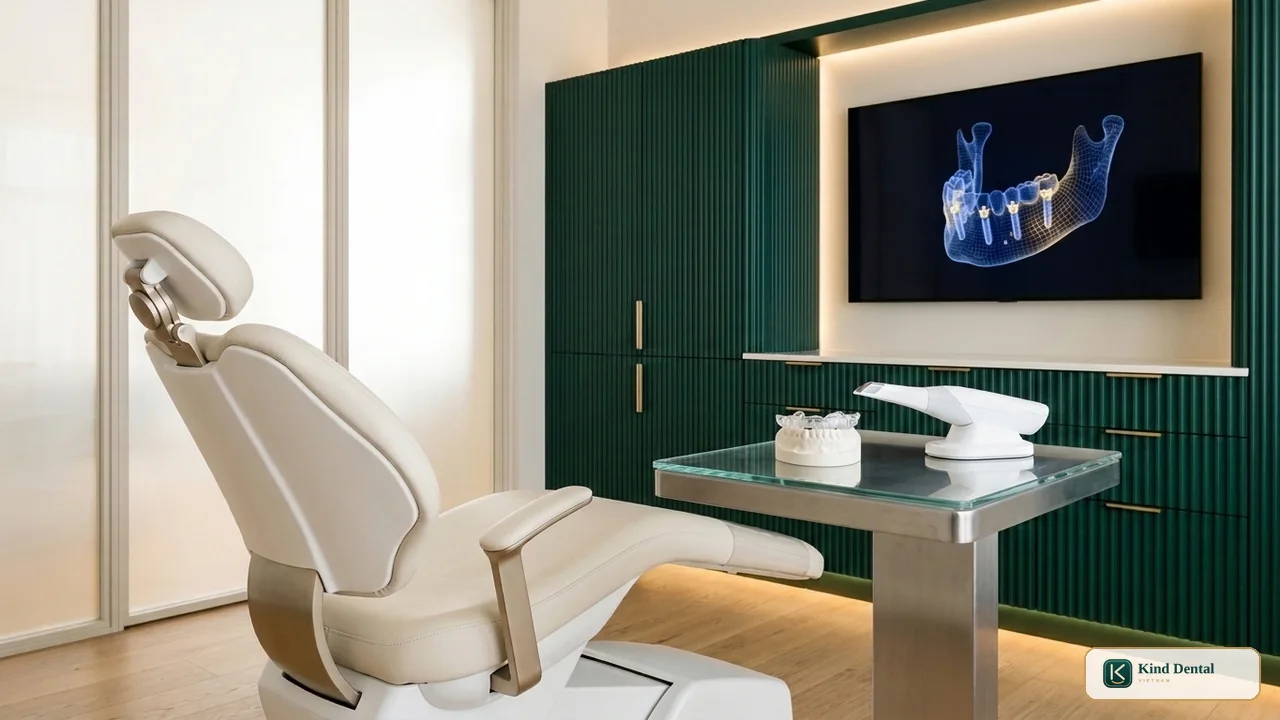
Every procedure follows European Class-B autoclave sterilization protocols in a calm, private suite. Gentle local anesthesia is always $0; optional anesthesiologist-monitored IV sedation is available at $350 – $650 USD per session for anxious patients.
8. Transparent 2026 Vietnam Pricing: Immediate-Load vs. Conventional
A common worry is that same-day teeth bring surprise charges on arrival. Our 2026 full-arch packages include both the Trip 1 provisional and Trip 2 definitive bridge, paid in milestones of roughly 65% on Trip 1 and 35% on Trip 2.
Figures match our All-on-4 Cost Page and Dental Implants Cost Page. Home-country fees are indicative private ranges only and vary by city, clinician and complexity.
| 2026 Treatment Pathway | Kind Dental Vietnam (USD) | What Is Included | Indicative Australia / USA Fee |
|---|---|---|---|
| Pre-Trip OPG / CBCT Review & Written Estimate | $0 (Always Included) | 1-on-1 review by Dr. Cuong | $150 – $350 |
| In-Clinic Consultation, 3D Scan & Plan | $0 (Included with Treatment) | Examination, intraoral scan, treatment plan | $250 – $450 |
| Single Implant — Osstem / Dentium | $750 – $950 | Fixture + custom abutment + zirconia crown | $3,500 – $5,000 |
| Single Implant — Nobel Biocare | $1,200 – $1,450 | Fixture + custom abutment + zirconia crown | $4,500 – $6,000 |
| Single Implant — Straumann BLT | $1,250 – $1,550 | SLA / SLActive fixture + abutment + zirconia crown | $4,800 – $6,500 |
| All-on-4 Full-Arch Fixed Restoration | $5,800 – $9,800 / arch | 2-trip package: provisional + definitive bridge | $18,000 – $30,000 |
| All-on-6 Full-Arch Fixed Restoration | $7,400 – $11,200 / arch | 2-trip package: provisional + definitive bridge | $22,000 – $36,000 |
| Implant-Supported Snap-In Overdenture | $2,600 – $4,800 / arch | 2–4 implants + Locator attachments | $9,000 – $16,000 |
| Optional Clinical Adjuncts | Bone graft & membrane: $180 – $300 / site Sinus lift: $350 – $650 / side IV sedation: $350 – $650 / session |
Extraction / root canal / nightguard: $50 – $220 · EMS AirFlow & exam: $45 – $65 · Local anesthesia: $0 | $800 – $3,500+ each |
If torque readings on the day favor submerged healing over an immediate fixed bridge, the change of pathway itself carries no surcharge. Trip 1 simply concludes with a soft-relined transitional denture rather than a fixed provisional, within your written package estimate.
9. 2-Trip Travel Schedule, Flying Safety & The 12-Week Soft Diet
The most avoidable mistake we see is a return flight booked 24 hours after surgery. Swelling usually peaks at around 48–72 hours, and any immediate provisional needs an unhurried bite check once the anesthetic has fully worn off.
| Stage | Full-Arch All-on-4 / All-on-6 | Single Aesthetic Implant |
|---|---|---|
| Pre-Trip | Send OPG / CBCT via WhatsApp for a $0 review & written estimate | Send X-ray + smile photos to confirm bone volume |
| Trip 1 (Days 1–2) | 3D CBCT & intraoral scan · Guided surgery with torque/ISQ check (~65% milestone) | 3D scan · Guided placement under local anesthesia ($0) |
| Trip 1 (Days 3–5) | Fixed provisional bridge fitted (24–72h) · Bite refinement | Non-biting temporary crown (if ≥35 Ncm) or clear retainer |
| Trip 1 (Days 6–8) | Suture review, hygiene coaching & fit-to-fly clearance (7–8 days in total) | Fit-to-fly clearance on Days 4–6 (longer after a lateral sinus lift) |
| Healing (At Home) | 4–6 months of osseointegration + 12-week fork-tender diet | 3–5 months (6–8 weeks in selected Straumann SLActive cases) |
| Trip 2 (Days 1–7) | Scan, try-in, definitive zirconia bridge & nightguard (~35% milestone) | Custom abutment & screw-retained zirconia crown (5–6 days) |
For safe flying windows after sinus procedures, read Flying After Dental Implants & Sinus Lift; to plan each stay, see How Many Days Do You Need in Vietnam? At home, follow Dr. Cuong’s 12-week Fork-Tender Rule: if a plastic fork cannot cut it cleanly, it waits until Trip 2.
- Comfortable staples (Weeks 1–12): Scrambled eggs, phở with soft noodles, steamed fish, ripe mango, avocado, yogurt, soups, pasta and silken tofu.
- Best saved for after Trip 2: Crusty baguettes, steak, raw carrots, nuts, ice, and biting into whole apples with front provisionals.

Complimentary Pre-Trip CBCT & Eligibility Review ($0): Send your panoramic OPG or 3D CBCT via WhatsApp on +84 853 020 003, email kinddentalvietnam@gmail.com, or use our Online Consultation Desk. Dr. Cuong replies personally, usually within 24 hours, with a candid written plan and estimate. No agency commissions are involved.
10. Peer-Reviewed PubMed Clinical Evidence
Each criterion and outcome discussed here draws on peer-reviewed research indexed by the U.S. National Library of Medicine, listed so that you, or your dentist at home, can review it directly:
- Pjetursson BE, et al. Systematic review evaluating the influence of the prosthetic material and prosthetic design on the clinical outcomes of implant-supported multi-unit fixed dental prosthesis in the posterior area. Clin Oral Implants Res. 2023. PMID: 37750526
- Ye M, et al. Immediate vs Conventional Loading of Mandibular Overdentures: A Comprehensive Systematic Review and Meta-Analysis of Randomized Controlled Trials. J Oral Implantol. 2022. PMID: 33206979
- Salem AS, et al. Socket-shield Technique vs Conventional Immediate Implant Placement for Esthetic Rehabilitation: A Systematic Review and Meta-analysis. J Contemp Dent Pract. 2022. PMID: 35748456
- Nagay BE, et al. Clinical efficacy of anodized dental implants for implant-supported prostheses after different loading protocols: A systematic review and meta-analysis. Clin Oral Implants Res. 2021. PMID: 34352130
- Morton D, et al. Group 2 ITI Consensus Report: Prosthodontics and implant dentistry. Clin Oral Implants Res. 2018. PMID: 30328196
- Huynh-Ba G, et al. Immediate loading vs. early/conventional loading of immediately placed implants in partially edentulous patients from the patients’ perspective: A systematic review. Clin Oral Implants Res. 2018. PMID: 30328205
- Joda T, et al. The complete digital workflow in fixed prosthodontics: a systematic review. BMC Oral Health. 2017. PMID: 28927393
- Sanz-Sánchez I, et al. Clinical efficacy of immediate implant loading protocols compared to conventional loading depending on the type of the restoration: a systematic review. Clin Oral Implants Res. 2015. PMID: 24917174
- Del Fabbro M, Ceresoli V. The fate of marginal bone around axial vs. tilted implants: a systematic review. Eur J Oral Implantol. 2014. PMID: 24977252
- Schrott A, et al. Implant loading protocols for partially edentulous patients with extended edentulous sites: a systematic review and meta-analysis. Int J Oral Maxillofac Implants. 2014. PMID: 24660201
- Pjetursson BE, et al. A systematic review of the survival and complication rates of implant-supported fixed dental prostheses (FDPs) after a mean observation period of at least 5 years. Clin Oral Implants Res. 2012. PMID: 23062125
- Pieri F, et al. Immediate occlusal loading of immediately placed implants supporting fixed restorations in completely edentulous arches: a 1-year prospective pilot study. J Periodontol. 2009. PMID: 19254125
11. Frequently Asked Questions: Immediate-Load Dental Implants in Vietnam
Are same-day immediate-load dental implants in Vietnam permanent on Trip 1?
No. Immediate loading delivers a fixed, natural-looking provisional PMMA bridge within 24–72 hours, so you can smile with confidence while bone heals. Your final monolithic zirconia bridge is made on Trip 2, after 3–6 months of healing.
What insertion torque is required for safe immediate implant loading?
Dr. Cuong looks for insertion torque of at least 35 Ncm together with an ISQ reading of 65–70 or higher. If the bone proves softer than expected during surgery, the implants are left to heal beneath healing caps instead.
How much do immediate-load All-on-4 or single implants cost in Vietnam in 2026?
Complete 2-trip All-on-4 packages are $5,800–$9,800 USD per arch (All-on-6: $7,400–$11,200), including both provisional and definitive bridges. Complete single implants range from $750–$950 (Osstem/Dentium) to $1,200–$1,550 USD (Nobel Biocare or Straumann).
What happens if my bone is too soft for same-day teeth on surgery day?
Safety comes before speed. If torque falls below 30–35 Ncm, Dr. Cuong fits smooth healing caps so the implants integrate undisturbed, and provides a lightweight clear retainer or soft-relined transitional denture for the healing period.
Who should not have immediate-load dental implants?
Immediate loading is usually unsuitable after head and neck radiotherapy, with intravenous antiresorptive therapy, poorly controlled diabetes, heavy smoking, untreated grinding or active infection. A staged approach, an overdenture or a conventional bridge may be wiser.
How many days should I stay in Ho Chi Minh City for immediate-load implants?
Plan 7–8 days in District 1 for Trip 1 of full-arch treatment. This allows guided surgery, a fixed provisional within 24–72 hours, unhurried bite refinement as swelling settles, and fit-to-fly clearance before you depart.
This guide is general clinical education and cannot replace a personal examination; please read our Medical Disclaimer.
Want Honest Clinical Advice on Your X-Ray or Quote?
Send your panoramic OPG scan or an existing treatment estimate via WhatsApp. Dr. Cuong will provide a clear, conservative comparison with zero agency markup.