Surgeon’s Executive Summary (Key 2026 Clinical Takeaways):
- Let 3D CBCT anatomy—not headline marketing—decide: All-on-4 excels when posterior jawbone height is limited near the maxillary sinus or lower mental nerve, using 30°–45° tilted distal fixtures to avoid invasive grafting. All-on-6 is preferred when posterior bone volume permits—especially in the softer upper jaw (maxilla) or in patients with strong bite forces—to reduce distal cantilever stress and add structural redundancy.
- 2026 Transparent Full-Arch Fees in Ho Chi Minh City: At Kind Dental Vietnam (District 1), complete two-trip All-on-4 packages range from $5,800 – $9,800 USD per arch (approx. A$8,930 – A$15,090), and All-on-6 packages range from $7,400 – $11,200 USD per arch (approx. A$11,395 – A$17,250)—representing 70%–73% savings versus $24,000–$38,000 domestic fees in Australia or the USA, even after flights and boutique hotels.
- Why two staged trips protect your investment: Trip 1 (7–10 days) delivers extractions, implant placement, and an immediate fixed PMMA provisional bridge (subject to surgical primary stability ≥35 Ncm). Trip 2 (7–10 days, 4–6 months later) delivers your definitive screw-retained monolithic zirconia or titanium-reinforced hybrid arch after bone and gum remodeling stabilize.
2. Upper vs. Lower Jaw Bone Density
3. Clinical Comparison Matrix
4. Zirconia vs. Titanium-Acrylic
5. Straumann, Nobel & Osstem
6. 2026 Vietnam Cost & Travel ROI
7. Two-Trip Clinical Timeline
8. Honest Risks & Maintenance
9. Peer-Reviewed PubMed Evidence
10. Patient FAQs
When patients from Sydney, Melbourne, Perth, California, London, or Auckland research full-arch fixed tooth replacement abroad, one clinical question dominates every consultation: should I choose All-on-4 or All-on-6 dental implants in Vietnam? Unfortunately, much of the online commentary treats the choice as a simplistic sales upsell—either insisting that four implants are universally sufficient for every jaw, or claiming that six implants are always automatically superior regardless of bone anatomy.
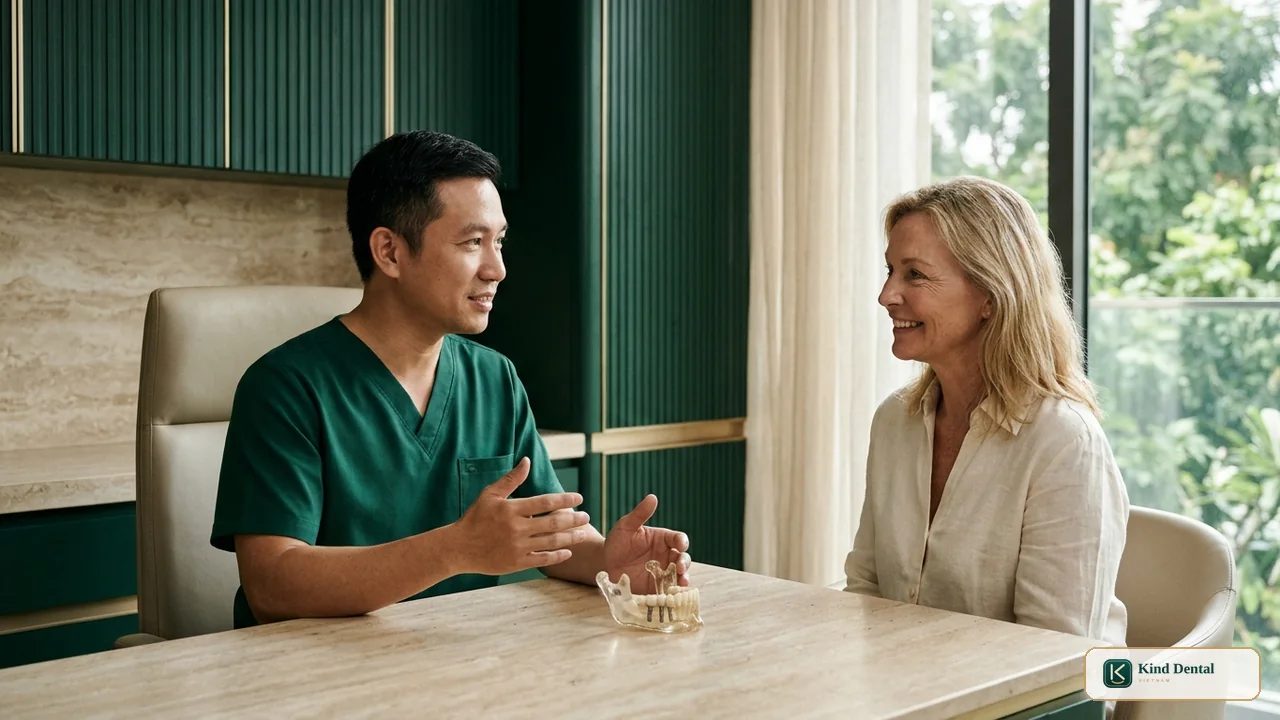
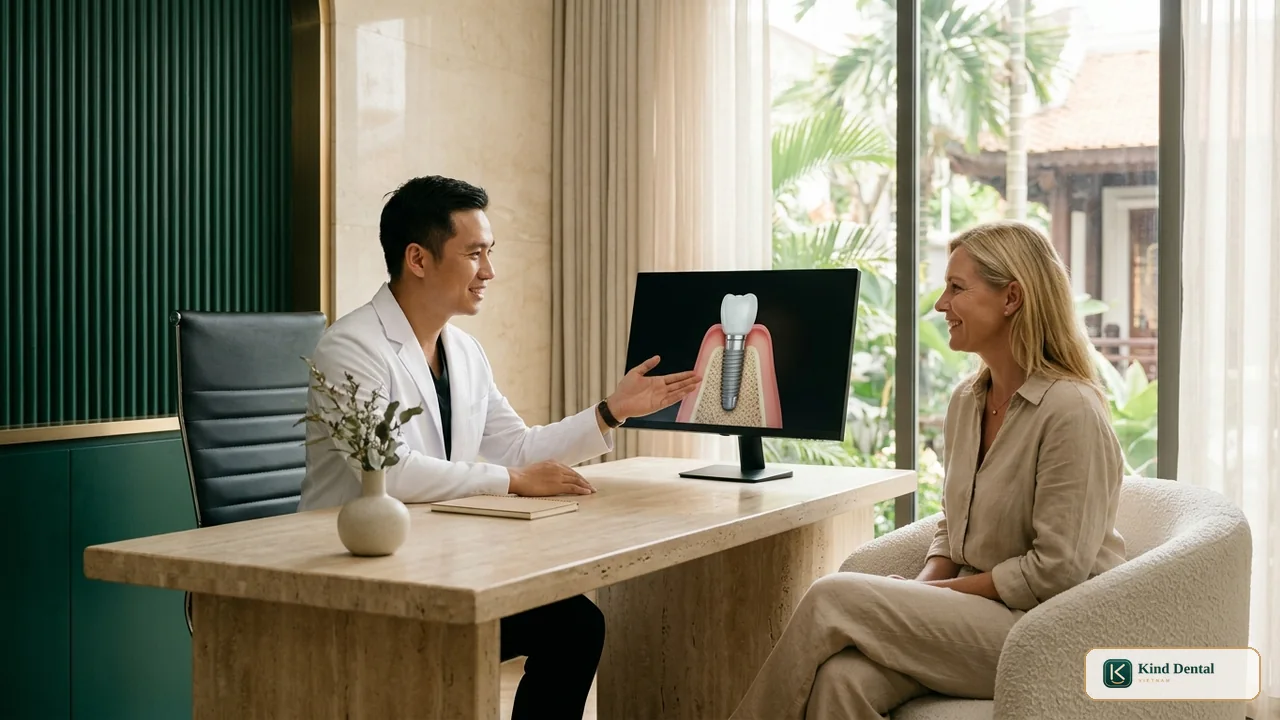
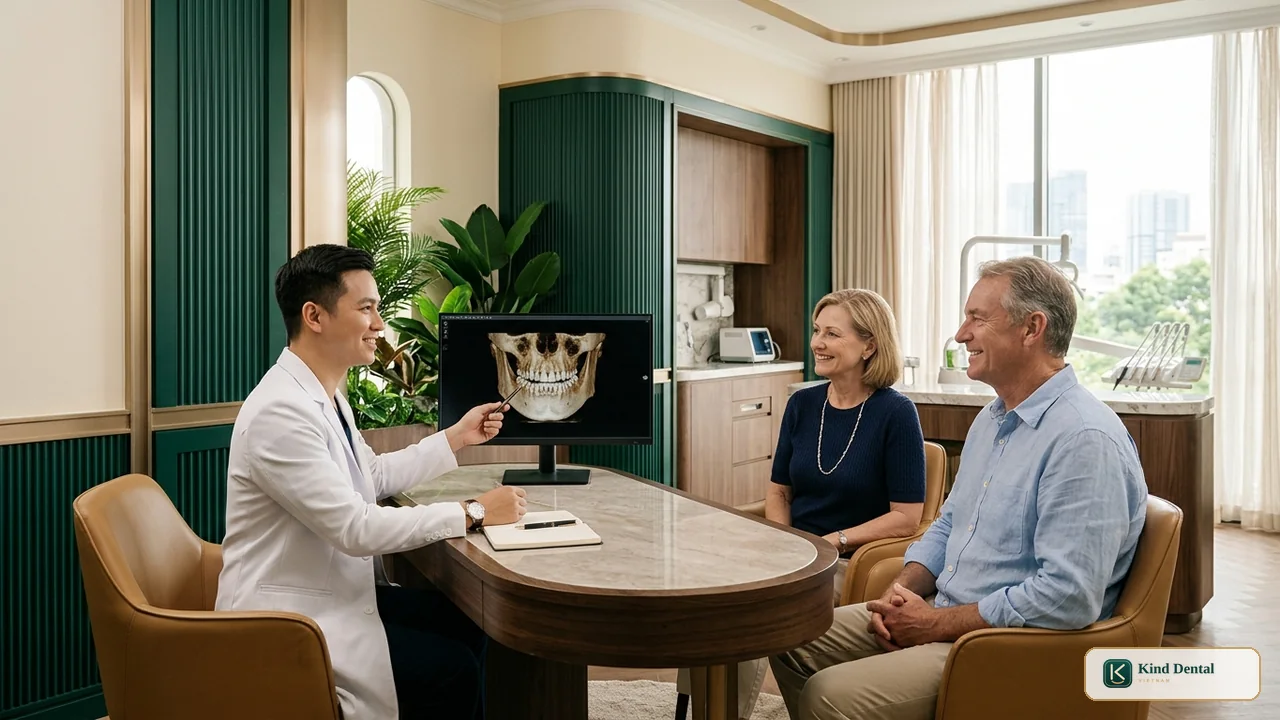
In real-world oral surgery and prosthodontics, neither extreme is medically sound. At Kind Dental Vietnam in District 1, Ho Chi Minh City (Private Appointment Only), Dr. Nguyen Van Cuong, DDS (Vietnam Ministry of Health Practice Certificate 0003265/BL-CCHN, Member of ICOI & VOSA) evaluates full-arch candidates strictly through three-dimensional Cone Beam Computed Tomography (3D CBCT), opposing bite force mechanics, systemic health risk factors, and restorative prosthetic space. Two additional titanium fixtures only add biological value when placed into viable bone with healthy inter-implant spacing (typically ≥3 mm between fixtures) and passive prosthetic alignment.
This comprehensive clinical decision guide breaks down the exact surgical engineering behind All-on-4 and All-on-6 rehabilitation in Vietnam, compares definitive bridge biomaterials, lays out itemized two-trip costs in USD and AUD, and cites recent peer-reviewed evidence from PubMed (2018–2026) so you can evaluate quotes with surgeon-level clarity before booking a single flight.
1. Biomechanical Engineering: Why Four Tilted vs. Six Axial Implants Behave Differently
A full-arch fixed dental bridge restores 12 to 14 teeth on a single jaw and endures rhythmic chewing forces ranging from 150 to over 450 Newtons—and significantly higher during nocturnal bruxism (clenching or grinding). Unlike natural teeth, which are suspended inside bony sockets by shock-absorbing periodontal ligaments, titanium implants fuse directly to jawbone via osseointegration. Consequently, the structural longevity of your full-arch bridge hinges on how effectively those implants distribute axial (vertical) and non-axial (lateral) occlusal loads.
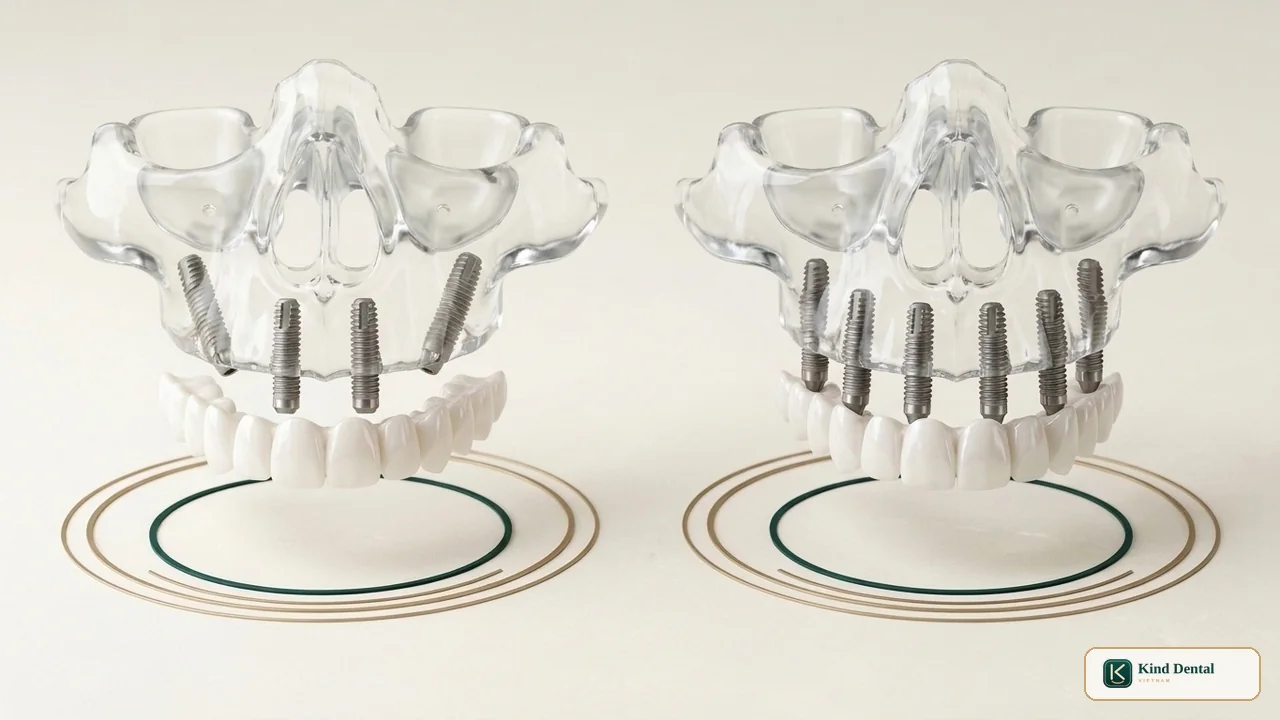
Anterior-Posterior (A-P) Spread & Distal Cantilever Physics
Every full-arch prosthodontist measures two critical geometric parameters on your 3D CBCT scan: the Anterior-Posterior (A-P) Spread—the distance between a line connecting the two most anterior implants and a line connecting the two most posterior implants—and the distal cantilever length, meaning how far the back molar teeth extend behind the rearmost implant platform. As a well-established biomechanical principle—recently refined further by geometric load models such as the Prosthesis-Implant Arch Area Ratio (PIAAR) published in the Journal of Prosthodontics (Kim, 2023; PMID 35512845)—excessive distal cantilevers act like a crowbar lever, multiplying bending stress on the rearmost abutment screw, titanium bar, and surrounding crestal bone.
- How All-on-4 Solves Cantilever Stress: By tilting the two posterior implants distally at 30° to 45° and connecting them via angled Multi-Unit Abutments (MUAs), the surgeon moves the posterior prosthetic emergence point further back toward the second premolar or first molar region without puncturing the maxillary sinus floor or the inferior alveolar nerve canal. This smart angulation increases A-P spread, allows longer implants (13–16 mm) to engage denser anterior cortical bone, and keeps the posterior cantilever compact (ideally ≤10–12 mm or ≤1.5× the A-P spread).
- How All-on-6 Expands the Support Polygon: Adding a fifth and sixth fixture further posteriorly (typically into the first-molar zone when sufficient vertical bone exists, or following conservative sinus floor elevation) enlarges the supporting polygon directly beneath the heaviest chewing centers. Instead of cantilevered back molars, your first molars rest squarely over titanium support—reducing bending moments on every individual screw and abutment.
Structural Redundancy: The Practical Insurance Factor
Beyond load distribution, international travelers should understand prosthetic redundancy. Long-term clinical reviews show high implant survival rates for both four- and six-implant full-arch bridges, yet biological realities remain: even under strict European Class-B sterilization and expert surgical care, roughly 2% to 4% of individual implants can fail to integrate early or develop peri-implant bone loss years later. In an All-on-4 bridge, losing a single rear implant typically compromises support for that entire side of the arch until a replacement fixture is placed and healed. In an All-on-6 arch, losing one intermediate fixture often allows the remaining five implants to continue stabilizing the bridge comfortably while a conservative repair is planned. That margin of safety is a major reason many clinicians favor six implants in the softer upper jaw whenever bone volume allows.
Dr. Cuong’s Clinical Rule of Thumb: More implants are not better if they must be crowded tightly together into narrow bone. Squeezing six fixtures into a small jaw with less than 3 mm of bone between implants restricts blood supply, complicates water-flosser hygiene, and actually increases crestal bone resorption. A well-spaced All-on-4 with broad cortical anchorage will always outperform a cramped, poorly positioned All-on-6.
2. Upper Jaw (Maxilla) vs. Lower Jaw (Mandible): Why Bone Density Dictates Implant Count
One of the most overlooked factors in patient research is that the upper jaw and lower jaw are structurally completely different organs. Under the classic Misch and Lekholm–Zarb bone density classifications (D1 to D4), jawbone quality varies dramatically by arch:
- The Lower Jaw (Mandible — Typically D1 to D2 Dense Cortical Bone): The anterior mandible possesses thick, compact outer cortical bone similar in density to seasoned oak. Four strategically placed implants—two axial anterior fixtures and two 30° tilted fixtures positioned safely anterior to the mental foramen—routinely achieve high primary insertion torque (40–50+ Ncm). Recent 3D Finite Element Analysis confirms that mandibular arch shape (tapered, ovoid, or square) directly influences stress transfer in full-arch designs (Sevinç Gül et al., 2025; PMID 40278242), and in many square or ovoid mandibles with dense bone, All-on-4 provides exceptional biomechanical stability without requiring unnecessary posterior surgery.
- The Upper Jaw (Maxilla — Typically D3 to D4 Porous Trabecular Bone): The maxilla is lighter, trabecular, and bordered superiorly by hollow air-filled maxillary sinuses. After years of missing upper molars or wearing a removable denture, sinus pneumatization shrinks vertical bone height rapidly. An overview of systematic reviews published in the International Journal of Prosthodontics notes that maxillary full-arch rehabilitations experience slightly higher biomechanical and biological demands than mandibular arches, often benefiting from 4 to 6 well-distributed implants depending on posterior sinus clearance and opposing dentition (Messias et al., 2021; PMID 33571327).
The Hybrid Upper-6 / Lower-4 Strategy (Commonly Overlooked by Overseas Chains)
Many patients assume dual-arch full-mouth rehabilitation must be symmetrical—either All-on-4 on both jaws or All-on-6 on both jaws. In reality, when Dr. Cuong reviews CBCT scans for dual-arch cases, one of the most biologically rational combinations is All-on-6 in the softer upper maxilla paired with All-on-4 in the denser lower mandible. This tailored asymmetric protocol reinforces the trabecular upper jaw against heavier chewing forces while keeping lower-jaw surgical trauma, swelling, and total fees conservatively optimized.
3. Complete Side-by-Side Clinical Comparison Matrix (All-on-4 vs. All-on-6)
Use this evidence-based decision matrix to evaluate how each protocol aligns with your jaw anatomy, systemic health, chewing profile, and budget:
| Clinical Parameter | All-on-4 Full-Arch Protocol | All-on-6 Full-Arch Protocol |
|---|---|---|
| Implant Architecture | 2 vertical anterior + 2 distally tilted posterior implants (30°–45°) with angled MUAs | 6 axial (or mildly tilted posterior) implants distributed across anterior, premolar & first-molar zones |
| Primary Bone Requirement | Ideal for moderate-to-severe posterior bone loss; frequently avoids sinus lifts | Requires sufficient posterior bone height/width or targeted conservative sinus elevation |
| Best Anatomical Fit | Dense lower mandible (D1–D2); upper jaws with large expanded sinuses; smaller V-shaped arches | Softer upper maxilla (D3–D4); broader jaws; patients with natural opposing teeth or heavy bite forces |
| Distal Cantilever Load | Short-to-moderate posterior cantilever (10–12 teeth fixed, controlled distal extension) | Minimal or zero cantilever (12–14 teeth supported directly beneath first molars) |
| Structural Redundancy | All 4 fixtures are load-critical; failure of 1 rear fixture usually requires surgical revision | High safety margin; 5 remaining implants can often retain arch stability if 1 fixture falters |
| Surgical Chair-Time & Recovery | Slightly shorter single-arch surgery (~2–2.5 hrs); gentler post-op swelling profile | Moderately longer surgery (~2.5–3.5 hrs); comparable 48–72 hr peak swelling window |
| Daily Hygiene Access | Wide inter-implant spans make water-flossing & super-floss threading simpler | Requires disciplined daily water-flossing around 6 emergence profiles & 6-monthly checks |
| 2026 Kind Dental Vietnam Package | $5,800 – $9,800 USD / arch (A$8,930 – A$15,090) |
$7,400 – $11,200 USD / arch (A$11,395 – A$17,250) |
Note for elderly travelers or tighter budgets: If you prioritize effortless removable daily hygiene or wish to minimize surgical scope in the lower jaw, Dr. Cuong also evaluates conservative Implant-Supported Overdentures (Snap-In Locator Dentures) using 2 to 4 implants as an honest alternative.
4. Definitive Bridge Biomaterials: Monolithic 3D Zirconia vs. Titanium-Reinforced Hybrid Acrylic
Choosing between four and six implants is only half of the engineering equation. The second—and arguably equally decisive—choice you will make before Trip 2 is the definitive arch material screwed onto your multi-unit abutments. The 2026 Italian Consensus Statement on Full-Arch Implant Rehabilitations (Rapone et al., 2026; PMID 42194656) and long-term 4-to-10-year retrospective studies (Acar & Koçak-Büyükdere, 2026; PMID 41826858) highlight that technical complications—such as acrylic tooth chipping, debonding, or veneer fracture—far outnumber biological implant failures over a decade of chewing.
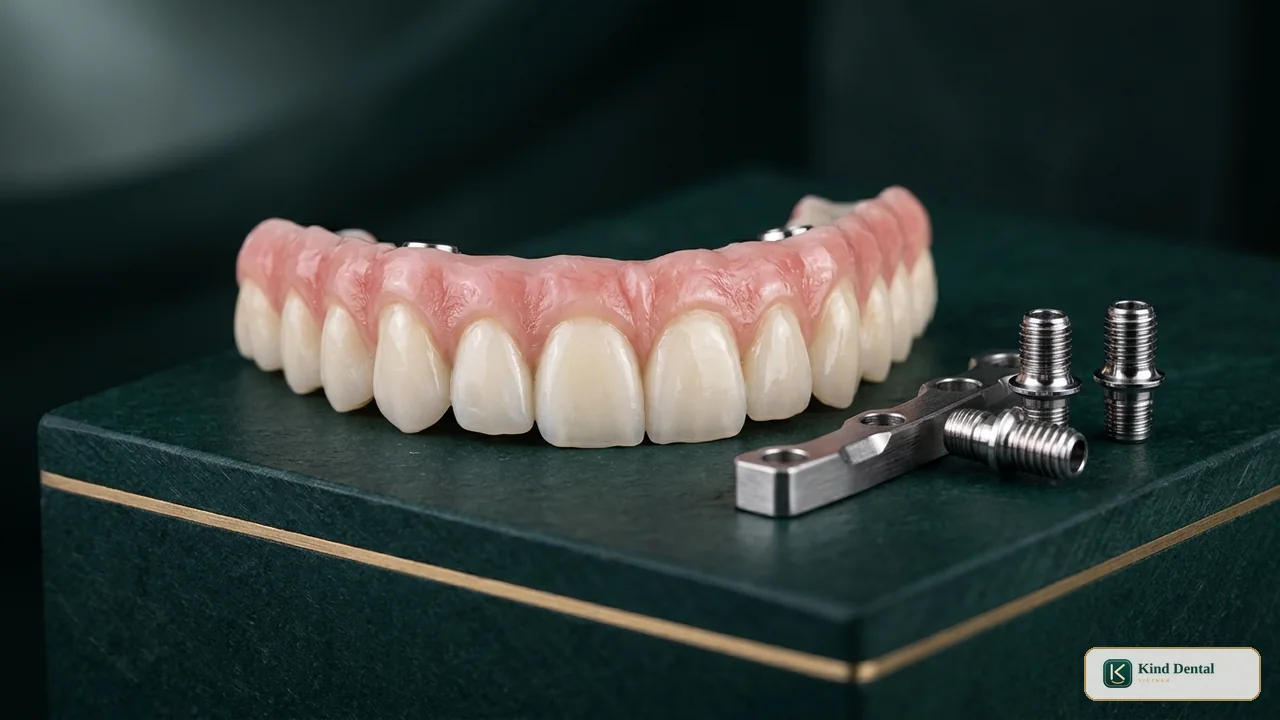
| Definitive Arch Option | Internal Structure | Strength & Wear Profile | Aesthetics & Hygiene | Ideal Patient Profile |
|---|---|---|---|---|
| Titanium-Reinforced Hybrid Acrylic / Composite | CAD/CAM milled Grade-5 Titanium bar wrapped in pink acrylic & high-density denture teeth | Gentle shock absorption; acrylic teeth gradually wear or chip over 5–8 years (repairable chairside) | Warm lifelike gum contours; slightly more porous than ceramic, absorbs coffee/tea stains over years | Budget-conscious All-on-4 patients, older adults with lighter bite force, or reduced prosthetic space needing lighter weight |
| Monolithic 3D Multilayer Zirconia (No-Chip Ceramic) | Solid CAD/CAM milled multilayer zirconia arch bonded via titanium Ti-base inserts (or Ti-bar supported) | Exceptional flexural strength (900–1,200 MPa); virtually eliminates tooth fracture or wear over 10–15+ years | Smooth glazed ceramic resists plaque & stains; multi-layer translucency mimics natural enamel | Most All-on-4 & All-on-6 travelers seeking maximum longevity, stain resistance, and strong chewing force |
| FP1 vs. FP3 Prosthetic Architecture | FP1 replaces teeth only (no pink gum); FP3 replaces teeth + sculpted gingival flange | Requires strict minimum vertical restorative space (typically 12–15 mm for FP3 zirconia arches) | FP3 seamlessly masks severe ridge resorption and restores sunken lip/facial volume | Selected digitally during 3D CBCT & smile-line transition zone analysis prior to Trip 1 |
A 2025 clinical analysis of 115 edentulous jaws published in the Journal of Prosthodontics (Papaspyridakos et al., 2025; PMID 39136214) and a 2026 prospective digital-workflow cohort in the Journal of Dentistry (Rutkūnas et al., 2026; PMID 41276067) demonstrate remarkably high prosthesis survival rates for monolithic zirconia full-arch fixed bridges—provided two strict rules are respected: (1) adequate vertical prosthetic thickness (avoiding thin, fragile connector areas), and (2) wearing a protective nightguard if opposing ceramic or natural teeth are present. For a deeper dive into ceramic science, read our Dental Ceramic Materials Guide (IPS e.max vs. 3D Zirconia).
Crucially, every Kind Dental Vietnam full-arch bridge—whether hybrid titanium or monolithic zirconia—is strictly screw-retained onto genuine multi-unit abutments, never cemented permanently onto implants. As explained in our Screw-Retained vs. Cemented Implant Guide, retrievable screw access guarantees zero residual subgingival cement and allows any dentist in Australia, the USA, the UK, or Canada to remove, inspect, and deeply clean your arch years later without damaging the prosthesis.
5. Genuine Implant Systems: Straumann, Nobel Biocare & Osstem Compared
For dental tourists returning home thousands of kilometers away, global prosthetic parts availability matters just as much as surgical skill. At Kind Dental Vietnam, we refuse regional clones or non-standard private-label fixtures. You can inspect unopened factory-sealed sterile boxes before surgery and leave with a permanent physical Implant Authenticity Passport containing lot numbers, diameters, lengths, and exact multi-unit abutment torque specs (covered in our Authentic Implant Brands Guide and International Warranty Charter).
- Straumann BLT / Roxolid SLActive (Switzerland): Crafted from a titanium-zirconium alloy (Roxolid) offering higher tensile strength in narrow ridges, paired with hydrophilic SLActive surfaces engineered to accelerate early osseointegration—especially advantageous in softer maxillary bone or patients with well-controlled metabolic considerations (see our Systemic Health & Implant Safety Guide).
- Nobel Biocare NobelActive / NobelParallel (Switzerland/Sweden): The original pioneers of the All-on-4 clinical concept. NobelActive’s aggressive expanding thread design generates outstanding primary insertion torque in softer bone, making it a benchmark platform for immediate fixed provisional loading.
- Osstem TSIII / Dentium SuperLine (South Korea): Widely distributed across Australia, Asia, North America, and Europe with decades of peer-reviewed survival data and sandblasted acid-etched (SA) surfaces. Ideal for cost-conscious patients seeking proven global compatibility at $5,800–$8,900 per arch.
For an honest head-to-head comparison of surgical handling and long-term maintenance across all three systems, see Dr. Cuong’s dedicated Straumann vs. Nobel Biocare vs. Osstem Comparison.
6. Transparent 2026 Full-Arch Costs in Vietnam vs. Australia, USA & UK (Including Travel)
Beware of overseas advertising that quotes a low headline number for “4 implants only,” then surprises you upon arrival in Saigon with mandatory add-ons for extractions ($80–$150/tooth), bone leveling ($600), multi-unit abutments ($250–$350 × 4–6), and the Trip 1 fixed provisional bridge ($1,200–$1,800). Every full-arch fee at Kind Dental Vietnam—aligned identically with our All-on-4 & All-on-6 Pricing Schedule—bundles both Trip 1 and Trip 2 clinical milestones with zero agency commissions (learn why in our Booking Direct vs. Dental Agencies Guide).
| Full-Arch Fixed Implant Package (Per Arch — Trip 1 + Trip 2) | Definitive Arch Material | Kind Dental Vietnam (USD) | Indicative AUD* | Typical Australia / USA Fee | Est. Savings |
|---|---|---|---|---|---|
| All-on-4 Korean Platform 4× Osstem / Dentium + Genuine MUAs |
Titanium-Reinforced Hybrid Acrylic | $5,800 – $6,600 | A$8,930 – A$10,165 | $20,000 – $26,000 USD (A$23,000 – A$30,000) |
Save ~72% |
| All-on-4 Korean Platform + Zirconia 4× Osstem / Dentium + Milled Ti-Bar |
Monolithic 3D Multilayer Zirconia | $6,900 – $7,600 | A$10,625 – A$11,705 | $24,000 – $30,000 USD (A$27,000 – A$34,000) |
Save ~73% |
| All-on-4 Swiss / Global Platform 4× Nobel Biocare or Straumann BLT/Roxolid |
Hybrid Titanium or Monolithic Zirconia | $7,900 – $9,800 | A$12,165 – A$15,090 | $25,000 – $35,000 USD (A$28,000 – A$38,000) |
Save ~70% |
| All-on-6 Korean Platform 6× Osstem / Dentium + Genuine MUAs |
Titanium Hybrid or Monolithic Zirconia | $7,400 – $8,900 | A$11,395 – A$13,705 | $24,000 – $32,000 USD (A$28,000 – A$36,000) |
Save ~71% |
| All-on-6 Swiss / Global Platform 6× Nobel Biocare or Straumann + Zirconia |
Monolithic 3D Zirconia + Ti-Bar | $9,200 – $11,200 | A$14,170 – A$17,250 | $28,000 – $38,000 USD (A$32,000 – A$42,000) |
Save ~70% |
*Indicative AUD calculated at ~1.54 AUD/USD. Even after adding two return economy flights ($1,500–$2,100 USD total from Australia or the US West Coast) and 18 combined nights at a comfortable boutique hotel in District 1 ($1,650–$2,200 USD), a single-arch Swiss All-on-4 Zirconia case totals roughly $12,050–$13,200 USD all-in—retaining $14,000 to $22,000+ in net savings (and $33,000–$48,000+ on dual-arch cases). Australian patients exploring ATO Compassionate Release of Superannuation or itemized English tax invoices can review our Australian Superannuation & Tax Guide.
Milestone Payment Schedule (Zero Full-Upfront Pressure)
- Trip 1 Milestone (~65%): Settled upon completion of diagnostics, extractions, surgical placement of 4 or 6 serialized implants, genuine multi-unit abutments, and delivery of your Trip 1 fixed provisional bridge.
- Trip 2 Milestone (~35%): Settled 4 to 6 months later once osseointegration is verified and you approve your aesthetic prototype try-in prior to final zirconia or titanium-hybrid milling.
- Only 3 Potential Add-Ons (Quoted Clearly Before Travel Only If Indicated): Anesthesiologist-monitored IV sedation ($350–$650/session—see our Gentle Sedation Protocol), major bilateral sinus floor grafting if extreme posterior resorption prevents tilted anchorage, or specialized zygomatic/pterygoid anchorage in severe upper-jaw atrophy.
7. Step-by-Step Two-Trip Protocol in District 1, Ho Chi Minh City
One of the biggest red flags in medical tourism is any clinic promising “permanent zirconia All-on-4 in one 7-day holiday.” Biologically, extracted tooth sockets and remodeled jaw ridges shrink and resorb substantially over the first 12 to 20 weeks while bone cells integrate microscopically onto titanium surfaces. Screwing a definitive ceramic arch onto freshly operated gums in Week 1 inevitably creates unsightly food-trapping gaps months later—and risks catastrophic early implant overload (read more in Why Ultra-Cheap Dental Work Abroad Fails). Consistent with the Group 2 ITI Consensus Report (Morton et al., 2018; PMID 30328196), Kind Dental Vietnam strictly follows a disciplined two-trip staging model:
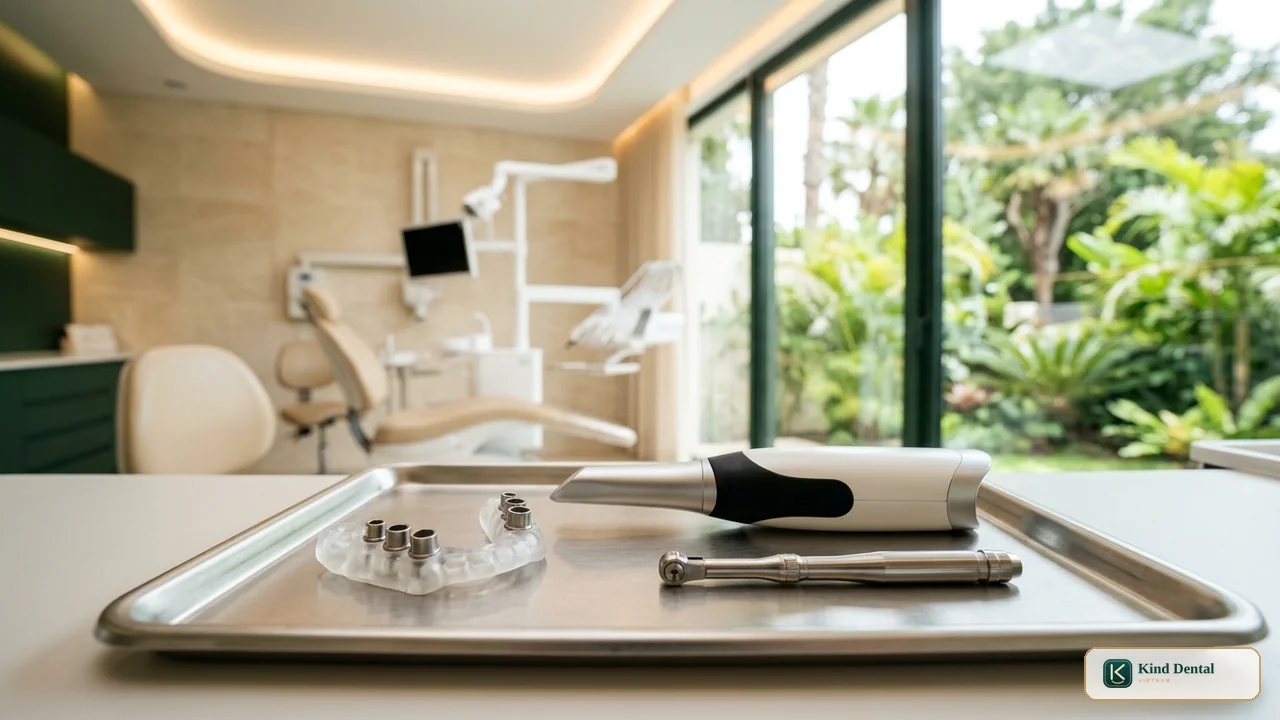
Trip 1: Surgical Foundation & Fixed Provisional Arch (7–10 Days in Ho Chi Minh City)
- Day 1 — In-Clinic 3D CBCT, Intraoral Scan & Smile Blueprint: Full diagnostic verification, vertical jaw dimension recording, facial symmetry photography, and final 1-on-1 confirmation of All-on-4 versus All-on-6 with Dr. Cuong inside our private suite (3D Digital Technology).
- Day 2 — Gentle Guided Surgery: Pain-conscious local anesthesia (or anesthesiologist-monitored IV sedation for anxious patients), atraumatic extraction of failing teeth, ridge smoothing (alveoloplasty), placement of 4 or 6 serialized implants, and multi-unit abutment torquing under strict European Class-B sterilization protocols.
- Days 3–4 — Quiet Recovery & Digital Provisional Fabrication: Facial swelling peaks gently around 48–72 hours, controlled via cold compresses and prescribed anti-inflammatory care while our master lab fabricates your screw-retained milled PMMA provisional bridge.
- Days 5–6 — Immediate Fixed Provisional Delivery: Provided surgical primary stability reached safe torque thresholds (typically ≥35 Ncm), your rigid fixed provisional bridge is torqued onto the implants and bite-balanced so you leave with a confident, natural smile. (Clinical transparency: if bone proves unexpectedly soft during surgery, Dr. Cuong prioritizes long-term implant survival over speed by fitting a comfortable soft-lined healing denture during osseointegration.)
- Days 8–10 — Suture Check & Fit-to-Fly Clearance: Post-operative tissue inspection, water-flosser hygiene coaching, soft-diet roadmap, and cabin-pressure clearance before flying home (review our Flying After Dental Implants Safety Guide).
Healing Window at Home (4–6 Months): Osseointegration & Real-World Testing
During these 4 to 6 months, you adhere to a disciplined fork-tender soft diet (steamed fish, eggs, pasta, soups, soft rice, pho—avoiding nuts, crusty bread, or tough steak) while living with your provisional teeth. Crucially, this trial period acts as a functional dress rehearsal: you note whether you want the final teeth slightly longer, warmer in shade, or adjusted for crisp “S” and “F” speech pronunciation.
Trip 2: Verification Jig & Definitive Arch Delivery (7–10 Days in Ho Chi Minh City)
- Days 1–2 — Osseointegration Verification & Passive-Fit Jig: Digital stability check (ISQ/torque confirmation), precision multi-unit impression or photogrammetry/optical scan, and splinted verification jig to guarantee micron-level passive fit.
- Days 4–5 — Aesthetic Prototype Try-In: You test-drive a milled prototype arch in your mouth to approve smile curve, tooth proportions, lip support, bite comfort, and phonetics—adjustments are refined until both you and Dr. Cuong are completely satisfied.
- Days 7–8 — Definitive Bridge Insertion & Protective Nightguard: Final screw-retained monolithic zirconia or titanium-hybrid arch torqued to manufacturer specifications, screw access channels sealed cleanly with PTFE tape and composite resin, occlusal force calibration, delivery of your protective occlusal splint, and handover of your complete English surgical archive + Implant Passport.

Planning flights from Sydney, Melbourne, Perth, Los Angeles, or London? Explore our dedicated travel logistics handbooks for Australian Travelers, US Patients, and How Many Days You Really Need in Vietnam.
8. Honest Clinical Risks, Limitations & Long-Term Maintenance Discipline
Ethical surgical counseling requires discussing complications as openly as benefits. No reputable implant surgeon promises effortless permanence without ongoing maintenance. Here are the real risks observed in 4-to-10-year clinical follow-ups (Acar & Koçak-Büyükdere, 2026; PMID 41826858) and exactly how Kind Dental Vietnam mitigates them:
- Early Implant Non-Integration (~2%–4%): Strongly correlated with heavy smoking, poorly controlled HbA1c diabetes (>7.5%–8.0%), or chewing hard foods on a Trip 1 provisional bridge. Mitigation: strict pre-trip medical screening, smoking cessation counseling, primary torque discipline, and 4–6 months of soft-chew adherence.
- Peri-Implant Mucositis & Peri-Implantitis: Plaque trapped beneath a full-arch bridge inflames surrounding gums just like natural teeth. Mitigation: Dr. Cuong designs smooth, convex, cleansable intaglio (underside) bridge contours—never ridge-lap concave traps—and teaches mandatory twice-daily water-flossing plus 6-monthly professional maintenance with your home hygienist.
- Prosthetic Screw Loosening or Ceramic Micro-Chipping: Often triggered by nocturnal jaw clenching or uneven bite contacts. Mitigation: calibrated manufacturer torque wrenches, monolithic (single-block) zirconia over fragile layered porcelain, and a custom protective nightguard included for high-bite-force patients.
- Temporary Speech Adaptation: Adjusting to a fixed bridge replacing lost palatal or alveolar bone typically produces mild lisping on “S” and “Th” sounds for 10 to 21 days before tongue proprioception naturally recalibrates.
Before selecting any clinic in Vietnam, always verify your treating surgeon’s official license independently through the Ho Chi Minh City Department of Health Practitioner Registry (see our step-by-step How to Verify a Vietnamese Dentist’s License Guide and our transparent analysis of 1-on-1 Surgeon Boutiques vs. Corporate Dental Chains).
9. Peer-Reviewed Clinical Evidence & PubMed References
Every biomechanical principle and prosthetic survival benchmark in this guide is grounded in verifiable, peer-reviewed prosthodontic and implantology literature indexed by the U.S. National Library of Medicine (PubMed):
- Rapone B, Ferrara E, Tomarelli F, et al. Consensus Statement on Full-Arch Implant Rehabilitations: Evidence-Based Recommendations from the Italian Consensus Conference. Journal of Clinical Medicine. 2026 May. PubMed PMID: 42194656
- Acar M, Koçak-Büyükdere A. Long-term outcomes and complications of full-arch implant-supported fixed prostheses: a 4-10 year retrospective study. BMC Oral Health. 2026 Mar. PubMed PMID: 41826858
- Rutkūnas V, Kuleš D, Akulauskas M, et al. Success and survival of full-arch implant-supported monolithic zirconia fixed dental prostheses fabricated using a digital workflow: A 2-year prospective cohort study. Journal of Dentistry. 2026 Feb. PubMed PMID: 41276067
- Papaspyridakos P, Sinada N, Ntovas P, et al. Zirconia full-arch implant prostheses: Survival, complications, and prosthetic space dimensions with 115 edentulous jaws. Journal of Prosthodontics (American College of Prosthodontists). 2025 Mar. PubMed PMID: 39136214
- Sevinç Gül SN, Murat F, Şensoy AT. Evaluation of Biomechanical Effects of Mandible Arch Types in All-on-4 and All-on-5 Dental Implant Design: A 3D Finite Element Analysis. Journal of Functional Biomaterials. 2025 Apr. PubMed PMID: 40278242
- Kim YK. Prosthesis-Implant Arch Area Ratio (PIAAR) – A New Geometric Paradigm, Replacing the Current ‘A-P Spread’ of a Cantilever in Full-Arch Implant Prosthesis. Journal of Prosthodontics. 2023 Mar. PubMed PMID: 35512845
- Messias A, Nicolau P, Guerra F. Different Interventions for Rehabilitation of the Edentulous Maxilla with Implant-Supported Prostheses: An Overview of Systematic Reviews. The International Journal of Prosthodontics. 2021. PubMed PMID: 33571327
- Morton D, Gallucci G, Lin WS, et al. Group 2 ITI Consensus Report: Prosthodontics and implant dentistry. Clinical Oral Implants Research. 2018 Oct. PubMed PMID: 30328196
10. Frequently Asked Questions: All-on-4 vs. All-on-6 in Vietnam
Is All-on-6 always stronger and better than All-on-4?
Not automatically. All-on-6 offers broader posterior support and extra redundancy when your jawbone has adequate height and width to space six implants at least 3 mm apart—making it frequently preferred in the softer upper jaw (maxilla) or for heavy chewers. However, when posterior bone near the upper sinus or lower nerve is thin, a well-spaced All-on-4 with 30°–45° tilted rear implants engages denser cortical bone without invasive grafting and outperforms crowded implants.
How much does All-on-4 vs. All-on-6 cost in Vietnam in 2026?
At Kind Dental Vietnam in District 1, Ho Chi Minh City, complete two-trip All-on-4 packages range from $5,800 to $9,800 USD per arch (approx. A$8,930–A$15,090), while All-on-6 packages range from $7,400 to $11,200 USD per arch (approx. A$11,395–A$17,250), depending on implant brand (Osstem, Nobel Biocare, or Straumann) and final bridge material (titanium-reinforced hybrid acrylic or monolithic 3D zirconia). Both Trip 1 provisional and Trip 2 final arches are bundled transparently.
Can I get All-on-6 on the upper jaw and All-on-4 on the lower jaw?
Yes—in fact, pairing All-on-6 on the softer trabecular upper maxilla with All-on-4 on the denser cortical lower mandible is one of the most clinically balanced dual-arch designs when upper posterior bone permits. Dr. Cuong confirms whether symmetric or asymmetric implant counts fit your anatomy best after reviewing your 3D CBCT scan.
Should I upgrade from titanium-acrylic hybrid to monolithic zirconia for my final bridge?
Monolithic 3D multilayer zirconia is generally the stronger long-term investment for patients with vigorous bite forces, bruxism, or dual-arch bridges because it resists tooth wear, chipping, and staining over 10–15+ years. Titanium-reinforced acrylic hybrid bridges remain a valid, gentle-shock-absorbing choice for lighter chewers or tighter budgets, though acrylic teeth typically require resurfacing or replacement after 5 to 8 years.
Why can’t I finish permanent All-on-4 or All-on-6 zirconia teeth in a single 7-day trip to Vietnam?
Immediately after tooth extractions and implant placement, your jawbone and gums undergo substantial remodeling and shrinkage over 4 to 6 months while osseointegration occurs. Delivering a permanent zirconia arch in one week before tissues stabilize frequently results in food-trapping gaps beneath the bridge and raises the risk of premature biomechanical failure. Staging Trip 1 (7–10 days) and Trip 2 (7–10 days) protects long-term survival and aesthetics.
How painful is All-on-4 or All-on-6 surgery, and what sedation is available?
Surgery is performed under thorough, pain-conscious local anesthesia so you feel vibration and gentle pressure rather than sharp pain. For nervous travelers or dual-arch surgeries, anesthesiologist-monitored IV sedation is available ($350–$650/session). Post-operative swelling and soreness typically peak at 48–72 hours and respond reliably to prescribed anti-inflammatory medications and cold compresses.
What happens if I need maintenance or a screw check back home in Australia, the USA, or the UK?
Because Kind Dental Vietnam uses only globally standardized Straumann, Nobel Biocare, and Osstem screw-retained multi-unit platforms—never proprietary regional clones—any qualified dentist or prosthodontist worldwide has the matching drivers and parts to clean, retorque, or service your bridge. You receive a full physical Implant Passport with serial stickers, part numbers, and English surgical records.
How can Dr. Cuong tell whether I need All-on-4 or All-on-6 before I book flights?
Simply obtain a recent panoramic OPG X-ray or 3D CBCT scan from a local radiology center in your home city and share the file via WhatsApp (+84 853 020 003) or our online consultation desk. Dr. Cuong personally evaluates your bone height, sinus position, and remaining teeth within 24 hours and sends a conservative, line-by-line written plan with zero obligation or agency markup.
Want Honest Clinical Advice on Your X-Ray or Quote?
Send your panoramic OPG scan or an existing treatment estimate via WhatsApp. Dr. Cuong will provide a clear, conservative comparison with zero agency markup.