
Dr. Cuong’s 2026 Summary for Australian Travellers:
- Four nonstop gateways: Sydney (SYD), Melbourne (MEL), Brisbane (BNE) and Perth (PER) connect with Ho Chi Minh City (SGN) in roughly 6.5–9.5 hours, with a time shift of only one to four hours.
- One trip (4–7 days): IPS e.max veneers ($320–$420 USD/tooth), 3D multilayer zirconia crowns ($260–$350 USD/tooth) and Swiss EMS AirFlow cleaning ($45–$65 USD), paid 50% / 50%.
- Two trips (implants): single implant packages ($750–$1,550 USD depending on brand), All-on-4 ($5,800–$9,800 USD/arch) and All-on-6 ($7,400–$11,200 USD/arch), paid ~65% on Trip 1 and ~35% on Trip 2, three to six months later.
- When not to fly: one isolated implant with no other treatment, an uncontrolled medical condition, or no realistic way to return for Trip 2 (see Section 7).
2. 1-Trip vs. 2-Trip
3. 1-Trip Blueprint
4. 2-Trip Blueprint
5. Biomaterials
6. Landed Cost
7. When Not to Fly
8. Fit-to-Fly Safety
9. Visas & Hotels
10. PubMed Evidence
11. FAQs
A dental trip from Australia to Ho Chi Minh City Vietnam is simpler to arrange than most people expect, and easier to get wrong. The most common mistake we see is a return flight booked before anyone has checked how many healing days the treatment genuinely needs.
At Kind Dental Vietnam in District 1 (Private Appointment Only), Dr. Nguyen Van Cuong, DDS (Ministry of Health Practice License 0003265/BL-CCHN; ICOI & VOSA) reviews Australian OPG and CBCT scans before any airfare is bought. Read this alongside our Dental Tourism Vietnam From Australia Hub and Vietnam Dental Tourism Guide.
Nonstop services now link four Australian capitals with Tan Son Nhat. This planner matches those schedules to the biology of one-trip and two-trip care, a realistic landed budget, cabin-pressure rules and ten peer-reviewed studies.
1. Direct Flights from Sydney, Melbourne, Brisbane & Perth to Saigon (2026)
Dental travel to Europe or Turkey usually means a connection, twenty-odd hours in transit and a body clock pushed eight or nine hours out of line. Ho Chi Minh City keeps Indochina Time (UTC+7) all year, so most Australians arrive rested enough for next-morning imaging.
In practice, Saigon is one hour behind Perth, three hours behind Brisbane, and three or four hours behind Sydney and Melbourne depending on daylight saving. Patients from Adelaide, Canberra, Hobart and New Zealand usually connect through Sydney, Melbourne or Singapore with a single change.
| Gateway | Approx. Flight Time | Time Diff. | Nonstop Carriers* | Typical Economy Return | Scheduling Note |
|---|---|---|---|---|---|
| Sydney (SYD) | 8h 45m–9h 30m | -3h / -4h | Vietnam Airlines, Vietjet | A$580–A$1,050 | Afternoon arrival; imaging at 09:30 the next day. |
| Melbourne (MEL) | 8h 30m–9h 15m | -3h / -4h | Vietnam Airlines, Vietjet | A$540–A$990 | Good frequency for Monday–Saturday plans. |
| Brisbane (BNE) | 8h 15m–9h 00m | -3h | Vietjet (selected days) | A$620–A$1,120 | Check operating days; add one buffer day. |
| Perth (PER) | 6h 15m–7h 00m | -1h | Vietjet (selected days) | A$490–A$920 | Shortest route; easiest for two-trip plans. |
*Approximate block times and typical economy fares at the time of writing. Airlines adjust routes, operating days and frequencies seasonally, so please confirm the live timetable only after you have received Dr. Cuong’s written clinical calendar.
Why Ho Chi Minh City Rather Than Hanoi or Da Nang
Most of Vietnam’s nonstop capacity from Australia lands in Ho Chi Minh City, which also hosts the country’s densest cluster of CAD/CAM ceramic laboratories and authorised implant distributors. With senior technicians close by, a shade adjustment or custom abutment is resolved in hours rather than couriered between cities.
Where fares are similar, we prefer daytime departures to overnight flights. A proper night’s sleep in District 1 before implant surgery helps keep blood pressure and hydration steady, which tends to mean less swelling. Regional differences are compared in Ho Chi Minh City vs. Hanoi vs. Da Nang.
2. The 1-Trip vs. 2-Trip Clinical Decision Matrix
Flight schedules should never compress biological healing. One of the clearest warning signs in overseas dentistry is a clinic offering to extract infected teeth, graft bone, place implants and fit definitive bridges inside a single six-day holiday.
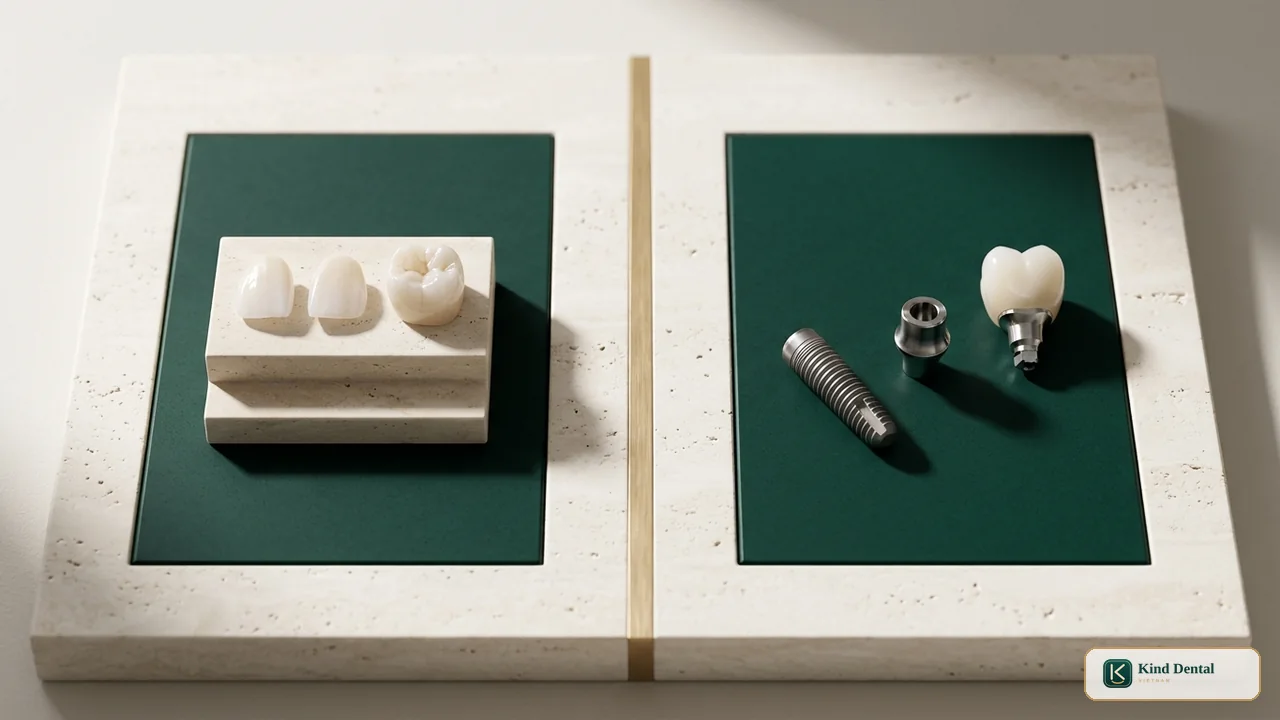
Every plan at Kind Dental Vietnam follows either a 1-Trip Restorative Protocol or a 2-Trip Implant Integration Protocol. The table sets out visits, healing gaps and payment milestones; detailed day counts are in How Many Days Do You Need in Vietnam?
| Treatment Pathway | Trips | Days in Saigon | Healing Gap | Milestones | Fit-to-Fly |
|---|---|---|---|---|---|
| Porcelain Veneers (IPS e.max) | 1 Trip | 5–7 working days | None | 50% / 50% | 24h bite check |
| 3D Zirconia Crowns & Bridges | 1 Trip | 4–6 working days | None | 50% / 50% | 24h bite check |
| Single Dental Implant Package | 2 Trips | T1: 4–6d · T2: 5–6d | 3–5 months | ~65% / ~35% | 48–72h post-op |
| Implant Snap-In Overdenture | 2 Trips | T1: 5–7d · T2: 5–7d | 3–5 months | ~65% / ~35% | 3–5d post-op |
| All-on-4 / All-on-6 Full Arch | 2 Trips | T1: 7–9d · T2: 7–9d | 4–6 months | ~65% / ~35% | 5–7d post-op |
| Implant + Maxillary Sinus Lift | 2 Trips | T1: 8–10d · T2: 5–7d | 5–7 months | ~65% / ~35% | 7–10d clearance |
Dr. Cuong’s Scheduling Rule: Be cautious of any advertisement promising definitive All-on-4 zirconia teeth, or grafted implants, within one five-day trip. Bone needs months to integrate around titanium threads, and finalising a bridge too early raises the risk of a late complication once you are back in Australia.
3. The 1-Trip Clinical Blueprint: Veneers, Crowns & Conservative Bridges (4–7 Days)
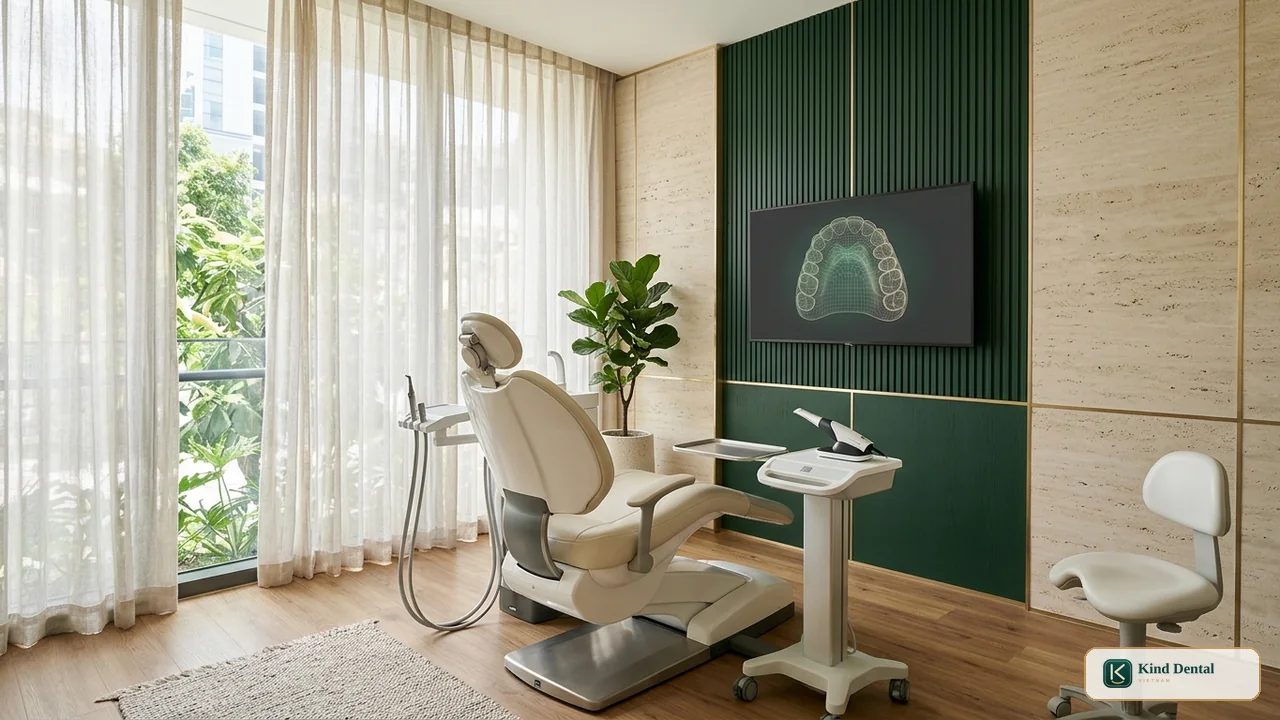
Many of our patients from Sydney, Melbourne, Brisbane and Perth complete their restorative plan within one unhurried week in District 1. A digital workflow is what makes a five-to-seven-day turnaround precise rather than rushed, provided the case has been planned carefully before you fly.
A systematic review in BMC Oral Health (Joda et al., 2017; PMID 28927393) found that complete digital workflows, pairing intraoral scanning with CAD/CAM fabrication, can shorten clinical and laboratory time while keeping marginal fit clinically acceptable, although the authors noted the evidence base was still limited.
Day-by-Day 1-Trip Schedule (Veneers or Crowns)
- Day 0 (Arrival): Land at SGN, transfer 25–45 minutes to District 1, drink plenty of water and sleep early.
- Day 1 (Examination & Mock-Up): Consultation, 3D intraoral scan and treatment plan ($0 with treatment), daylight shade matching and a reversible smile mock-up.
- Day 2 (Preparation): Minimal preparation under gentle local anaesthesia ($0), final scan and aesthetic temporaries (first 50% milestone).
- Days 3–4 (Laboratory): Technicians mill and glaze your IPS e.max veneers ($320–$420 USD/tooth) or 3D zirconia crowns ($260–$350 USD/tooth) while you rest or explore.
- Day 5 (Bonding): Daylight try-in, adhesive cementation, margin polishing and bite calibration (final 50%).
- Day 6 (Review & Flight): A short bite check, plus an optional nightguard ($50–$220 USD) before flying home. A Swiss EMS AirFlow cleaning ($45–$65 USD) fits into any day.
How Long Do Single-Visit Ceramics Last?
Australian patients reasonably ask whether ceramics completed over five days in Saigon will last as long as work done at home. Longevity depends on enamel preservation, careful isolation during bonding, ceramic selection and your own habits, rather than on the clinic’s postcode.
Systematic reviews in Dental Materials (Sailer et al., 2015; PMID 25842099) and Clinical Oral Implants Research (Pjetursson et al., 2018; PMID 30328190) report high five-year survival for all-ceramic single crowns, although veneered zirconia showed more porcelain chipping than metal-ceramic designs.
Replacing one missing tooth in a single trip, without surgery, depends on the teeth either side. Multi-unit zirconia bridges show acceptable five-year survival but more technical complications than metal-ceramic bridges (Sailer et al., 2018; PMID 30328185). Fees are on our Veneers & Crowns Cost Page.
Selected front gaps may suit a conservative resin-bonded all-ceramic bridge (Habibzadeh et al., 2024; PMID 38706266). Where both neighbouring teeth are healthy and unfilled, however, we rarely advise cutting them down simply to avoid a second flight; see Single Implant vs. Dental Bridge.
4. The 2-Trip Clinical Blueprint: Dental Implants, All-on-4 & All-on-6
Whenever titanium fixtures replace missing roots, long-term success depends on osseointegration, the process of bone forming directly against the implant surface. Respecting that biological timeline protects your investment far more effectively than saving one return flight ever could.
The Group 2 ITI Consensus Report in Clinical Oral Implants Research (Morton et al., 2018; PMID 30328196) sets out when immediate provisional loading is appropriate and when conventional healing is wiser. That evidence is why we stage single implants, All-on-4 and All-on-6 across two visits.
Trip 1: Guided Placement & Provisionals (5–9 Days)
- Day 1 (3D CBCT & Planning): Confirm bone volume, sinus height and nerve position ($0 with treatment) and design your surgical guide.
- Day 2 (Placement): Surgery under gentle local anaesthesia ($0) or optional anesthesiologist-monitored IV sedation ($350–$650 per session; see Sedation Protocols). We open sealed Osstem/Dentium, Nobel Biocare or Straumann packaging together (~65% Trip 1 milestone).
- Days 3–5 (Provisionals): Swelling usually peaks at 48–72 hours. For All-on-4 ($5,800–$9,800/arch) or All-on-6 ($7,400–$11,200/arch), a fixed provisional arch is fitted within 48–72 hours where implant stability allows.
- Days 6–8 (Clearance): Suture review, soft-diet bite check, English clinical summary and fit-to-fly sign-off.
The Healing Window & Trip 2 Delivery
Between visits, the gums mature and bone integrates around the fixtures while you are home in Australia. Conventional single implants usually need three to four months; selected dense-bone sites with Straumann SLActive may be restored sooner, while full-arch cases and sinus lifts need four to six months.
During healing you stay in direct contact with Dr. Cuong on WhatsApp (+84 853 020 003) for photo reviews at no charge. Trip 2 takes five to eight days: we confirm integration, scan, fabricate custom abutments and monolithic zirconia restorations, and torque to manufacturer specification.
The remaining ~35% is settled on delivery, with a serialised International Implant Passport & Warranty. Packages run $750–$950 USD (Osstem/Dentium), $1,200–$1,450 USD (Nobel Biocare) or $1,250–$1,550 USD (Straumann); see our Dental Implants Cost Breakdown and All-on-4 & All-on-6 Cost Page.
5. Built for a Long Flight Home: Materials and Design Choices
If a layered porcelain crown chips and your dentist is ten minutes away, it is an inconvenience. If your dentist is 7,000 km away, it becomes a logistics problem. For that reason we specify materials and designs that favour low maintenance and straightforward servicing in Australia.
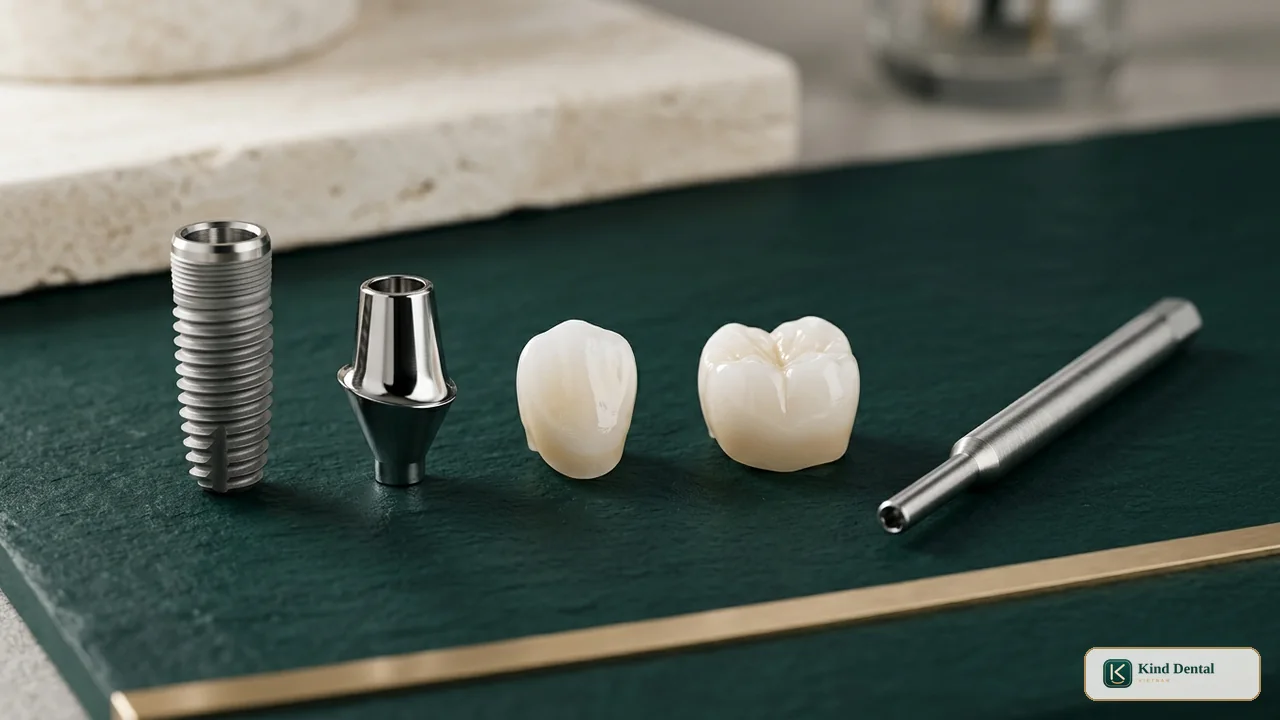
- Monolithic zirconia on back teeth: Meta-analyses in Clinical Oral Implants Research (Pjetursson et al., 2021; PMID 34642991; Pjetursson et al., 2023; PMID 37750526) associate monolithic designs with less chipping than hand-veneered ceramics. The trade-off is slightly lower translucency, so front teeth may still suit e.max; see Monolithic vs. Layered Crowns.
- Established titanium platforms: A 2023 meta-analysis (Mohseni et al., 2023; PMID 38135804) found shorter follow-up and fracture concerns with zirconia implants compared with titanium. Straumann, Nobel Biocare and Osstem/Dentium components are widely supported internationally; see Implant Brands Guide.
- Screw-retained serviceability: A five-year review of implant bridges (Pjetursson et al., 2012; PMID 23062125) found high implant survival alongside technical issues such as screw loosening. Screw-retained crowns, placed under European Class-B sterilization, let an Australian dentist retighten a screw without cutting anything; see Screw-Retained vs. Cemented Crowns.
6. 2026 Total Landed Cost: Clinical Fees, Flights & District 1 Hotels
Sensible budgeting covers the whole trip, not only the dental invoice. The model below combines Kind Dental Vietnam’s 2026 fees with typical direct economy fares from Australia and a four-star District 1 boutique hotel at about A$140 a night, converted at roughly 1.54 AUD per USD.
| Sample Australian Case | Kind Dental Fee | Flights + Hotel* | Total Landed (~AUD) | Typical Australian Fee | Net Savings |
|---|---|---|---|---|---|
| 8 IPS e.max Veneers (1 Trip · 6 Nights) |
$2,560–$3,360 USD (~A$3,940–A$5,175) |
~A$1,550 | ~A$5,490–A$6,725 | A$14,400–A$20,000 | Save ~A$8,900–A$13,200 |
| 2 Straumann Implants (2 Trips · 5 + 6 Nights) |
$2,500–$3,100 USD (~A$3,850–A$4,775) |
~A$2,950 | ~A$6,800–A$7,725 | A$11,000–A$15,000 | Save ~A$4,200–A$7,200 |
| All-on-4 Fixed (1 Arch) (2 Trips · 8 + 8 Nights) |
$5,800–$9,800 USD (~A$8,930–A$15,090) |
~A$3,650 | ~A$12,580–A$18,740 | A$26,000–A$38,000 | Save ~A$13,400–A$19,200 |
| Dual-Arch All-on-6 (2 Trips · 9 + 9 Nights) |
$14,800–$22,400 USD (~A$22,790–A$34,495) |
~A$3,950 | ~A$26,740–A$38,445 | A$56,000–A$78,000 | Save ~A$29,200–A$39,500 |
*One traveller; A$700–A$750 return fares and about A$140 per night. Australian fees are indicative private ranges. Optional items—bone graft ($180–$300 per site), sinus lift ($350–$650 per side), extraction or root canal ($50–$220) and IV sedation ($350–$650 per session)—are itemised only when your CBCT shows a genuine need.
The Honest Single-Tooth Break-Even
We would rather tell you when a trip does not make financial sense. If you need one isolated implant, nothing else, and have no wish to visit Vietnam twice, roughly A$2,900 in flights and hotels can shrink your net saving to around A$1,000–A$1,800, and sometimes less.
In that situation, treatment at home is often the better decision, particularly if your local dentist already knows your history. Once you need two or more implants, four or more crowns or veneers, or a full-arch restoration, travel costs are spread across far more treatment.
7. When a Dental Trip Is Not the Right Choice
Not every mouth or medical history suits treatment 7,000 km from home. Saying so at the X-ray stage saves patients money, disappointment and occasionally real harm. In these situations Dr. Cuong will recommend delaying, modifying or declining a plan.
- Uncontrolled medical conditions: Poorly controlled diabetes, unstable heart disease or a recent stroke should be stabilised with your Australian GP or specialist first; see Blood Thinners, Diabetes & Osteoporosis Medications.
- Antiresorptive or anticoagulant therapy: Bisphosphonates, denosumab and blood thinners call for individual risk assessment. We never ask anyone to stop a medication without their prescribing doctor’s agreement.
- Previous head and neck radiotherapy: Elective implant surgery abroad is generally inappropriate; this care belongs with a hospital-based team at home.
- Active gum disease or heavy smoking: Both raise the risk of implant complications, so we usually ask for periodontal stabilisation and reduced smoking first.
- Untreated grinding (bruxism): Veneers and full-arch bridges can fail early under heavy clenching; a nightguard and a more conservative design, or postponing veneers, may be wiser.
- Pregnancy: Elective surgery and cosmetic work are best deferred until after delivery.
- No realistic Trip 2: If work, caring duties or health make a second visit uncertain, a one-trip alternative planned with your local dentist may serve you better.
All dental treatment, at home or abroad, carries risks: infection, nerve sensitivity, implant failure, ceramic fracture or the need for later adjustment. The real safeguard is a surgeon who discusses these openly and documents everything for your Australian dentist; see Why Ultra-Cheap Dental Work Abroad Fails.
8. Cabin Pressure, Swelling & Fit-to-Fly Safety Rules
Airliners pressurise the cabin to the equivalent of roughly 6,000–8,000 feet. Following Boyle’s Law, trapped gas in the sinuses or healing tissues expands slightly on the climb and contracts on descent, which is harmless for healed teeth but uncomfortable over a fresh surgical site.
Cabin pressure does not damage bonded crowns or integrated implants. Boarding an eight-hour flight too soon after surgery, however, can increase throbbing and sinus discomfort. Dr. Cuong’s minimum windows are below, with more detail in Flying After Dental Implants & Sinus Lift.
- Veneers & crowns: No altitude restriction; allow 24 hours after bonding for a final bite check.
- One or two straightforward implants: Wait 48–72 hours after placement so the clot stabilises and the tissues seal.
- All-on-4, All-on-6 or bone grafts: Allow 5–7 days in District 1 so the day-two-to-three swelling peak can settle.
- Maxillary sinus lift ($350–$650/side): Allow 7–10 days (see Sinus Lift & Bone Grafting). Avoid blowing your nose, sneeze with your mouth open and carry saline spray.
Pack prescribed medication, a travel-size chlorhexidine rinse (under 100 ml) and your English clinical summary in your cabin bag. An aisle seat makes it easy to drink water and walk every couple of hours, which also lowers the risk of blood clots on long flights.
9. Practical Saigon Logistics: Visas, Hotels & Your $0 Pre-Trip Review
Settling a few practical details two to four weeks before departure keeps clinic days unhurried and removes most airport and paperwork surprises. These are the steps we suggest once your written plan is in hand.

Australian e-Visa & Quiet District 1 Hotels
Australian passport holders need a Vietnamese e-Visa, valid for up to 90 days and usually processed within three to five working days, so apply at least two weeks ahead. Because the gap between implant trips often exceeds 90 days, most patients apply for a separate e-Visa for each visit.
Kind Dental Vietnam sees patients by Private Appointment Only in District 1, Ho Chi Minh City, about 25–45 minutes from Tan Son Nhat. We suggest quiet boutique hotels near Ben Nghe, Dong Khoi or Tao Dan Park rather than the nightlife around Bui Vien.
Health Funds, Superannuation & Your $0 OPG/CBCT Review
Most Australian extras policies reimburse only treatment by AHPRA-registered practitioners in Australia, so assume no rebate unless your fund confirms otherwise in writing. Compassionate early release of superannuation is assessed by the ATO and is never automatic; see our Superannuation & Insurance Page and ATO Paperwork Guide.
Before buying airfare, send a local OPG or CBCT via our Online Consultation Desk, to kinddentalvietnam@gmail.com, or on WhatsApp at +84 853 020 003. Dr. Cuong usually replies within 24 hours with a $0 written estimate, a trip calendar and an itemised USD and AUD schedule.
10. Peer-Reviewed PubMed Clinical Evidence
The pacing rules, digital timelines and material choices in this planner draw on the following peer-reviewed studies, each indexed by the U.S. National Library of Medicine:
- Habibzadeh S, Khamisi F, Mosaddad SA, et al. Full-ceramic resin-bonded fixed dental prostheses: A systematic review. J Appl Biomater Funct Mater. 2024. PubMed PMID: 38706266
- Mohseni P, Soufi A, Chrcanovic BR. Clinical outcomes of zirconia implants: a systematic review and meta-analysis. Clin Oral Investig. 2023. PubMed PMID: 38135804
- Pjetursson BE, Sailer I, Merino-Higuera E, et al. Systematic review evaluating the influence of the prosthetic material and prosthetic design on the clinical outcomes of implant-supported multi-unit fixed dental prosthesis in the posterior area. Clin Oral Implants Res. 2023. PubMed PMID: 37750526
- Pjetursson BE, Sailer I, Latyshev A, et al. A systematic review and meta-analysis evaluating the survival, the failure, and the complication rates of veneered and monolithic all-ceramic implant-supported single crowns. Clin Oral Implants Res. 2021. PubMed PMID: 34642991
- Morton D, Gallucci G, Lin WS, et al. Group 2 ITI Consensus Report: Prosthodontics and implant dentistry. Clin Oral Implants Res. 2018. PubMed PMID: 30328196
- Pjetursson BE, Valente NA, Strasding M, et al. A systematic review of the survival and complication rates of zirconia-ceramic and metal-ceramic single crowns. Clin Oral Implants Res. 2018. PubMed PMID: 30328190
- Sailer I, Strasding M, Valente NA, et al. A systematic review of the survival and complication rates of zirconia-ceramic and metal-ceramic multiple-unit fixed dental prostheses. Clin Oral Implants Res. 2018. PubMed PMID: 30328185
- Joda T, Zarone F, Ferrari M. The complete digital workflow in fixed prosthodontics: a systematic review. BMC Oral Health. 2017. PubMed PMID: 28927393
- Sailer I, Makarov NA, Thoma DS, et al. All-ceramic or metal-ceramic tooth-supported fixed dental prostheses (FDPs)? A systematic review of the survival and complication rates. Part I: Single crowns (SCs). Dent Mater. 2015. PubMed PMID: 25842099
- Pjetursson BE, Thoma D, Jung R, et al. A systematic review of the survival and complication rates of implant-supported fixed dental prostheses (FDPs) after a mean observation period of at least 5 years. Clin Oral Implants Res. 2012. PubMed PMID: 23062125
11. Frequently Asked Questions: Flying from Australia to Saigon for Dental Care
How many days do I need in Saigon for porcelain veneers or zirconia crowns?
Plan five to seven working days for IPS e.max veneers ($320–$420 USD/tooth) or four to six days for 3D zirconia crowns ($260–$350 USD/tooth). That covers scanning, laboratory work, try-in, bonding and a 24-hour bite check before you fly.
Can dental implants or All-on-4 be completed in one trip from Australia?
Rarely, and we do not recommend it. Trip 1 (5–9 days) places the implants and, for All-on-4 or All-on-6, fits a fixed provisional arch. Trip 2 (5–8 days, three to six months later) delivers the definitive monolithic zirconia teeth once integration is confirmed.
How soon after implant surgery or a sinus lift can I safely fly home?
Allow 48–72 hours after one or two straightforward implants, five to seven days after All-on-4, All-on-6 or bone grafting, and seven to ten days after a maxillary sinus lift ($350–$650/side). Dr. Cuong signs off fitness to fly in person.
Do I pay the full treatment fee before leaving Australia?
No. The pre-trip X-ray review is $0 and the in-clinic consultation, 3D scan and plan are $0 with treatment. Payment follows milestones: 50% / 50% for one-trip crowns or veneers, and ~65% on Trip 1 / ~35% on Trip 2 for implants.
What if work delays my Trip 2 beyond five months?
Minimum integration is three to four months for single implants and four to six months for full-arch or grafted sites. Returning at month seven or eight is usually fine, provided your provisional is designed for the longer interval.
What happens if I have a problem after returning to Australia?
Send photos to Dr. Cuong on WhatsApp first; many concerns can be assessed remotely. Your English summary, radiographs and implant serial details allow an Australian dentist to examine you promptly, and warranty terms are set out on our warranty page.
Want Honest Clinical Advice on Your X-Ray or Quote?
Send your panoramic OPG scan or an existing treatment estimate via WhatsApp. Dr. Cuong will provide a clear, conservative comparison with zero agency markup.